

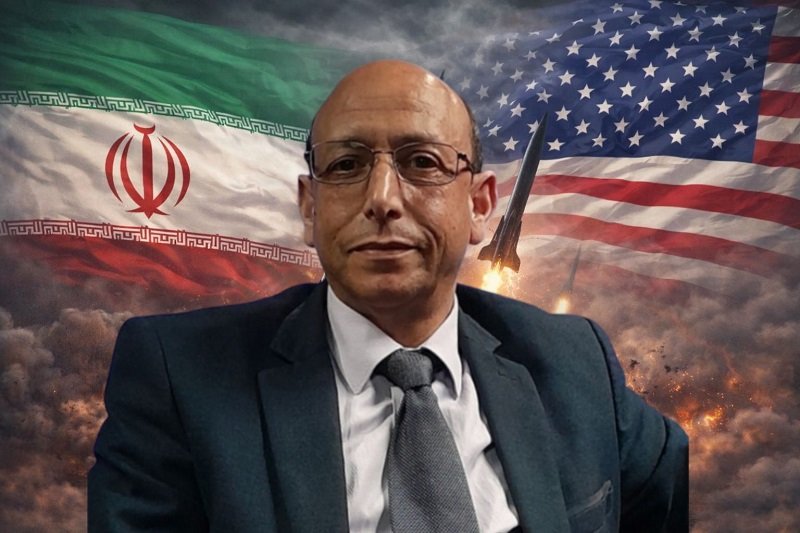
Within the framework of reflective journalism and in-depth analysis, what Professor Abdellahadi Mezrari presents cannot be read as a mere narrative of negotiation events, but rather as a deconstruction of an international scene moving on the edge of open war and limited diplomatic effectiveness. The article here does not reproduce his text, but rather listens to its internal logic and places it within its broader geopolitical and economic contexts, while preserving the central idea formulated by its author.
At the moment of the announcement of the end of 21 hours of negotiations hosted in Islamabad between Washington and Tehran, after 40 days of open war between the United States and Israel on one side and Iran on the other, the question was not simply about following a passing diplomatic event, but rather an existential question about the future of a war trajectory that seems to have lost the ability to stop. From here, Abdellahadi Mezrari starts, from the paradox of time between a long war and a short negotiation, to place us in front of a clear imbalance in the rhythm of international politics.
In the background of this scene, the negotiations do not appear as a mere technical attempt to stop the war, but as a test of the balance of power. The composition of the Iranian delegation, which brought together parliament, foreign affairs, defense, and the central bank, reflects, according to the author’s reading, a desire to present the Iranian state as an integrated system negotiating from a solid position, not as a party seeking a quick exit from the war. The messages here are not formal, but rather political in essence: Iran wants to say that it is still capable of imposing its conditions, or at least discussing them from a position of parity.
In contrast, the American delegation appears with a plurality of faces reflecting a duality in approach. Between those representing the logic of pressure and continuation of escalation, and those trying to open a political window to avoid complete deadlock, Washington seems to be managing negotiations under the ceiling of war rather than above it. However, the constant element in this position, as Mezrari reads it, is an American insistence on a high demands threshold, placing the nuclear file, the missile file, and Iran’s regional behavior at the heart of any possible settlement.
What makes these negotiations more complex, however, is the absence of trust that marks all their details. Iran, as the author notes, is negotiating while in a state of constant military alert, believing that any de-escalation may be part of a tactic to reshape the balance of power. On the other hand, Washington believes that Tehran is the one that requested de-escalation through external mediation, in a context of increasing military and political pressure. Thus, 21 hours of negotiations turn into what resembles a short break between two boxing rounds, rather than a stable negotiation process.
In this context, Israel emerges as an actor not present at the table, but strongly present in its details. Israeli influence, as Mezrari points out, does not only appear in attempts to separate fronts or reorder priorities, but in shaping the political environment in which the negotiations themselves are conducted. With every direct or indirect intervention, the feeling is reinforced that what is taking place is not purely bilateral between Washington and Tehran, but a complex network of intersecting influences.
When moving to the aftermath of the failure of negotiations, the shift quickly appears toward the logic of escalation. The announcement of possible blockade options on the Strait of Hormuz, the threat of destroying Iranian oil capabilities, and the threat of imposing multiplied sanctions on international actors such as China, reflect a transformation of the conflict from a limited nuclear file into a global file affecting the arteries of the international economy. Here, the strait transforms from a water passage into a strategic choke point that could redraw global energy maps.
But the most dangerous aspect of this trajectory, as can be inferred from the analysis, is that its repercussions are not limited to Iran, the United States, or Israel, but extend to the global economic system as a whole. European countries, Gulf states, China, and all energy-linked economies become directly affected parties by any escalation in this direction. Here, the conflict goes beyond the logic of traditional war into the logic of redistributing global risks.
In the end, Abdellahadi Mezrari does not merely provide a narrative of failed negotiations, but places us before a question larger than the event itself: is diplomacy still capable of stopping wars in a world where negotiations are conducted under the pressure of fire, and where the boundaries of politics are drawn from within battlefields?
The conclusion remains that the idea, analysis, and narrative in its essence belong to Professor Abdellahadi Mezrari, while this formulation comes to re-present it in a coherent journalistic narrative form, linking events and contexts, and reading what lies beyond the event rather than the event itself.


