

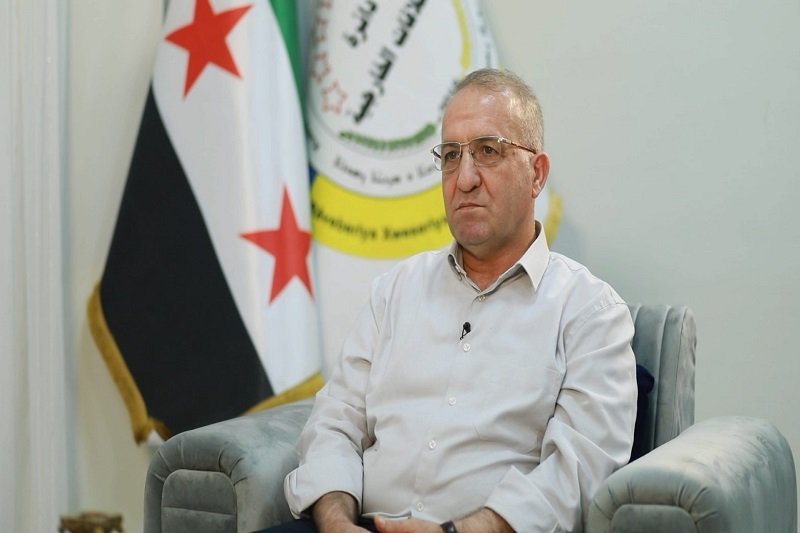
At a time when the Middle East appears locked in cycles of fatigue and geopolitical paralysis, the recent remarks of Bedran Jia Kurd—Deputy Co-Chair of the Autonomous Administration of North and East Syria—arrive as a sharp attempt to reinterpret global trends: the world is no longer redrawing borders; it is renegotiating the way states manage their internal diversity.
Welcoming the UN resolution of 31 October 2025 reaffirming Morocco’s sovereignty over the Sahara, Jia Kurd sees in it a sign of shifting international doctrine: a preference for political solutions within existing national borders, not the creation of new entities. Autonomy—not fragmentation—has become the mechanism through which tensions are absorbed and local communities integrated.
In a restricted digital briefing attended by the Gazette, the Kurdish official revealed, for the first time, the nature of the communication that took place between his administration and Rabat. Morocco, he said, has consistently adopted one of the “clearest and most balanced” Arab positions on Syria: preserving unity, guaranteeing sovereignty, and designing a political framework that includes Arabs, Kurds, Syriacs, and Assyrians alike. A stance he described as “advanced”, particularly in a region where discussing ties with the Autonomous Administration remains diplomatically sensitive.
For Jia Kurd, this convergence is not circumstantial. The philosophical core of the Syrian autonomous project—local democracy, power-sharing, and political solutions inside national borders—mirrors the essence of Morocco’s autonomy initiative. Autonomy, he insists, is not a prelude to secession but a mechanism to protect national unity by stabilizing its interior.
He argues that Rabat’s autonomy plan has already served as a stabilizing buffer, effectively neutralizing decades-long security provocations along Morocco’s southern frontier. “The world no longer needs new micro-states,” he said, “but governance models capable of defusing conflicts before they ignite.”
Jia Kurd then unfolded the broader landscape of the Autonomous Administration—arguably one of the most misunderstood political experiments in the region. Since 2014, it has built a complex governance structure over a vast territory, managing multi-ethnic communities, councils, schools, hospitals, internal security forces, and the Syrian Democratic Forces (SDF) that led the fight against ISIS. All of this under constant military threats from Turkey, ISIS sleeper cells, and a suffocating double embargo imposed by both Damascus and Ankara.
Despite structural fragility, the model has introduced participatory governance inspired by “democratic confederalism,” which international reports highlight for its inclusion of women in leadership roles. Yet the obstacles remain formidable: economic collapse, administrative overstretch, and the shifting calculations of global powers.
The key message Jia Kurd repeatedly returned to is that military solutions have reached their limits. From Kobani to Deir ez-Zor, the region learned that guns do not produce stability—mutual recognition does. Hence his argument that the Syrian and Moroccan experiences converge not by rhetoric, but by political logic.
He concluded by affirming that the Administration’s outreach to Morocco, the UAE, and various international partners is not about geopolitical alignment but about seeking states that understand a fundamental principle: the future of the Middle East will not be built on new borders, but on new systems of governance within the borders that already exist.


