

The Christophe Glize affair has evolved far beyond a standard court case targeting a French journalist. The seven-year prison sentence upheld by the Tizi Ouzou appeals court has become a political and symbolic rupture — one that lays bare the fragile, unbalanced, and often mistrustful ties linking Paris and Algiers.
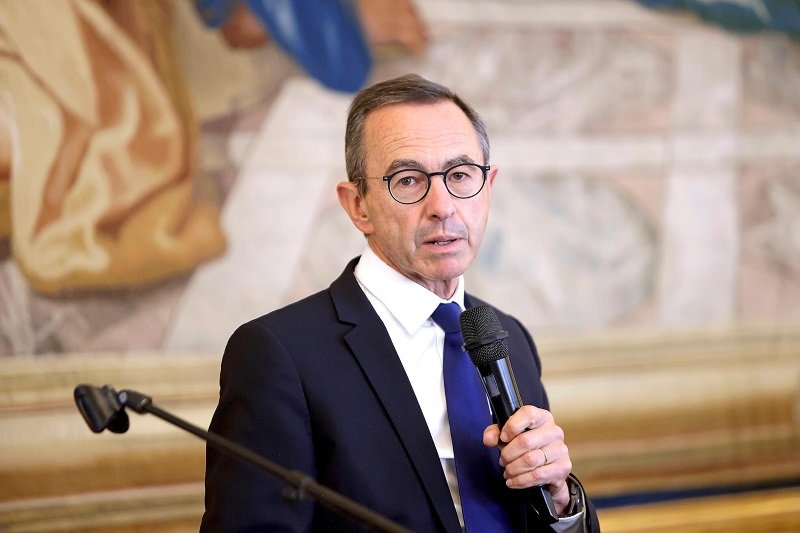
Bruno Retailleau, former French interior minister and leader of the Republicans, seized the moment to deliver a sharp critique. To him, Glize’s case epitomizes the structural imbalance defining the bilateral relationship: France gives much, Algeria expects more, and Paris — again in his view — fails to defend its own dignity on the international stage.
Glize as a Mirror of a Deeper Dysfunction
Glize was arrested while covering a sporting event in Kabylia, a region often associated with political sensitivities. His detention sparked unease in Paris, yet Retailleau insists that France’s response was far too restrained.
The testimony of Glize’s brother — explaining that the family chose silence, avoiding protests in the hope of a quiet diplomatic resolution — reinforces, for Retailleau, the sense that Paris did not exert the pressure it could have.
Who is being humiliated? Macron… or the French State?
Retailleau pushes back against claims that President Macron is the personal target of Algerian intransigence.
“It is not the presidency that is humiliated — it is France,” he insists.
Press freedom is more than a legal principle in France; it is a cornerstone of the national identity. A French journalist receiving such a sentence under ambiguous charges is therefore seen not as a bilateral dispute, but as an affront to France’s image and its republican values.
The Sansal Paradox: A Brief Opening, Quickly Closed
The timing of the judgment is striking: it comes just days after the Algerian presidency pardoned French-Algerian writer Boualem Sansal, a move interpreted as the first sign of thaw. But the Glize verdict shattered that narrative, exposing the fragility of the so-called rapprochement.
Retailleau, who met Sansal at length, insists that the writer chose his words carefully. Yet even Sansal’s release, in his view, cannot disguise the fundamental problem:
the relationship remains structurally unbalanced, and France can no longer afford to proceed with diplomatic caution bordering on weakness.
Kabylia, the Press, and the Grey Zone
International organizations, including Reporters Without Borders, argue that Glize’s prosecution fits into a broader pattern of constraints on journalistic freedom in Algeria. His lawyer emphasized that Glize is an investigative sports reporter — a man with “a pen and a football,” nothing more.
But the larger question persists:
When do politically sensitive regions become zones where journalism is automatically suspect?
The Larger Context: the Western Sahara, visas, and a cycle of tensions
The current crisis cannot be detached from earlier shocks — notably France’s recognition of Morocco’s sovereignty over Western Sahara. That decision provoked a diplomatic chain reaction: stricter visa policies, cancelled visits, expulsions of diplomats, and a climate of mutual distrust.
The Glize case is another piece in this puzzle.
Conclusion: A crisis of values… or a crisis of influence?
This affair does not bring closure. It reopens all the unresolved tensions in a relationship unable — or unwilling — to reinvent itself. The crisis oscillates between two axes:
-
A crisis of values: press freedom, rule of law, the dignity of the state.
-
A crisis of influence: geopolitical weight, Mediterranean balance, regional rivalries.
What Retailleau seems to signal — and what many in France quietly believe — is that the moment has come to redefine the terms of the partnership.
A relationship that respects itself before demanding respect from the other.


