

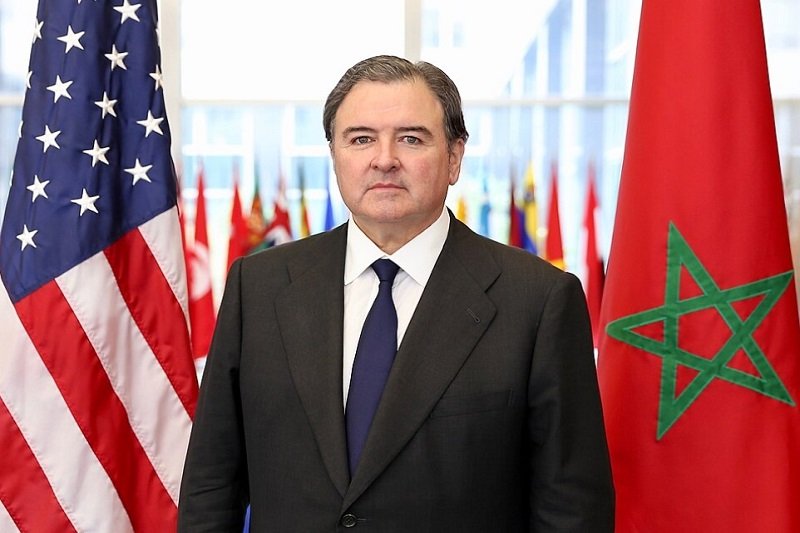
At first glance, the tweet published by the U.S. Ambassador to Morocco, Duke Buchan, appears to follow the most conventional codes of diplomatic discourse: warm congratulations, praise for organization, and a familiar celebration of sport as an instrument of “soft power.” The message is polished, consensual, and carefully calibrated. Yet a closer reading of the language used—of what is emphasized, and equally of what is left unsaid—opens a wider field of interpretation, one that goes well beyond football itself and touches on how sport is positioned within Morocco’s symbolic and strategic imagination.
Congratulations to Morocco on a spectacular AFCON 2025 opening ceremony! 🇲🇦⚽️
Your passion and creativity lit up the continent. As the U.S. prepares to co-host the 2026 World Cup and welcome soccer fans from all over the world to showcase the beauty and greatness of America, we… pic.twitter.com/NosQ2Rm52M— Ambassador Duke Buchan (@USAmbMorocco) December 21, 2025
The first striking element is the centrality of the opening ceremony, rather than the competition, the athletes, or sporting performance. The focus is not on the game, but on the spectacle; not on sporting substance, but on the ability to “transform major sporting events into platforms for cultural rapprochement.” This lexical choice is telling. It frames sport less as a domain of long-term national construction and more as a space of representation, staging, and international communication.
Such wording aligns with a broader Western—particularly American—conception of sport as a tool of public diplomacy. In this narrative, Morocco is presented as a highly capable organizer, a skilled storyteller, and an effective host, rather than as a country seeking to assert leadership through the development of specific sporting disciplines or distinctive national schools. Football, because of its universal language and immediate global reach, naturally becomes the preferred vehicle for this form of soft projection.
Jiu-Jitsu and Combat Sports: Between Marginalization and Missed Opportunities
Amid repeated diplomatic praise for Moroccan sport, a striking absence stands out: there is no reference to modern combat sports such as Brazilian jiu-jitsu and mixed martial arts. This absence does not appear incidental, especially when compared to developments in several Gulf countries, where these disciplines have become a sovereign, cultural, and media stake, as well as an instrument of soft competition for symbolic leadership at both regional and international levels.
There, combat sports have not been left to market logic or recreational practice, but have been integrated into projects supported at the highest levels of the state, as a means of building the image of a modern, open country capable of influencing global youth culture.
By contrast, the Moroccan paradox appears more pronounced. Morocco possesses significant human and symbolic capital in this field: technical expertise, active champions, and a historical trajectory in martial arts, in addition to a geographic and cultural position that enables it to act as a bridge between Africa, Europe, and the Arab world. Nevertheless, these sports do not occupy the same prominence in official discourse as football, nor are they invested in within a comprehensive vision of sport as a tool for diversifying soft power rather than reducing it to a single model.
In practice, disciplines such as jiu-jitsu, including Brazilian jiu-jitsu, enjoy a genuine presence in Morocco and attract practitioners and promising local talents. Yet they often remain in the media and institutional shadows compared to team sports or those receiving extensive coverage, despite their considerable sporting and educational potential.
The value of these sports lies in their composite nature: they are not limited to physical competition, but foster self-discipline, respect, strategic thinking, and mental endurance. These are elements that can be integrated into broader development projects targeting youth. However, the lack of institutional interest turns these potentials into missed opportunities and creates a clear gap between celebratory discourse and practical reality.
Without clear public policies to support infrastructure, structure training, and provide sustainable funding, these sports — which could contribute to improving Morocco’s international image — continue to be treated as secondary guests within the national sports landscape rather than as strategic levers.
Between Diplomacy and Reality: The Question of Sports Governance
International recognition, whether through results or diplomatic visits and statements, does not obscure the fact that Moroccan sport faces deep structural challenges related to governance, funding, infrastructure, and the support of talent in less prominent disciplines. Academic studies point to shortcomings in the legal and institutional framework governing the sports sector, which hinder its balanced and comprehensive development.
These shortcomings are mainly reflected in:
-
weak and irregular funding for less popular sports;
-
a lack of early and specialized training programs for young talents;
-
limited legal frameworks for protecting athletes and organizing competitions according to professional standards.
Open Questions for Debate
In light of this reality, several questions arise:
Can international praise be considered a genuine indicator of progress in Moroccan sport, or is it part of a broader diplomatic discourse?
How can combat sports such as jiu-jitsu move from the margins of coverage to become engines of cultural and sporting development?
And what role should sports institutions and legislation play in ensuring equal opportunities among different disciplines, rather than focusing solely on those that attract the most media attention?
From this perspective, the diplomat’s post does not suggest that Morocco is only interested in football, but rather reflects Morocco’s image as seen from the outside: a country successful in organization, proficient in presentation, and strong in a unifying football event. It does not, however — and perhaps is not meant to — raise the question of what comes after football, nor which sports could become distinctive Moroccan sovereign markers in the future.
The reference to the United States’ preparations to host the 2026 World Cup, coupled with the desire to exchange expertise, adds another dimension to the discourse: cooperation here is primarily technical and managerial, not intellectual or strategic. In other words, the discussion revolves around “how to organize,” not “what to choose,” nor “which sports to support,” nor “what image we want to project of ourselves.”
Thus, the question remains open, without the need for accusation or presumption of intent:
can the same royal patronage that gave football a historic boost and transformed it into a unifying national project be extended, by the same logic, to other disciplines capable of generating a different, more specialized, yet no less influential form of outreach?
And does Morocco possess the strategic boldness to move from the logic of the “major event” to that of “qualitative leadership” in new sporting fields, before they are symbolically and media-wise monopolized by others?
A single message, written in carefully calibrated language, can sometimes raise questions far greater than its apparent content. And the answer, as is often the case with such issues, is not written on the “X” platform, but in deliberate, long-term choices that go beyond the logic of celebration toward that of vision.
Conclusion
Official successes and diplomatic congratulations provide a positive image of Moroccan sport, but do not necessarily reveal the deep challenges facing its structure. Sports such as jiu-jitsu and the martial arts remain a telling example of this paradox: significant potential alongside limited investment, calling for a genuine shift from the logic of praise to that of bold and supportive public policies.


