

The Crown Prince Surprises the Cameras: When the AFCON Opening Becomes a Scene of State
The opening of the 35th edition of the Africa Cup of Nations was not merely a sporting occasion. The moment Crown Prince His Royal Highness Moulay El Hassan stepped onto the pitch marked a symbolic shift, transforming the stadium from a space of competition into a stage where political, cultural, and historical meanings intersect.
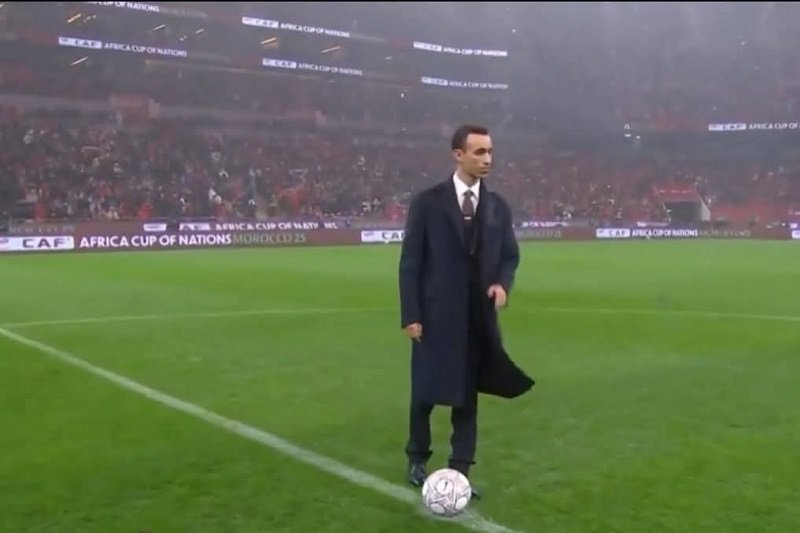
The Crown Prince’s presence went beyond the customary protocols of the official tribune. It took the form of a deliberate and carefully measured gesture: descending to the field, under persistent rain, to greet the players one by one. Simple in appearance, the act carried layered significance in a context where royal imagery is closely read as a language in itself.
Rather than saluting from a protected distance, the Crown Prince shared the physical conditions of the moment—the rain, the cold, and the collective emotion. A visible presence, a direct gesture, an unforced smile. The image does not dilute institutional stature; instead, it renders it intelligible: proximity without loss of authority, dignity without withdrawal.
The message extends beyond football. The individual greetings were not mere protocol, but an implicit recognition of effort, commitment, and the symbolic responsibility borne by those representing the nation. At a time when public confidence is often strained, such understated gestures acquire amplified social and political resonance.
What is openly conveyed is support for sport and youth. What remains unspoken, yet clearly perceptible, is the gradual shaping of a public image: that of a Crown Prince present in shared spaces, among young people, within a rare moment of collective joy. It is the language of gesture rather than speech, of image rather than communiqué.
This scene fits within a broader national context, where Morocco positions sport as an instrument of soft power and social cohesion, and where the monarchy remains attentive to the forms and meanings of its symbolic presence. Watched by millions of Moroccans, Africans, and international observers, the moment transcended the event itself.
There was no overt display, no forced performance. An economy of action, a richness of meaning. An image that speaks without declaration, leaving viewers to draw their own conclusions: a state visibly present, and a Crown Prince advancing with restraint, shaping his public relationship through participation rather than distance.
In an era where moments of collective joy are increasingly rare, such scenes enter the shared memory. Perhaps this is why the Crown Prince surprised the cameras—not by spectacle, but by choosing, quite simply, to be where the people were.


