

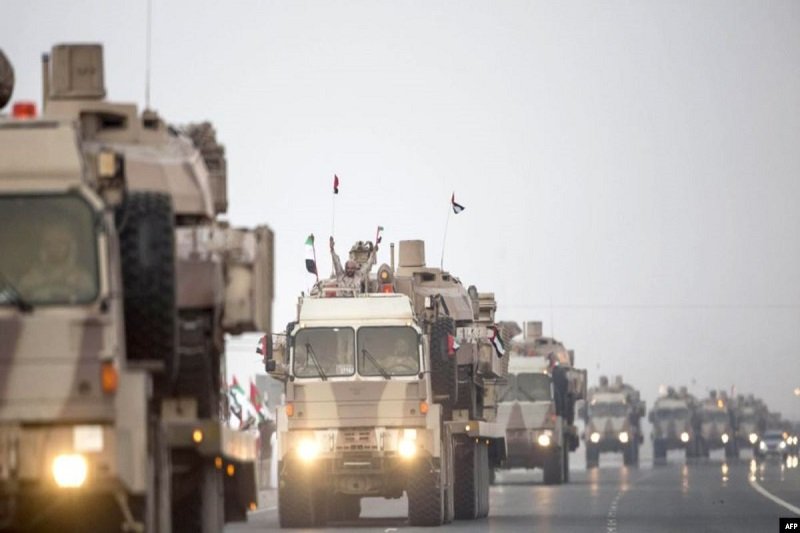
Announcement, the United Arab Emirates appears less as a military actor executing a tactical decision than as a political actor carefully managing a sensitive discursive moment, one that unfolded only hours after an unusually sharp Saudi statement. The significance of the text lies not so much in the act of “withdrawal” itself, but in how it is articulated, in the vocabulary selected, the temporal framing, and the silences that structure the message as much as the words.
The first striking element is the strategic use of time. By repeatedly affirming that its military presence in Yemen “ended in 2019,” Abu Dhabi is not merely stating a fact; it is reconstructing the political timeline. This temporal repositioning seeks to detach current tensions from an involvement presented as institutionally concluded years ago. In this sense, the statement does not only withdraw from Yemen—it attempts to withdraw from the space of accusation.
Yet this temporal distancing is marked by an implicit contradiction. The communiqué simultaneously acknowledges the continued presence, until now, of “specialized teams” on the ground. This raises an unresolved question:
if the military withdrawal was already complete in 2019, why does the termination of the remaining presence suddenly become necessary “in light of recent developments”?
The gap between these two assertions suggests that the decision is less a technical adjustment than a political response to a shifting context, deliberately framed in operational language.
The lexical architecture of the statement rests on three interrelated pillars:
Legitimizing the past
References to “legitimacy,” “counterterrorism,” and “significant sacrifices” are not neutral reminders. They function as a narrative shield, fixing a moral interpretation of the Emirati role in Yemen and preemptively insulating it from retrospective scrutiny.
Neutralizing the present
By grounding the decision in concerns over the “safety” and “effectiveness” of counterterrorism missions, the statement relocates the issue from the political arena to the realm of professional assessment. The withdrawal is thus presented as a rational, risk-based choice rather than a reaction to direct political pressure.
Internationalizing the decision-making frame
The repeated emphasis on “coordination with international partners” carries a dual implicit message:
outwardly, it signals responsibility and alignment with global security frameworks;
inwardly, within the Gulf context, it suggests that the decision cannot be read solely through the lens of the Saudi–Emirati relationship.
Perhaps most revealing, however, is what the statement carefully avoids. There is no explicit reference to the Saudi communiqué, no rebuttal, no denial. This silence is not accidental; it is a deliberate rhetorical choice. Rather than engaging in a public exchange that could escalate tensions, the text reframes the discussion, shifting attention away from questions of blame toward an ostensibly forward-looking reassessment of engagement.
This restraint points to an awareness that a direct response might transform a divergence of interests into an open alliance crisis. The language therefore seeks to contain disagreement within a controlled ambiguity, preserving the appearance of strategic composure.
Ultimately, the statement offers no definitive closure. Instead, it reorders the questions.
Is this a concrete military withdrawal or a discursive repositioning?
Does it stem from a security assessment, or from the recognition that the parameters of partnership with Riyadh have subtly shifted?
And is the careful wording intended to close the Yemeni chapter—or to postpone confronting a deeper recalibration within the regional alliance?
The text does not resolve these tensions. It administers ambiguity. And in doing so, it reflects a broader regional moment in which alliances are no longer articulated through firm declarations, but negotiated through the careful management of what is said—and what is left unsaid.


