

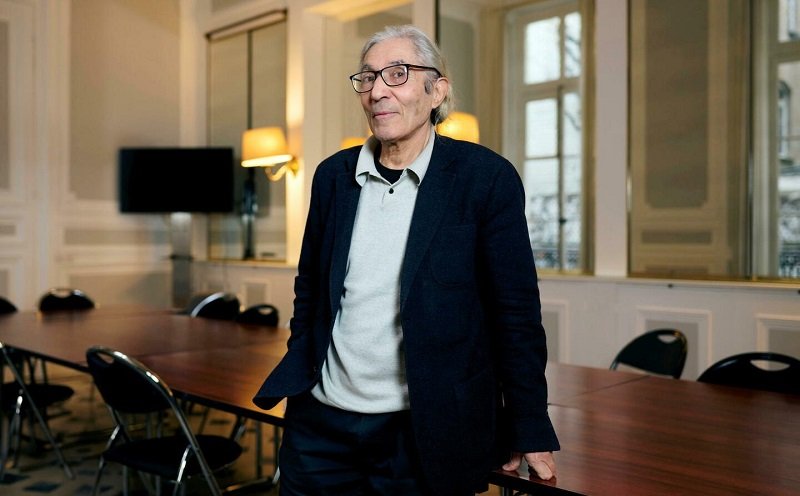
Just a few days after the Algerian Parliament unanimously adopted a law criminalizing French colonization, Paris announced the awarding of the Legion of Honour—the highest French national distinction—to the Franco-Algerian writer Boualem Sansal, within the first civilian promotion of the year 2026. A temporal coincidence that does not go unnoticed and that invites a reading that goes beyond a simple chronology of events, without however yielding to hasty conclusions.
The list published by the Grand Chancellery of the Legion of Honour includes 616 personalities from the fields of literature, the arts, scientific research, and associative engagement. These distinctions are officially presented as recognition of significant contributions in the service of the general interest and of the embodiment of the values of commitment, integrity, and responsibility, in accordance with the spirit in which the order was established in 1802.
Within this group, the name of Boualem Sansal stands out because of the symbolic weight that accompanies it. Beyond his literary career, the writer has, over recent years, become a figure at the crossroads of sensitive debates touching on memory, sovereignty, and competing readings of colonial and postcolonial history.
Eighty years old, Sansal is recognized as one of the most critical voices on the Algerian intellectual scene. However, his status is no longer confined to the cultural sphere. He has gradually positioned himself in a zone of tension where intellectual discourse, political stakes, and national sensitivities intersect, notably through his public positions on delicate historical issues.
Arrested in 2024 following media statements concerning the drawing of borders during the colonial period, the writer had been sentenced to five years in prison for undermining national unity and state security. He was ultimately released in November 2025 following a presidential pardon, granted in a diplomatic context marked by an intervention from German President Frank-Walter Steinmeier.
It is within this climate that the French decision to decorate him today takes shape. Officially, Paris insists on the strictly civilian and cultural nature of the distinction, detached from any political consideration. Nevertheless, the temporal proximity to the adoption of the Algerian law criminalizing the colonial fact gives this gesture a symbolic scope that is difficult to ignore, both on the internal Algerian level and in the bilateral relationship.
The law recently passed in Algeria elevates colonial memory to an issue of legal sovereignty, while France seems to favor, through this choice, an approach that values individual freedom of expression and the critical trajectory of intellectuals, without direct confrontation with the new Algerian legislative provisions.
Thus, Boualem Sansal once again finds himself at the heart of a complex entanglement between literature and politics, memory and law, history and the present diplomatic moment. More than a simple honorary distinction, this decoration appears as a revealing signal of the persistent divergences in the way a shared past that remains largely contested is approached.
Between the measured language of cultural recognition and the legal firmness claimed by Algiers on the question of memory, a question remains: are we witnessing a form of indirect dialogue on history, or a new accumulation of misunderstandings managed through symbols rather than through explicit positions? An open question, beyond the sole moment of the decoration.


