

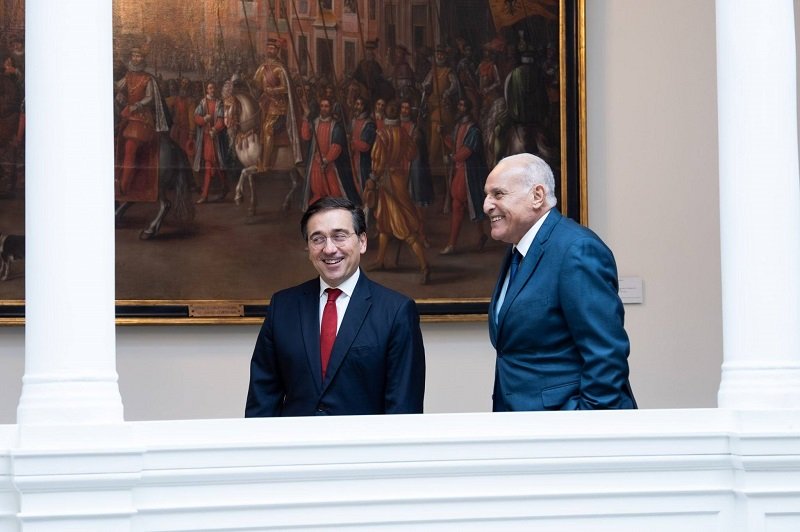
The silence surrounding Algerian Foreign Minister Ahmed Attaf’s participation in the Madrid negotiations is not merely a procedural detail; it reflects a carefully calculated strategy to navigate a politically delicate moment. For the first time in decades, Algeria faces a new reality: moving from the role of an “external supporter” to that of an active participant at the negotiation table on the Sahara issue.
Since news of the session at the U.S. Embassy in Madrid emerged, Algeria has maintained complete silence, both officially and in the media, despite tangible signs confirming its direct involvement. Chief among these was Attaf’s meeting with his Spanish counterpart José María Álvarez on the eve of the negotiations—an encounter that cannot be separated from the broader political context.
Attaf’s arrival in Madrid followed preparatory steps, including his meeting in Algiers with Massad Boulos, senior advisor to the U.S. President on Africa and the Arab world. At the time, few details about this trip were disclosed. It later became clear that it was part of the arrangements leading to Algeria’s practical participation in the negotiations, based on Morocco’s updated autonomy proposal, in line with UN Security Council Resolution 2797.
The official and media silence surrounding Attaf’s trip deliberately conceals a broader context, gathering four parties: Morocco, Algeria, Mauritania, and the Polisario Front, under direct U.S. supervision, with the personal UN envoy Stefano de Mistura present. This quiet approach aims to prevent domestic public shock, accustomed to a discourse of Algeria as an “observer” supporting the principle of self-determination without direct involvement.
Though confidential, the negotiations adhere to the framework set by Security Council Resolution 2797, adopted on 31 October 2025, which calls on all parties to resume talks without preconditions, in a spirit of realism and compromise. Algeria’s presence, despite its silence, constitutes an implicit acknowledgment of its real role in the conflict.
The choice of Madrid, under explicit U.S. sponsorship, is deliberate. Washington signals that the Sahara dossier is no longer merely a regional dispute but a key element in North African and Sahel security and stability, amid growing challenges such as terrorism, irregular migration, and international geopolitical competition.
Resolution 2797 itself marks a decisive turning point, moving from fragile balance management to a realistic political framework, establishing Moroccan autonomy as the only credible solution. This new approach marginalizes outdated positions and underscores international commitment to negotiations based on Morocco’s plan.
بعثة الولايات المتحدة لدى الأمم المتحدة: قامت وفود رفيعة المستوى من الولايات المتحدة والأمم المتحدة بتيسير محادثات في مدريد بإسبانيا جمعت المغرب وجبهة البوليساريو والجزائر وموريتانيا، تركّزت حول تنفيذ قرار مجلس الأمن الدولي رقم 2797 (2025) المتعلّق بالصحراء الغربية.
— الخارجية الأمريكية (@USAbilAraby) February 9, 2026
Thus, the Madrid talks are not merely technical meetings but a concrete step toward implementing an actionable solution, enhancing Morocco’s role as a reliable partner in regional security and placing Algeria before a domestic challenge: how to explain the shift from “neutral” rhetoric to active participation?
In conclusion, Madrid marks the beginning of a new phase: from symbolic positions to real political commitments, from defending legitimacy to consolidating it on the ground. It is a stage meant to close a long-standing conflict and redirect North Africa’s energy toward development and integration rather than conflict and stagnation.


