

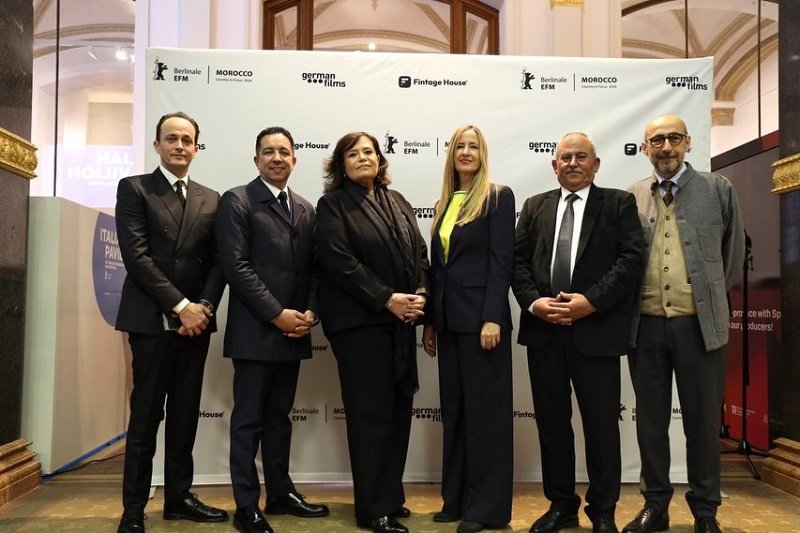
Morocco’s participation as guest of honor at the Berlin International Film Festival was not merely a ceremonial event within the usual cultural agenda, but a defining moment reflecting a clear shift in the state’s perception of cinema: from a local artistic sector to a soft diplomacy lever, invested in repositioning Morocco on the global symbolic map.
The selection of the Kingdom as the “pivot country” within the European Film Market – the most important professional platform in Europe for the film industry – goes beyond symbolic recognition of Africa. It implicitly acknowledges Morocco’s role as a cultural and geographic mediator between three strategic spheres: Africa, the Arab world, and Europe.
From “Filming Location” to “Narrative Actor”
Historically, Morocco was primarily seen as an “open natural studio”: attractive shooting locations, skilled technical workforce, and costs lower than Europe or the U.S. But this participation reflects a conscious effort to shift from technical service provision to narrative power: Morocco becomes not just a filming site but an active participant in shaping, financing, and directing cinematic storytelling.
The inauguration at Gropius Bau, attended by figures such as Tricia Tuttle and Tanja Meissner, alongside Morocco’s ambassador Zohour Alawi, was not merely ceremonial but carefully staged to project an image: Morocco as a cultural hub rather than a marginal state in the production market.
Apparent: Infrastructure and Cultural Investment
Implied: Reframing the National Image
The official discourse emphasized familiar elements: quality infrastructure, competence of Moroccan technicians, dynamic co-productions, and the support of the Moroccan Film Center. Yet this international momentum raises a strategic question: how can culture be leveraged to reinforce Morocco’s image while consolidating the national film ecosystem?
In a world where “international reputation” is a capital in itself, military or economic power alone is insufficient. Cinema plays a multifaceted role: enhancing image, redefining identity, and exporting the model of a “stable, open, multicultural Morocco.” The real challenge lies in turning this international recognition into a sustainable boost for the domestic cultural landscape.
Thus, it remains essential to continue strengthening Moroccan film distribution networks, modernizing theaters, expanding audiences, supporting emerging creators and technicians, and bridging the gap between Morocco’s growing international presence and its local cultural embedding. Soft power in culture reaches its full potential when it benefits the national audience directly.
Recovering Memory: “Al-Sarab” as a Double Message
The selection of Al-Sarab by director Ahmed Bouanani in the Berlinale Classics section is far from an innocent technical detail. It conveys a double message: internationally, Morocco has a cinematic heritage worthy of restoration and global display; domestically, it restores recognition to pioneers long marginalized by national cultural policies.
Cinematic memory thus becomes part of diplomacy itself: investing in the past to produce symbolic legitimacy in the present, and fostering an active cultural citizenship that balances Morocco’s global image with the role of cinema in Moroccan society.


