

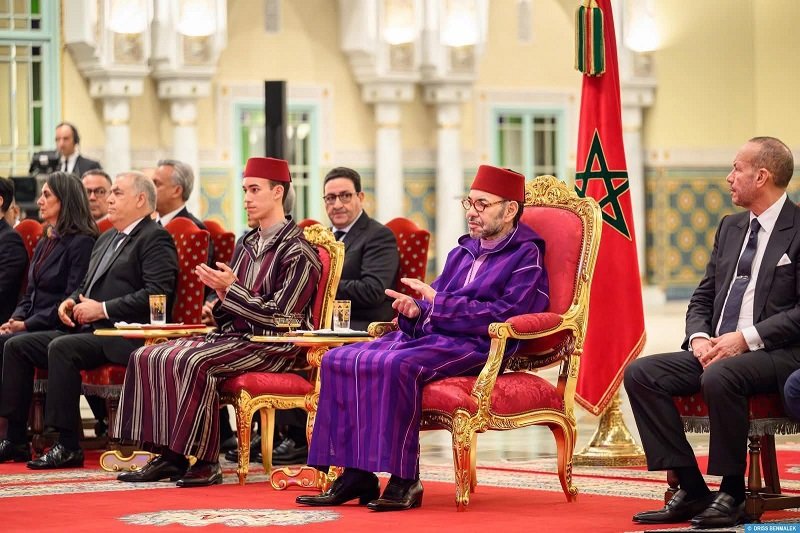
Amid the challenges facing the country, from catastrophic floods to economic and social pressures, King Mohammed VI affirms that the solution does not lie solely in confronting crises, but in transforming them into opportunities. The launch of the aircraft landing systems factory in Nouaceur, in partnership with the Safran Group, is not merely an industrial event, but a clear message: Morocco is consolidating its global position in precision industry, creating jobs, attracting foreign currency, and converting local challenges into a platform for sustainable economic development.
What is visible in this project is the strengthening of Morocco’s position on the global aerospace map, through its integration into precise links of the value chain: from high-precision manufacturing to testing, certification, and maintenance. What is implicit is the anchoring of a development model that treats heavy industry and technical expertise as a sovereign lever, not merely a dependent economic activity. The choice of Nouaceur within the Midparc platform is not a neutral geographical decision, but part of a new territorial engineering that turns industrial hubs into centers of economic power—capable of absorbing skilled unemployment, generating networks of local suppliers, and reducing technological dependency.
Even more telling is the fact that the factory is dedicated to the Airbus A320 model, one of the most in-demand aircraft worldwide. This means that Morocco is not entering the margins of the market, but positioning itself at the heart of growing international demand, securing a place within the dynamics of global civil aviation production. Here, the announced figures—280 million euros in investment, 500 direct jobs, and full reliance on clean energy—shift from being mere technical indicators to signs of Morocco’s transition from a logic of “attracting investment” to a logic of “negotiating its position within the global value chain.”
Politically, this path reflects what can be described as a “strategic royal economy”: an economy guided not by reaction, but by anticipation; one that does not limit itself to managing immediate social shortages, but works to build a productive structure capable, in the future, of financing the social state itself. In this context, royal activities—despite harsh climatic and humanitarian conditions—appear as a reordering of political time: emergencies are addressed, but development is not postponed.
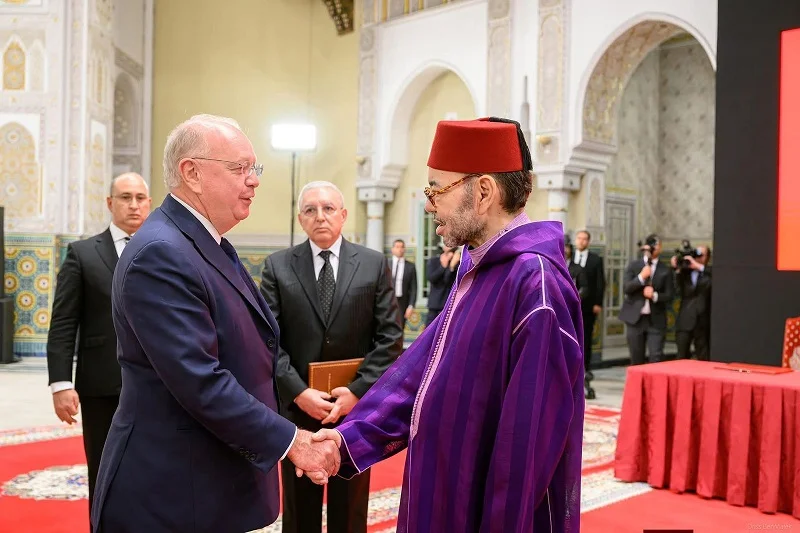
On the symbolic level, Safran’s statement that it “does not produce in Morocco but with Morocco” carries deep sovereign meaning. It signals the country’s shift from being a low-cost platform to becoming a reliable industrial partner—possessing internationally recognized human capital and participating in the design of the industrial model itself, not merely in its execution. The new factory thus becomes more than a production unit; it is a practical embodiment of Morocco’s transformation from a consumer of technology into an actor in its production, and from a dependent subject of globalization into a negotiating partner within it.
In sum, this event cannot be read outside a broader context: a monarchy that treats industrial investment as a form of “undeclared public policy”, and sees the creation of productive wealth as a prerequisite for any meaningful social justice. The implicit message to the domestic audience is clear: the state does not merely compensate for losses, but builds new sources of economic power. And to the outside world, the message is even clearer: Morocco is no longer just a space for consumption or assembly, but a field of industrial partnership with strategic depth.


