

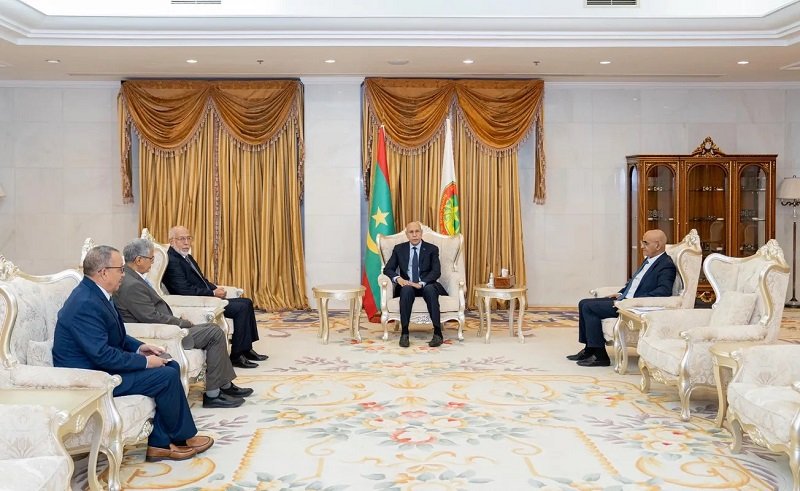
In a regional context marked by intensified diplomatic activity surrounding the Sahara dispute, Mauritanian President Mohamed Ould Cheikh El Ghazouani received a delegation from the “Polisario” front led by what the movement presents as the president of its National Council, Hamma Salama. The Mauritanian presidency limited its communication to publishing photographs of the meeting without providing details about its agenda or the issues discussed, leaving room for political interpretation.
The timing of the meeting carries particular significance, as it coincides with discussions held in Washington over two days on the same issue, under the supervision of Msaad Boulos, envoy and adviser to former U.S. President Donald Trump for Arab and African affairs. This overlap between engagements in Nouakchott and consultations in the U.S. capital reflects a broader diplomatic dynamic in which movements on one front resonate with developments on another, illustrating ongoing repositioning among key actors.
Mauritania officially maintains what it describes as a policy of “positive neutrality,” seeking to preserve equal distance from the parties to the conflict while safeguarding its national strategic interests. However, this stance is increasingly tested by rapid regional and international shifts. The regular visits of Polisario delegations to Nouakchott demonstrate the movement’s efforts to keep communication channels open and maintain a diplomatic presence close to the geographic center of the dispute.
At the same time, Algeria and the Polisario leadership are closely monitoring developments that have reshaped the traditional balance of the dossier. Morocco’s growing diplomatic consolidation and the strengthening of the autonomy proposal as a reference framework for a political solution have introduced new variables into the equation. Furthermore, UN Security Council Resolution 2797 reaffirmed the international framework governing the process while leaving space for continued negotiations and potential adjustments.
In this context, the Mauritanian meeting cannot be viewed as a mere protocol event. Rather, it forms part of a broader diplomatic sequence in which regional and international capitals recalibrate their positions in light of ongoing transformations. The Sahara issue remains a strategic negotiation space whose trajectory is determined by evolving geopolitical alignments and diplomatic initiatives.


