

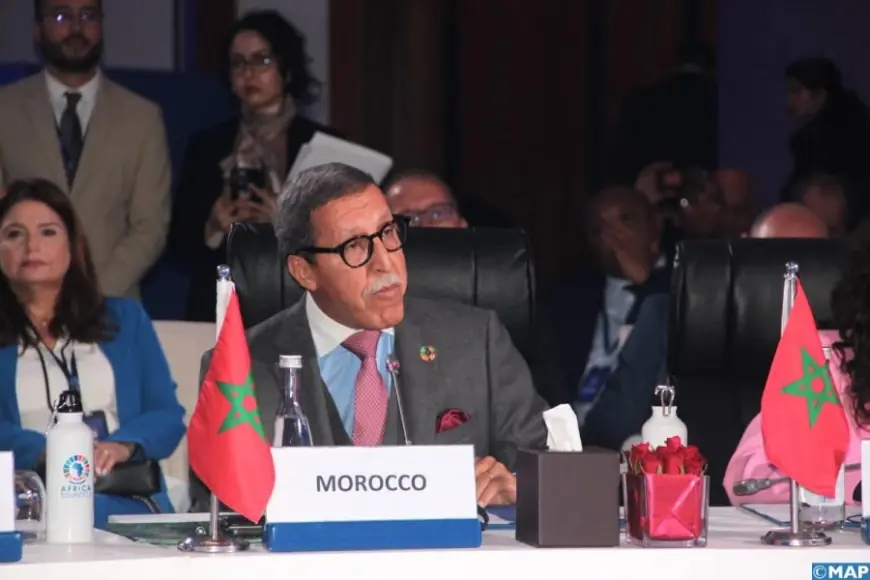
In a diplomatic engagement reflecting Morocco’s growing role in African peace processes, Ambassador and Permanent Representative of Morocco to the United Nations Omar Hilale presented a briefing before the UN Security Council in his capacity as Chair of the Central African Republic configuration of the Peacebuilding Commission. The session, convened at the invitation of the British presidency of the Council, focused on assessing post-election progress and outlining strategic priorities for consolidating peace and stability.
The briefing took place in the wake of the presidential, legislative, regional and municipal elections held on 28 December 2025. Hilale emphasized that the elections were conducted in a generally peaceful, free and transparent environment, marking a significant milestone in strengthening institutional legitimacy and democratic continuity. Beyond procedural progress, this development underscores the importance of political stability as a prerequisite for deeper reforms.
Speaking on behalf of the Peacebuilding Commission, Hilale congratulated President Faustin-Archange Touadéra on his re-election and highlighted the commitment of the Central African authorities to democratic governance and institutional continuity. At the same time, he acknowledged that despite notable progress, security challenges persist and require sustained international and national efforts.
He outlined four key priorities to advance consolidation efforts. The first concerns continuing security sector reform and extending the effective authority of the State across the national territory. The second focuses on strengthening the disarmament, demobilization and reintegration (DDR) process, which has reportedly led to the demobilization of 13 out of 14 armed groups — a significant achievement that nevertheless requires durable socio-economic reintegration mechanisms.
The third priority centers on reinforcing justice and the rule of law, particularly through support to the Special Criminal Court and transitional justice mechanisms, as essential tools to combat impunity and prevent renewed cycles of violence. The fourth priority links stability to inclusive development, stressing that lasting peace depends on tangible economic recovery, public investment and infrastructure rebuilding.
On the development front, Hilale recalled Morocco’s role — at the request of the Central African government — in organizing the partners’ roundtable held in Casablanca on 14 and 15 September 2025. The conference succeeded in mobilizing approximately 9 billion US dollars to finance the National Development Plan 2024–2028, marking a major step toward implementing structural projects.
He called on international partners to support the effective implementation of these commitments so that pledged funds translate into concrete projects on the ground. In this context, he highlighted the “Emai” Fund, officially launched by the Central African government on the sidelines of the roundtable, and encouraged states and partners to contribute to this mechanism aimed at strengthening national ownership of development.
Hilale also reaffirmed the strategic role of the United Nations Multidimensional Integrated Stabilization Mission in the Central African Republic (MINUSCA), describing it as a key partner not only in security stabilization but also in supporting institutional reforms and sustainable development.
The meeting was further marked by the presentation of the UN Secretary-General’s report by the Special Representative and Head of MINUSCA, Valentine Rugwabiza, reflecting the coordinated engagement of international actors in consolidating peace in the country.


