

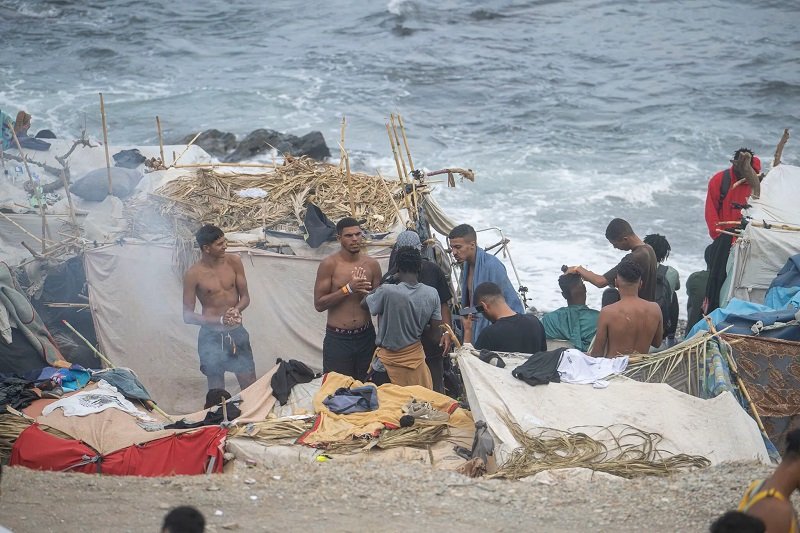
The suspension of the migrant camp in the port of occupied Ceuta lasted only a few hours.
After the Spanish National Court ordered a temporary halt to the camp’s installation on Wednesday and asked the Spanish Transport Ministry to provide the file on which its decision to allocate part of the port had been based, the same court on Thursday, September 17, rejected the Unified Police Union’s urgent request to suspend the project. The Spanish government can therefore continue setting up the camp in the Poniente port expansion area, covering approximately 16,000 square metres, to accommodate a large number of migrants who have remained in Ceuta since the mass entry of July 30 and 31.
The court’s decision does not mean that all objections raised against the camp were unfounded. That is an important point in understanding what has happened. The court did not rule on the substance of every security and safety issue. It concluded that, after examining the documents submitted by the Transport Ministry, there was no longer sufficient justification for an immediate suspension of the project.
The Unified Police Union had challenged the project over concerns about the security of the port and the working conditions of police officers who would be deployed at the site. It referred to the absence, before the camp became operational, of evidence that certain requirements relating to port protection, emergencies, fire risks, civil protection and occupational safety had been met. The proximity of the site to facilities linked to fuel, energy and other essential services was also among the concerns raised.
🚨 La Justicia permite que siga adelante el campamento de inmigrantes del puerto de Ceuta
👉 El proyecto ocupa unos 16.000 metros cuadrados del puerto de Ceuta y el dispositivo tiene capacidad para alrededor de 1.700 migrantes
💭 ¿Qué te parece que el campamento siga adelante… pic.twitter.com/zxp5EcLaBM
— EL ESPAÑOL (@elespanolcom) September 17, 2026
The court did not disregard those objections, but placed them within their administrative and legal framework. The decision taken by the Transport Ministry, it explained, is limited to temporarily authorising the use of approximately 16,000 square metres of port land for the establishment of a temporary reception facility. The detailed conditions governing humanitarian assistance and the working arrangements of security personnel are not defined by that authorisation itself. They are matters to be addressed through the measures and procedures to be adopted by the Interior Ministry and the competent authorities.
Even within the Spanish administration, the issue had not been free of reservations. On September 4, the Port Authority of Ceuta had opposed the use of the site, arguing that the temporary occupation of the land was incompatible with the port’s normal operation. By contrast, the state-owned Spanish port authority gave a favourable opinion, citing reasons of public interest while requiring the necessary measures to be taken to guarantee the port’s safety and protection and the normal continuation of its activities.
These details make the court’s decision more complex than the abbreviated version suggesting that the court simply “allowed” the camp. What it actually allowed was the continuation of an administrative decision on a temporary basis, after finding that the objections presented did not, at this stage, justify the exceptional judicial measure of stopping it. The security conditions and measures under which the camp will operate remain the responsibility of the competent Spanish authorities.
The practical consequence is already clear: the port, one of Ceuta’s sensitive pieces of infrastructure, is becoming a site for absorbing a migration crisis that emerged inside the city itself.
The camp being prepared on approximately 16,000 square metres is intended to accommodate around 1,700 people, according to the latest government and media figures, while other sources refer to roughly 1,800 migrants who remain in temporary accommodation facilities. Initial reports about the project had referred to a capacity of around 1,000 people, before the number of people targeted by the facility became clearer.
The Spanish government considers the site the most suitable location for dealing with a situation that has continued for weeks, particularly because migrants remain in temporary accommodation conditions inside the city. It welcomed the speed of the court’s decision and reaffirmed that the port land provides, in its view, the necessary guarantees for the operation to proceed.
But what deserves attention in these developments goes beyond the camp itself.
Over recent weeks, part of the Spanish political and media discourse has treated the wave of entries into Ceuta as a crisis connected to the Moroccan border, cooperation with Morocco and the ability to control migrant movements. The decision issued today deals with another dimension of the matter: what does Spain do with the migrants who are actually inside occupied Ceuta?
The judicial and administrative file provides an answer that is being worked out within Spanish institutions themselves: the Transport Ministry allocates the land, the Port Authority raises objections, the state port authority supports the project under conditions, the Interior Ministry is responsible for ensuring security, the police challenge the measure, and the National Court reviews the file before allowing implementation to continue.
That sequence does not require Morocco to be assigned responsibility for something the documents do not establish.
The existence of a migration crisis in Ceuta does not erase the reality of the Moroccan-Spanish border, nor does it remove the need for cooperation between the two countries on migration and security issues. But neither does it turn every measure taken by Spanish authorities inside the city into a direct extension of a Moroccan decision. In this particular case, the documents examined by the court concern the use of Spanish port land, coordination between Spanish institutions and services, and the reception of people who are already present inside Ceuta.
More importantly, the court has not placed the project beyond scrutiny. It rejected the urgent procedure seeking to stop it, while the underlying legal dispute remains. It also stressed that ensuring the safety and protection of police officers, migrants and personnel working at the site falls within the responsibility of the competent authorities, rather than being guaranteed by the administrative decision alone.
In that sense, the camp file brings the crisis back to a more concrete level: migrants are present in Ceuta and need accommodation; a Spanish port is allocating part of its land for that purpose; and administrative and security objections have not disappeared simply because Thursday’s decision was issued.
Reducing all of this to a ready-made narrative in which Morocco becomes the title of the crisis is not supported by the details of the decision itself. What the published documents show is that a significant part of the crisis, at its current stage, has become a matter of internal Spanish management, subject to decisions by the Spanish administration, police, port authorities and courts.
This does not end the migration file, nor does it settle the disputes surrounding the events of July. But it does shift the way the current situation inside Ceuta is viewed: the question is no longer only how the migrants entered, but also how their presence is managed after their arrival, who is responsible for the place that will accommodate them, who sets its security conditions, and who oversees the legality of those decisions.
In today’s ruling, for the time being, the answer lies within the Spanish institutions themselves.


