


Every time cinema returns to a figure as monumental as Oum Kalthoum, a question looms larger than the film itself: can art approach a legend without diluting it or turning it into a pale imitation?
This almost philosophical question is precisely what Marwan Hamed’s film Al-Sitt confronts. It is not a conventional biography; it is an attempt to explore the space between what we know and what we think we know about “The Star of the East.”
Much like Milan Kundera’s reflections on Nietzsche’s concept of the “eternal return,” the film confronts the viewer with a troubling truth: if the extraordinary were to repeat, it would lose its singularity. The challenge, then, is not to recreate Oum Kalthoum but to rethink the significance of her unique historical presence and what it means for a woman from the Nile Delta to become a timeless, transnational symbol.
Marrakech Film Festival: a choice that speaks volumes
The selection of the Marrakech International Film Festival for the world premiere of Al-Sitt was no mere ceremonial gesture. It reaffirms the festival’s role as a platform for ambitious projects, offering a space to discuss whether Arab cinema can handle a myth without glorifying or trivializing it.
The equation was complex:
-
Marwan Hamed, a master of visual composition,
-
Ahmed Mourad, a screenwriter adept at psychological and historical deconstruction,
-
and Mona Zaki, facing an interpretive challenge that goes beyond performance into transpositional acting.
The co-production between United Company and the Big Time Fund adds another layer: a monumental project for a monumental legend.
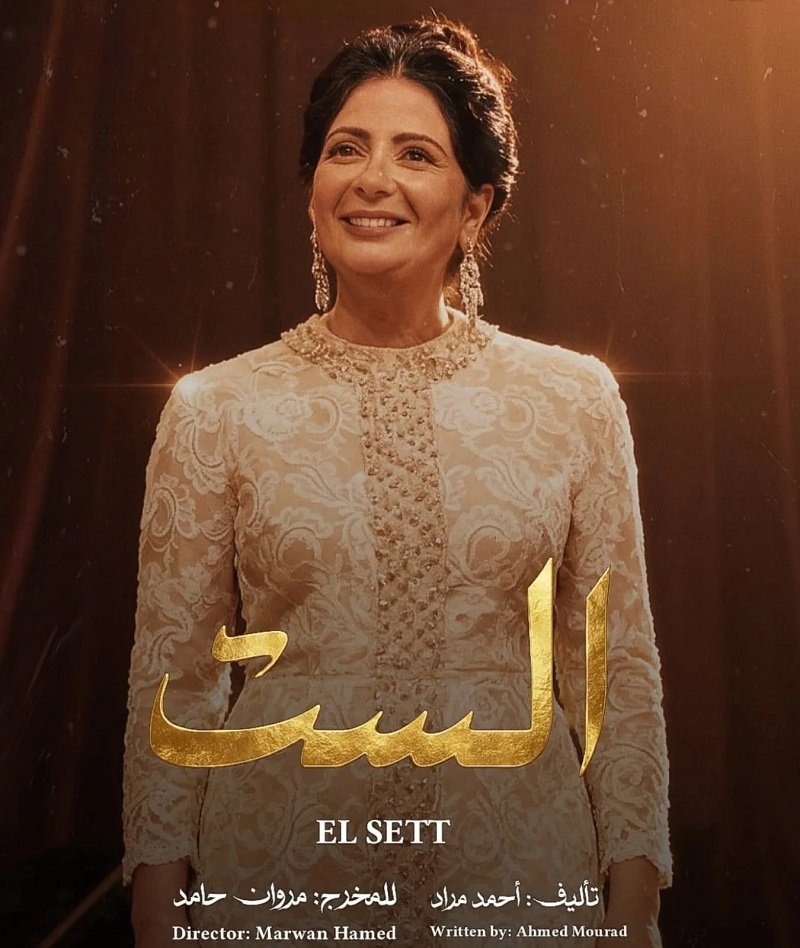
Between document and narrative: where does the film begin and end?
From the first scene, Hamed makes it clear: this is not a conventional documentary.
Starting with the iconic Olympia concert in Paris is not a return to a fixed event but a provocation: how did a voice born in the fields of the Nile reach one of the world’s most prestigious stages?
The film does not answer directly.
Instead, it lets the question resonate between light and shadow, crowd and silence, turning the moment into a gateway to the central conflict of the biography: a woman emerging from the margins to become the core of Arab collective memory.
Childhood: when the voice grows before the body
The early village scenes do not reconstruct the past—they establish a feeling that persists throughout the film.
Muted colors, the camera oscillating as if seeking the contours of a voice, and the iconic shot of the girl disguised as a boy… all elements map Oum Kalthoum’s inner journey:
a voice larger than the body that carries it.
This is not a romanticized image of rural life; it is a visual reading of her first moment of transformation:
art as quiet rupture and emancipation.
Cairo: the city that shapes and exposes the voice
When the narrative moves to Cairo, the visual language changes completely.
Lighting is brighter, shadows sharper, and space feels like a social laboratory rather than mere historical setting.
The most significant shift is not geographic but in Hamed’s perception of the city:
-
Cairo is not a launching pad;
-
it is a mirror reflecting the heroine’s anxieties,
-
a city that shapes as much as it reforms her voice.
Hamed’s treatment of the city recalls Antonioni: places intensify solitude rather than diminish it.
Tradition vs. modernity: a conflict implied
Rather than turning Oum Kalthoum’s conflict between religious chanting and modern song into a direct confrontation, the film uses editing as a field of tension.
The alternation between concerts and private moments underscores the idea that a biography is not a timeline, but interlocking circles: every step toward fame carries echoes of the past.
When the political dimension enters, the film avoids simplification: Oum Kalthoum is neither a tool of the state nor an opponent.
Her voice surpasses politics, not as a slogan, but as a historical presence.
A woman who redefines without declaring
One of the film’s greatest achievements is its ability to present a subtle vision of female agency:
she is not a woman proclaiming revolution, but one who transforms the rules through her acts, her art, her dignity, and her independence.
The film thus redefines the artist’s place in a patriarchal society without ever resorting to explicit feminist rhetoric.
Black & white vs. color: time as a dramatic material
The interplay between black-and-white and color is not merely aesthetic:
-
Black-and-white serves as a portal to memory,
-
Color provides a contemporary vitality to the legend.
At times, color enters gradually, like a visual vibration, extending the sense of sound, giving time itself the role of a character: what was, what we think we know, and what might be.
Mona Zaki: performance privileging essence over mimicry
Mona Zaki faced a perilous task. She could have fallen into mimicry, but she chose interpretive freedom:
she does not perform Oum Kalthoum as we know her, but what her legend can signify today.
She does not mimic gestures, posture, or stance, but the inner gravity of a woman living between an extraordinary voice and a fragile body.
Distance: where the film succeeds and hesitates
Despite its visual power, the viewer may sometimes sense restraint, a hesitation to get too close to the legend.
This distance is not a flaw; it is intrinsic to the project.
Oum Kalthoum is not a character to possess:
she is a presence the film honors without claiming to capture.
Conclusion: the film does not attempt to “recreate” Oum Kalthoum
The strength of Al-Sitt lies in this deliberate distance:
between cinema and memory, image and sound, legend and human being.
The film does not try to own the legend, but offers viewers a new way to hear her and perceive the silence between her notes.
Beyond Oum Kalthoum herself, the film invites reflection: how do we approach something we know can never be repeated or reproduced?
It is a meditation on memory, creation, and how cinema can engage with the extraordinary without betraying its essence.


