

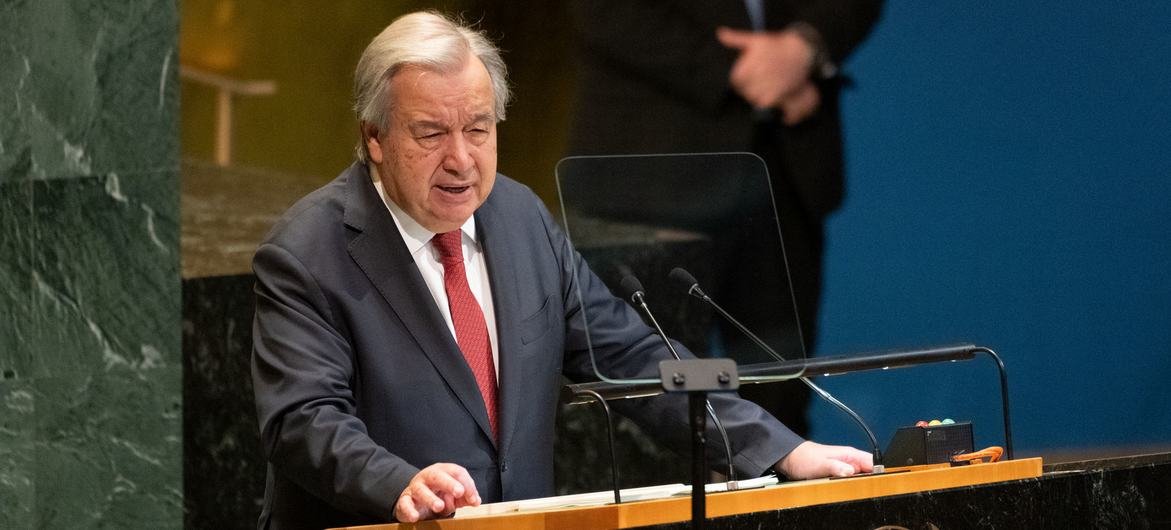
United Nations Secretary-General Antonio Guterres affirmed that the inalienable rights of the Palestinian people – foremost among them the right to self-determination – are a fundamental reality that must be implemented and respected, stressing that the two-state solution is the only viable path to achieving a just and lasting peace.
According to a statement distributed by the United Nations Information Centre in Cairo, a copy of which was obtained by the Diplomacy Correspondent, the Secretary-General’s remarks came during the opening session of the 2026 Committee on the Exercise of the Inalienable Rights of the Palestinian People, which saw the re-election of Coly Seck, the Permanent Representative of Senegal to the United Nations, as Chairman of the Committee.
Guterres praised the committee’s steadfastness in defending the rights of Palestinians over the past fifty years.
The two-state solution
The UN Secretary-General explained that the New York Declaration and the Global Coalition for a Two-State Solution provide clear pathways and platforms for progress, adding that what matters most is lasting change on the ground.
He described the current situation as extremely fragile, pointing to the severe suffering faced by Palestinians in Gaza, where more than 500 Palestinians have been killed since last October’s agreement.
The Secretary-General urged all parties to fully implement the agreement and comply with international law, calling for the unimpeded passage of humanitarian aid, particularly through the Rafah crossing.
He stressed that the continued suspension of the work of international non-governmental organizations undermines progress and increases the suffering of civilians, stressing that any sustainable solution must ensure that Gaza, the West Bank and East Jerusalem are administered by a unified, legitimate and internationally recognized Palestinian government, emphasizing that Gaza is an integral part of the Palestinian state.
Escalation in the West Bank
Regarding the West Bank, António Guterres warned of the accelerating pace of settlement expansion and demolitions, revealing that more than 37,000 Palestinians were displaced during 2025 alone, a year he said saw record levels of settler violence.
He expressed grave concern about the Israeli tender to build 3,401 housing units in the E1 area, stressing that its implementation would separate the northern West Bank from the south and undermine the contiguity of Palestinian territories.
The Secretary-General cited the opinion of the International Court of Justice, which deemed Israel’s presence in the occupied territories illegal, and noted with deep concern the reports of the Human Rights Commission, which provide evidence of racial discrimination entrenched in Israel’s administration of the West Bank and East Jerusalem.
Outrageous threats against UNRWA staff
The Secretary-General condemned in the strongest terms the actions taken by the Israeli authorities to demolish the UNRWA compound in Sheikh Jarrah in occupied East Jerusalem.
He said, “UNRWA premises are UN premises, and they are protected and must not be violated.” He described the public threats made by Israeli officials against UNRWA staff as “utterly reprehensible and must be met with unequivocal rejection”.
UNRWA continues its work despite the challenges
For his part, Michael Contet, head of the United Nations Relief and Works Agency for Palestine Refugees (UNRWA) in New York, said that the agency remains the largest provider of services to Palestinian refugees.
Despite the enormous operational challenges – including the killing of 385 of its staff and the destruction of many of its facilities – more than 11,000 UNRWA employees in Gaza continue to work every day.
The agency provides healthcare to nearly 100,000 Palestinians weekly, and education to more than 66,000 students in 73 schools.
UNRWA also leads vaccination campaigns in cooperation with its partners, and provides the majority of water and sanitation services in Gaza.
Michael Contet noted that new Israeli restrictions on international NGOs and legislation – which expand the scope of anti-UNRWA measures – have further hampered operations, including the closure of UNRWA schools and health centers in East Jerusalem and the destruction of its facilities.
Contet warned that Israeli restrictions, coupled with an unprecedented financial shortfall, pose an existential threat to UNRWA.
Warning against turning aid into a tool of subjugation
Speaking via video link from Jerusalem, Dr. Itai Epstein, special advisor to the Norwegian Refugee Council, warned that Israel’s failure to renew licenses for international NGOs operating in the occupied Palestinian territory is already hindering the delivery of humanitarian aid.
Dozens of organizations, including the Norwegian Refugee Council, have been notified that their licenses have expired without clear guidance, resulting in staff being barred from entering Gaza, programs being disrupted, and supply chains being cut off.
The special advisor said that these organizations provide essential services such as health care, shelter, food, water and education in coordination with the Palestinian authorities and United Nations agencies.
Dr. Itai Epstein stressed that restricting humanitarian operations directly harms civilians and undermines international humanitarian law, noting that “subjecting the humanitarian presence to Israeli administrative discretion amounts to imposing political authority on a fundamental dimension of sovereign Palestinian civilian life, and threatens to turn relief into a tool of subjugation.”
Palestinian Appreciation for UN Efforts
In his address, Riyad Mansour, Permanent Observer of the State of Palestine to the United Nations, reiterated the Palestinian leadership’s appreciation for the United Nations, the Secretary-General, and the Committee for their longstanding support of the rights of the Palestinian people.
He described the past two years as among the most painful periods in the history of Palestine, noting the killing of more than 72,000 Palestinians, the wounding of more than 171,000, the mass displacement throughout Gaza, and the continued civilian casualties despite the declaration of a ceasefire.
Ambassador Riyad Mansour stressed the need for full respect for and maintenance of the ceasefire. He called for unhindered humanitarian access throughout Gaza and for UN agencies, including UNRWA, to continue their work.
He stressed the urgent need to accelerate the provision of temporary housing, noting the Palestinian government’s request for 200,000 temporary housing units to allow displaced families to remain close to their lands and facilitate reconstruction, while warning against attempts to force Palestinians out of Gaza.


