

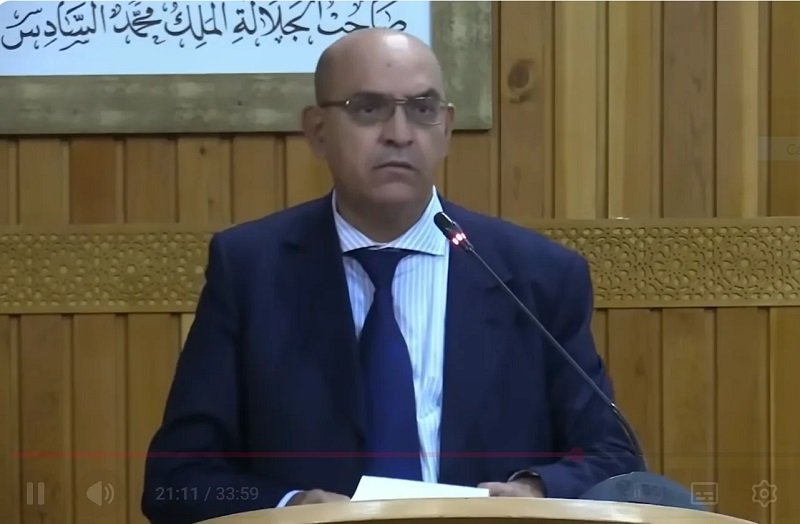
When Politics Meets History: Reflections on the Past’s Role in the Present
In his lecture titled “I Was Wali of Meknès but Not Master of the City”, Dr. Hassan Oureid, historian and former official spokesperson of the Royal Palace, offers a reflective and penetrating view on the intricate relationship between history and political power. Beyond personal anecdotes and factual clarifications about his administrative career, his discourse raises a key question: Is the politician a creator of history, or does history transcend political action?
Oureid begins by clarifying that he was never the “master” of Meknès, but its wali, a subtle distinction illustrating his central argument: administrative authority differs from the mastery of historical processes. Political actors operate within historical contexts but are not necessarily the architects of history. The historian observes, interprets, and enlightens, while the politician acts within immediate constraints—sometimes detached from historical vision.
1. The Revival of History as Culture
Oureid emphasizes a fundamental idea: true development occurs when knowledge becomes culture, and by analogy, social and political progress depends on transforming history into collective consciousness. Morocco, like many nations, has experienced periods where history was marginalized, eclipsed by economic priorities, globalization, and later, by democracy and human rights agendas. Critical reading of historical texts, reevaluation of archives, and public engagement contribute to a vibrant historical culture capable of informing contemporary political decisions.
This approach suggests the “democratization of history”: history is no longer solely the domain of academics but a shared field involving citizens, journalists, and writers who challenge official narratives and enrich collective memory.
2. History as a Strategic and Identity Tool
One of the lecture’s most stimulating insights is that history is never neutral. Oureid provides international examples—from Russia and China to Europe and the Middle East—showing how states instrumentalize historical memory to legitimize their present and guide their future. Celebrations of the Green March in Morocco or debates over the Hagia Sophia in Turkey illustrate how commemorations reinforce identity and anchor political legitimacy.
Even democracies face memory conflicts: in Israel, “new historians” challenge the official narrative of 1948, demonstrating that official history can be critically reassessed. History thus becomes a negotiation space between dominant narratives and divergent interpretations.
3. The Plurality of Historical Interpretations
Oureid highlights the diversity of historical readings, both between neighboring countries and within a single nation. In Spain, historiographical schools differ between continuity-focused narratives recognizing Arab-Andalusian heritage and interpretations framing Muslim history as an interruption to overcome. In Morocco, debates between Arab and Amazigh perspectives show how historical memory becomes a site of dialogue and symbolic contestation.
This plurality underlines a fundamental truth: history is not reducible to an official story; it is constructed through debate, reassessment, and confrontation between different viewpoints.
4. Professional and Amateur Historians
Oureid draws attention to a often-overlooked fact: actors of history are not limited to academic historians. Writers, journalists, and intellectuals contribute to critiquing established narratives. Figures like Orhan Pamuk or Boualem Sansal demonstrate that intellectual engagement can influence collective memory even outside formal institutions. The public sphere thus becomes a space where historical accuracy and interpretive plurality interact and mutually enrich.
Conclusion: Critical History as a Tool for the Present
Hassan Oureid’s lecture encourages a rethinking of the relationship between politics and history. History, far from being a mere record of the past, serves as a dynamic instrument for understanding the present and shaping the future. Historians, journalists, and engaged citizens navigate between official memory and parallel histories, challenge dominant narratives, and contribute to building a shared, critical historical consciousness.
In essence, Oureid reminds us that history is not a burden of the past but a lever for the future, and the dialogue between politics and memory must be guided by critical thinking, the pursuit of truth, and the common good.


