

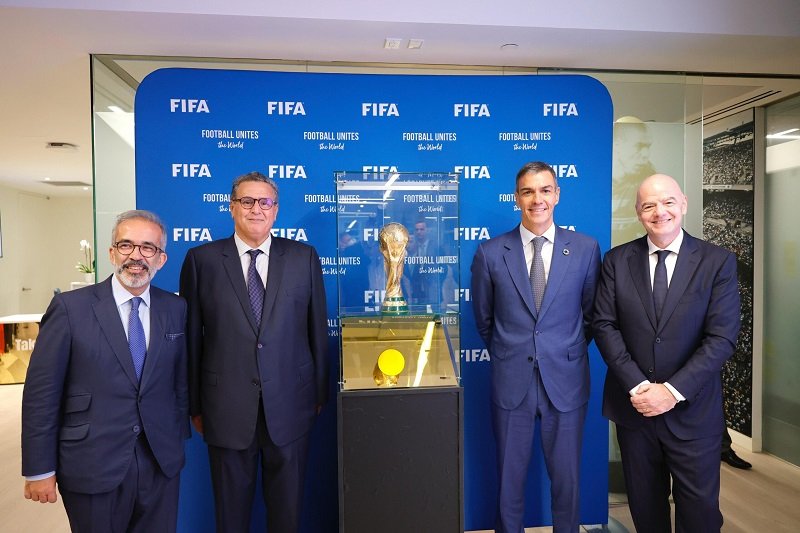
Within the framework of the joint organization of the 2030 FIFA World Cup by Morocco, Spain, and Portugal, a proposal advanced by Spain’s Partido Popular to include the city of Ceuta in activities linked to the tournament introduces a dimension that goes far beyond sport. Presented as a pragmatic and symbolic initiative, the move carries political and diplomatic implications that touch upon territorial sensitivities and the broader balance governing relations between Madrid and Rabat.
The proposal, approved without opposition within a committee of the Spanish Senate, calls on the government to consider designating Ceuta as a site for hosting cultural, institutional, and strategic events connected to the World Cup. Its proponents stress that the city would not host matches nor require large-scale infrastructure investments. Instead, it would accommodate conferences, exhibitions, and institutional meetings aligned with the international visibility of the tournament. By framing it in this way, supporters aim to position the initiative as realistic and consistent with the pre-established organizational framework.
Yet the political significance of the proposal cannot be overlooked. Ceuta, while under Spanish sovereignty, remains a territory whose status is historically contested by Morocco. Integrating it — even symbolically — into a global event co-organized with Morocco and Portugal inevitably carries interpretive weight. It risks being perceived not merely as an administrative decision but as a statement reinforcing Spain’s institutional presence and strategic narrative regarding the city. For the Partido Popular, which governs locally in Ceuta, the initiative also reinforces the city’s visibility and its role in Spain’s international projection.
In contrast, the Spanish Socialist Workers’ Party (PSOE), led by Prime Minister Pedro Sánchez, has adopted a more cautious stance. It emphasizes that the designation of venues and associated activities for the World Cup falls within a previously agreed institutional and technical framework. Such decisions depend on criteria related to infrastructure, connectivity, security, and international coordination — not on unilateral parliamentary resolutions. This response underscores the government’s intention to manage the issue within diplomatic parameters rather than allowing it to evolve into a politically charged debate.
The divergence between the two political positions highlights a broader tension between domestic political positioning and external diplomatic equilibrium. Major sporting events often function as platforms for symbolic messaging and strategic visibility. In this case, even limited activities in Ceuta linked to the tournament could generate political interpretations that extend beyond cultural programming and touch on questions of sovereignty and regional perception.
The central question therefore remains: how far can the symbolic scope of a global sporting event extend without transforming it into a vehicle for geopolitical friction? The success of the tripartite World Cup partnership depends on careful coordination and sensitivity to issues that carry historical and political weight.
Ultimately, the debate surrounding Ceuta illustrates how sport and geopolitics intersect in contemporary international cooperation. What appears at first glance as a localized proposal for cultural participation in a global tournament reveals deeper dynamics about territorial narratives, institutional messaging, and the delicate balance underpinning Spanish-Moroccan relations.


