

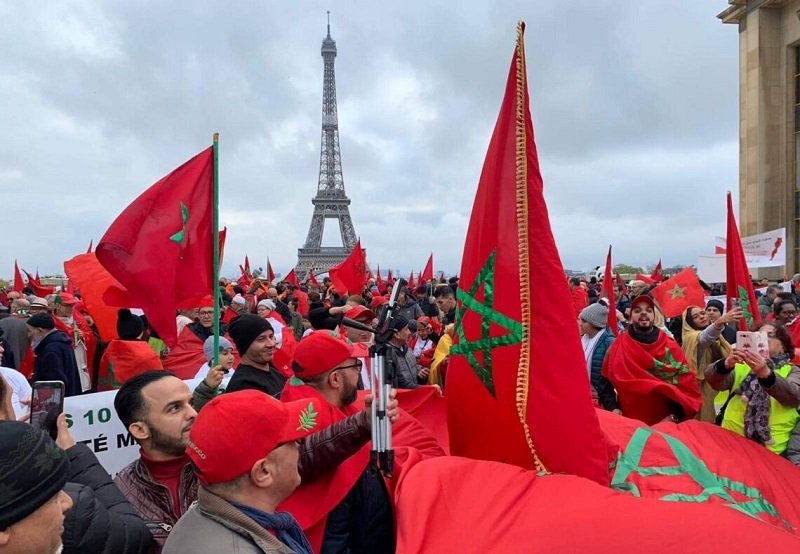
The issue of political participation by Moroccans living abroad has returned to the center of public debate, not as a technical footnote in an electoral calendar, but as a concrete test of the state’s—and political parties’—ability to translate an explicit constitutional provision into a measurable political practice. As the 2026 legislative elections draw closer, the pressure is no longer symbolic. It now revolves around a simple but decisive question: what does “participation” actually mean, and who controls its boundaries?
Since the 2011 Constitution, the principle has been formally settled. Moroccans residing abroad enjoy full citizenship rights, including the right to vote and to stand for election, from their countries of residence. Yet over the years, this apparently unambiguous formulation has evolved into a grey zone—caught between constitutional recognition and postponed implementation, between legal promise and what electoral engineering deems politically manageable.
The latest trigger for renewed debate came through a written response by the Minister of the Interior, Abdelouafi Laftit, to a parliamentary question in the House of Councillors concerning the “effective exercise” of voting and candidacy rights for Moroccans abroad ahead of the 2026 elections. On the surface, the response strikes a reassuring tone. It speaks of draft regulatory texts designed to simplify voter registration, facilitate participation in elections, and strengthen the representation of Moroccans of the world within the parliamentary institution.
Placed within its legislative and political context, however, the response reveals a consistent underlying logic. The state offers adjustments within the existing framework, but stops short of announcing a decisive shift toward direct voting from countries of residence or the creation of overseas electoral constituencies. In essence, the discourse is one of facilitation rather than transformation.
What stands out most is not merely what is stated, but where responsibility is redirected. The center of gravity is shifted away from state decision-making toward political parties. Achieving the stated objectives, the minister argues, depends primarily on the engagement of political actors, notably through placing candidates from the diaspora in “electable positions” on party lists. Participation is thus redefined—not as a constitutional right requiring autonomous mechanisms of implementation, but as an internal process of candidate selection governed by party endorsements and strategic balances.
Under this approach, diaspora representation becomes conditional. It depends on whether parties choose to include certain profiles from abroad, rather than on whether Moroccans living overseas can actually cast their ballots from their countries of residence. The distinction is fundamental. It reshapes the democratic relationship between voters and representatives, and subtly alters the meaning of accountability.
The minister further clarifies the model his department considers sufficient at this stage. Moroccans abroad are entitled to register on electoral lists and to participate, both as voters and candidates, in elections held within the national territory, with certain accommodations reflecting their specific circumstances. Voting may occur either in person in Morocco or by proxy from abroad, while candidacies are submitted in domestic constituencies.
Voting by proxy is not a novelty in Moroccan electoral law. In its 2011 decision (No. 817/2011), the Constitutional Council acknowledged the legislature’s discretionary authority to define the “conditions and modalities of effective exercise” of these rights, considering that proxy voting—though an exception to the principle of personal suffrage—does not in itself violate the Constitution. The issue, however, is not the legality of proxy voting, but its gradual normalization as a long-term solution, indefinitely postponing the question of direct overseas voting.
This is particularly sensitive given that Article 17 of the Constitution does more than recognize a right in abstract terms. It explicitly links the effective exercise of voting and candidacy rights to countries of residence. It is within this gap—between recognition and implementation—that the political participation of Moroccans abroad has remained suspended since 2011, oscillating between two paths: improving registration and proxy mechanisms within the national framework, or moving toward direct representation through overseas constituencies and consular or electronic voting.
By late 2025, this debate is no longer theoretical. It has become embedded in a concrete legislative sequence, marked by the adoption on December 1 of a package of major electoral laws. These include the organic law governing the House of Representatives, amendments to the law on political parties, and revisions to legislation on electoral rolls and the use of audiovisual media during election periods. The scale of parliamentary engagement is telling: 144 amendments were introduced by both majority and opposition groups, with the diaspora issue emerging as one of the most sensitive fault lines.
Within this precise context, the Minister of the Interior rejected an amendment proposing the creation of electoral constituencies specifically for Moroccans residing abroad, reaffirming the continued reliance on proxy voting. This stance lends a clearer reading to the minister’s broader discourse: calls for “facilitation” coincide with the legislative closure of one of the most significant pathways toward structural change.
Administratively, however, the machinery is in motion. Moroccan embassies and consulates have recently called on unregistered citizens abroad to submit registration or transfer requests before December 31, either through diplomatic missions or via the official digital platform, as part of the annual revision of electoral lists for 2026 under Law 57.11. Procedures are well-defined, deadlines are strict, and administrative mobilization is evident. Yet this activation unfolds within a framework whose limits are already firmly set.
Politically, party positions remain fragmented. The Party of Progress and Socialism, for instance, has explicitly advocated for the creation of overseas electoral constituencies based on proportional representation reflecting the geographic distribution of Moroccans abroad. It has also proposed the introduction of early electronic voting and the delegation of registration, candidacy, voting, and vote-counting operations to consulates. This vision moves beyond facilitation toward a comprehensive rethinking of electoral architecture.
Between this approach and that of the Ministry of the Interior lies a third path: incentives rather than structural obligation. During the 2021 elections, part of public funding for political parties was linked to indicators of representativeness, including women and certain categories such as Moroccans abroad. This incentive-based strategy encouraged the inclusion of diaspora figures on party lists, without establishing direct or autonomous electoral representation for overseas citizens.
The political outcome of this model becomes clear upon closer examination. The presence of diaspora candidates on domestic party lists cannot be equated with genuine electoral representation of citizens voting from abroad. The first model remains bound to internal party logic; the second would create a transnational relationship of democratic accountability, requiring a comprehensive overhaul of registration systems, voting procedures, campaigning rules, oversight mechanisms, and electoral dispute resolution.
As the 2026 elections approach, three trajectories intersect. A constitutional trajectory that affirms rights and calls for their exercise from countries of residence. A recent legislative trajectory that consolidates proxy voting and rejects overseas constituencies. And an administrative trajectory that annually activates voter registration revisions and mobilizes consular and digital tools within strict timelines.
It is at the intersection of these three paths that the real ceiling of participation is being defined. Participation is administratively facilitated, yet embedded within an electoral architecture that continues to defer direct overseas voting. The decisive question is therefore no longer rhetorical. Will the new organic laws finally deliver a concrete answer to the constitutional requirement of “effective exercise” from countries of residence? Or will the system once again settle for technical improvements while stopping short of a genuine democratic shift?
At this stage, the adopted texts and the parliamentary debates surrounding them suggest a clear orientation: the state favors controlled continuity, while some political parties continue to argue for a rupture that remains, for now, postponed.


