

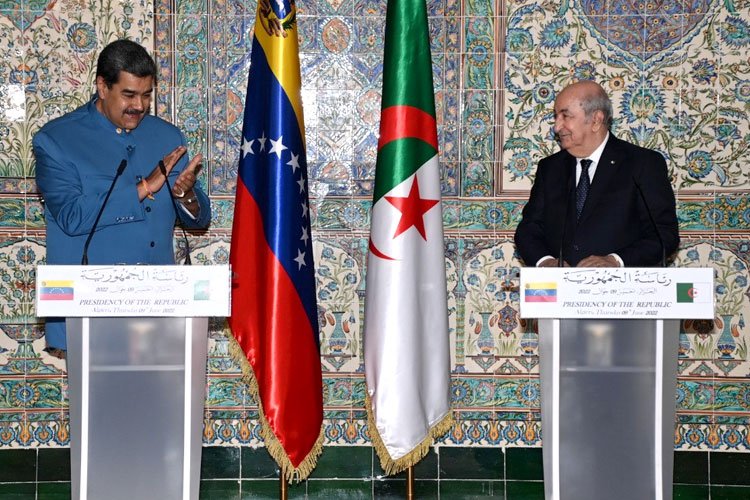
Former Algerian minister and outspoken critic of the military regime, Noureddine Boukrouh, has reopened debate on Algeria’s future by drawing parallels with Venezuela under Nicolás Maduro, cautioning that the country faces a combination of internal and external crises that, in his view, places Algeria at the start of 2026 in a “precarious position both domestically and internationally.”
These remarks appeared in a detailed Facebook post entitled “Is Algeria following in Venezuela’s footsteps?”, a phrasing that signals a prospective analysis rather than categorical judgment, highlighting worrisome indicators for the near-term outlook.
Venezuela as a political mirror
Boukrouh anchors his argument in recent Venezuelan developments, portraying them as illustrative of authoritarian outcomes: weakened internal legitimacy and heightened international exposure. He expresses frustration over what he describes as the “triumph of force over international law,” while noting that authoritarian regimes often face delayed accountability, suggesting a notion of post-facto responsibility.
He references several leaders who met humiliating ends – from Noriega to Gaddafi, Saddam Hussein, Mubarak, and Bashar al-Assad – to highlight a recurring pattern: regimes that espouse revolutionary and sovereign rhetoric but end in isolation and collapse, leaving populations to bear the brunt of systemic failures.
Beyond the comparison: rent and rhetoric
A core element of Boukrouh’s reasoning is the shared oil-dependent economic model, and chronic inability to develop a diverse, productive economy. The “friendship” between Algeria and Venezuela, he argues, is largely emotional, with tangible economic cooperation minimal, and masked by ideological anti-imperialist rhetoric that lacks concrete policy follow-through.
This exposes a contradiction: sovereign and revolutionary discourse overlaying practical restrictions on freedoms and erosion of rights, using rhetoric to shield authority.
Internal pressures in Algeria
Domestically, Boukrouh paints a bleak economic and social picture: depreciation of the dinar, expansion of the parallel currency market, refusal to deposit cash in banks, protests over proposed laws, transport strikes, and rising fuel prices with cascading effects on living costs.
Together, these factors suggest, in Boukrouh’s view, that Algeria faces complex pressures that cannot be managed through conventional tools or populist messaging.
External stakes: sensitive dossiers
On the international front, Boukrouh flags multiple issues threatening Algeria’s stability: border disputes, controversial regional agreements, human rights questions, alleged support for armed groups, drug trafficking, and involvement of senior officials in overseas judicial cases.
Their significance is amplified by a rapidly changing global environment, limiting maneuvering space and exposing rentier-dependent regimes to heightened vulnerability.
A warning, not a prophecy
Ultimately, Boukrouh stops short of issuing a deterministic scenario, framing his analysis as a political warning: 2026 could be a decisive year for Algeria, necessitating a review of economic and political choices to mitigate potential instability, with future outcomes remaining broadly uncertain.


