

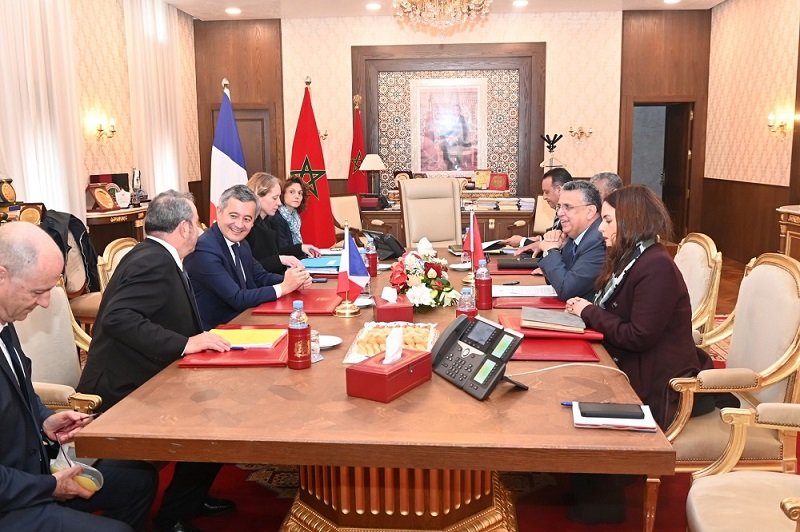
In a particularly sensitive political and judicial context, Morocco and France signed in Rabat a new action plan for technical cooperation in the field of justice for the period 2026–2028. Far from being a purely ceremonial agreement, the plan reflects a qualitative shift in the nature of judicial partnership between the two countries. The signing took place during the second visit of French Minister of Justice Gérald Darmanin to Morocco in less than a year, highlighting the growing weight of security challenges linked to transnational crime.
On the surface, the plan focuses on institutional priorities: modernising judicial administration, strengthening human resources, exchanging expertise on legislative developments, and coordinating positions in international forums. Yet beneath these headings lies a deeper logic: the redesign of judicial cooperation based on operational trust rather than traditional formal agreements.
Statements by both ministers clearly revealed this evolution. Moroccan Justice Minister Abdellatif Ouahbi spoke of a historic partnership that goes beyond sectoral cooperation, placing justice at the core of good governance and the rule of law. Darmanin, for his part, described the relationship as “strong and evolving”, a diplomatic expression that in practice signals growing French recognition of Morocco’s effectiveness in managing complex security cases.
À Rabat, au Maroc, avec mon ami Abdellatif Ouahbi, ministre de la Justice marocain, pour évoquer l’importance de la coopération judiciaire entre nos deux pays dans la lutte contre la criminalité organisée et le terrorisme. L’occasion d’évoquer le défi commun de la saisie des… pic.twitter.com/M99ew8jlm3
— Gérald DARMANIN (@GDarmanin) February 2, 2026
This recognition was reinforced in January, when Morocco handed over to France one of the most prominent drug trafficking network leaders operating in Marseille. In Paris, the operation was widely seen as evidence of Morocco’s rapid judicial responsiveness, and as a sign that Rabat is now viewed not merely as a cooperative partner, but as a central actor in Mediterranean security.
The trend has been further consolidated by a series of sensitive cases, including the arrest in Tangier of a suspect involved in kidnappings linked to digital money laundering, and the extradition of two individuals accused of complicity in a deadly attack on a French prison convoy. These highly technical cases highlight the intersection between organised crime, financial technologies and cross-border threats.
In France, such operations have been interpreted as proof of a mature judicial cooperation. The so-called “prison escape” case, in particular, became a symbol of the high level of trust between the two judicial systems.
Darmanin’s visit itself reflects a clear agenda of firmness against criminal networks. In a post on the platform X, he stated that the main goal of his mission was to act with maximum determination against drug trafficking. Informed sources also point to discussions on identifying French fugitives believed to be in Morocco, as well as on combating financial fraud and money laundering through cryptocurrencies.
Within this framework, Morocco emerges as a global security actor. Its agencies, notably the General Directorate for Territorial Surveillance and the judicial police, have developed a model based on speed, anticipation and legal rigor, making the handling of Interpol red notices a highly effective operational mechanism.
The case of French fugitive Mohamed Amra, known as “the fly”, illustrates this efficiency. Within hours of receiving the cooperation request, Moroccan authorities located and arrested his accomplices in Marrakech, an operation described in France as a “benchmark response”.
Beyond Europe, Moroccan expertise has extended to other continents, including cooperation with China in the “Fox Hunt” operation and the arrest of a Danish national at Mohammed V Airport in coordination with the US Drug Enforcement Administration. These cases confirm Morocco’s transformation into what many observers now describe as a “global security filter”.
In this sense, the 2026–2028 action plan is not merely a technical document, but a strategic marker of a fully mature Franco-Moroccan judicial partnership, where shared security interests prevail over short-term political considerations, paving the way for a durable and structured institutional cooperation in an increasingly interconnected world of transnational crime.


