

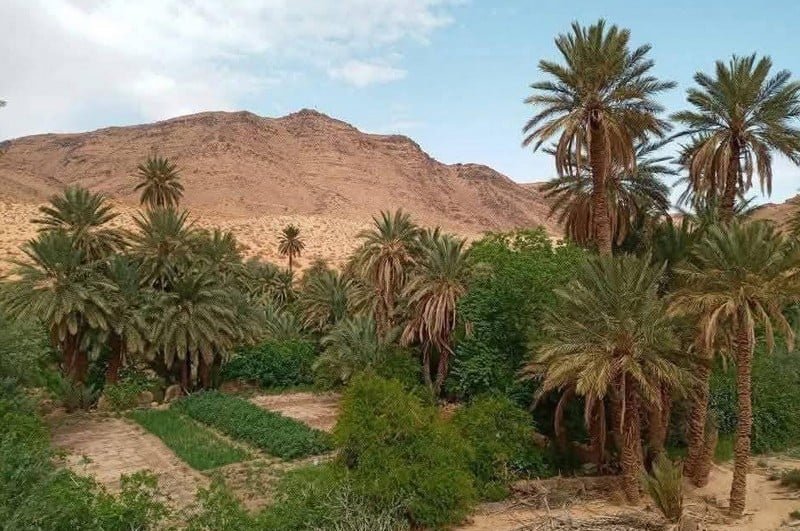
In a region that may seem marginal at first glance on the map of regional politics, Figuig is today turning into a highly symbolic نقطة توتر (point of tension), where geography blends with memory, sovereignty with colonial legacy, and the simple agricultural field with the calculations of armies and capitals. The shooting incident in the area of “Ich” is not merely an isolated security event, but rather a new episode in a long series of silent frictions that bring back to the surface an old yet persistent question: where do the borders between Morocco and Algeria truly begin, and who holds the legitimacy to draw and enforce them?
What happened in Ich, according to consistent local testimonies, goes beyond the traditional logic of military posturing and resembles a policy of symbolic intimidation. A farmer who was, until yesterday, busy irrigating his land or herding his livestock, suddenly found himself facing gun barrels, within a space he considers—historically and legally—a natural extension of Moroccan territory. Firing shots into the air, in this context, carries not only a security meaning but a heavily loaded political message: the imposition of a new fait accompli on the ground, without declaring war, without negotiations, but simply by creating a permanent feeling of insecurity.
Yet the seriousness of the incident does not lie solely in its field dimension, but in its complex historical background. The borders of Figuig are not the result of a clear and sovereign bilateral agreement between Morocco and Algeria, but rather the outcome of a French colonial demarcation that imposed administrative divisions on a tribal and social space that had long been unified in its economic and human relations. France, as the former colonial power, acted as the “geographical engineer” of these borders, without taking into account historical ties or the natural eastward extensions of Moroccan territory. Hence the paradox: Algeria, which celebrates resistance to colonialism in its official discourse, is in practice defending borders drawn by colonialism itself and treating them as “sacred lines”.
Moroccan legitimacy in this area does not rely solely on modern legal sovereignty, but on a documented historical and social depth. The populations of Figuig and Ich were never detached from the Moroccan sphere—neither in traditional allegiance, nor in administration, nor in economic continuity. Even more sensitive is what local memory preserves: these regions were among the spaces that hosted and supported the Algerian resistance against French colonialism, offering shelter and assistance, only to become today a target of suspicion and intimidation by the very state that emerged in the name of that resistance.
From this perspective, Algerian behavior along the border appears to reflect a deeper crisis than a simple territorial dispute. It is an expression of strategic confusion in dealing with Morocco, where field pressure replaces political dialogue, and symbolic force replaces legal solutions. The unilateral attempt to “re-draw” borders under military protection raises a fundamental question about respect for good-neighborly principles and Algeria’s real commitment to international agreements that promote the peaceful resolution of disputes.
In contrast, the Moroccan stance appears more cautious and perhaps more pragmatic. The state has so far chosen restraint, avoiding a direct military confrontation and leaving room for diplomatic and institutional channels. However, at the level of the local population, this caution is sometimes perceived as a worrying silence, especially when the farmer becomes a potential victim in a conflict he neither understands nor controls.
The issue, therefore, is not merely a “border provocation”, but a real test of the nature of Moroccan-Algerian relations at a highly sensitive regional moment. While the world is preoccupied with major geopolitical shifts, open wars, and new alliance projects, the Maghreb borders remind everyone that post-colonial disputes were never fundamentally resolved, but merely frozen under a thin layer of political discourse.
At its core, what is happening in Figuig is a clash between two logics: one that views borders as historical constructs open to discussion and negotiation, and another that sanctifies lines drawn by the colonizer and turns them into a security doctrine. Between these two logics stands the local population in a fragile position, trapped between the rifle of the Algerian soldier and the silence of international geography, asking for nothing more than a simple right: to live on their land without fear, and without becoming fuel for a symbolic war in which they have no stake.


