

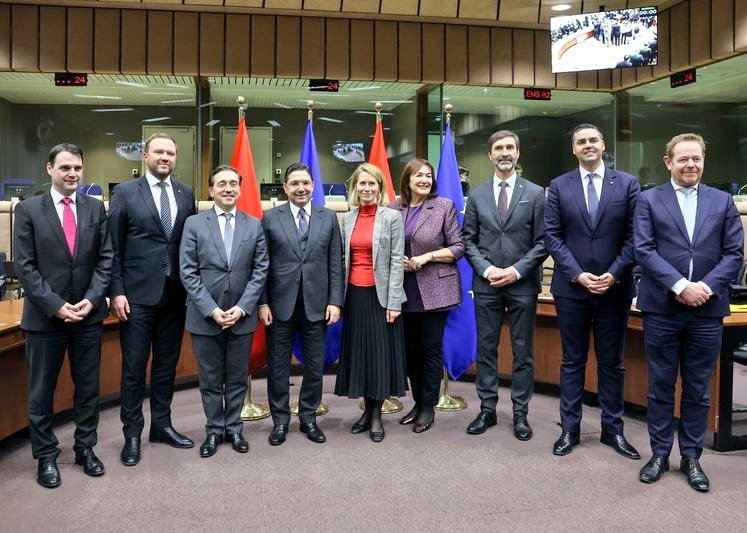
The fifteenth session of the Association Council between the Kingdom of Morocco and the European Union, held in Brussels, was not merely a routine diplomatic meeting. It emerged as a significant political moment, marked by the adoption of a new collective European position on the issue of the Moroccan Sahara, granting Morocco’s autonomy initiative an unprecedented institutional weight.
The joint statement signed by Moroccan Foreign Minister Nasser Bourita and the EU’s High Representative for Foreign Affairs, Kaja Kallas, acknowledges that the Moroccan proposal for autonomy stands among the most realistic and viable solutions for achieving a definitive settlement of the regional dispute. Yet the real significance of this development lies not only in the content of the statement, but in its nature: it reflects, for the first time, a unified position of the twenty-seven EU member states.
El Consejo de Asociación UE-Marruecos celebrado hoy en Bruselas es un momento importante que refuerza las relaciones entre Europa y Marruecos.
Marruecos es un país socio, amigo y vecino de España y también de la Unión Europea. Un aliado indispensable para abordar retos comunes. pic.twitter.com/9LC1k6rSKA
— José Manuel Albares (@jmalbares) January 29, 2026
This shift represents a departure from years of ambiguity and fragmented stances, moving the issue from the realm of individual national positions to that of a consolidated European policy. What is at stake is no longer cautious diplomatic language, but an institutional endorsement of a pragmatic Moroccan approach.
The European Union has also aligned its position with the United Nations framework, urging all parties to engage in serious political negotiations, without preconditions, on the basis of Morocco’s autonomy initiative. This convergence between Moroccan diplomacy, UN legitimacy and European consensus gives the new stance a reinforced international credibility.
Furthermore, the joint statement welcomed Morocco’s readiness to clarify the concrete mechanisms for implementing autonomy within its sovereignty, signaling a transition from a conceptual proposal to an operational political project capable of addressing development and stability needs.
The explicit reference to UN Security Council Resolution 2797 (2025) confirms that the Moroccan plan is now perceived as the realistic foundation of the UN-led process. In this context, the autonomy initiative is no longer one option among many, but increasingly the only credible solution supported by an expanding international momentum.
Ultimately, the new European position reflects a growing awareness that resolving the dispute requires a pragmatic approach that respects Morocco’s territorial integrity while ensuring regional stability. It also paves the way for a strategic redefinition of Euro-Moroccan relations, based on renewed political trust and shared interests.


