

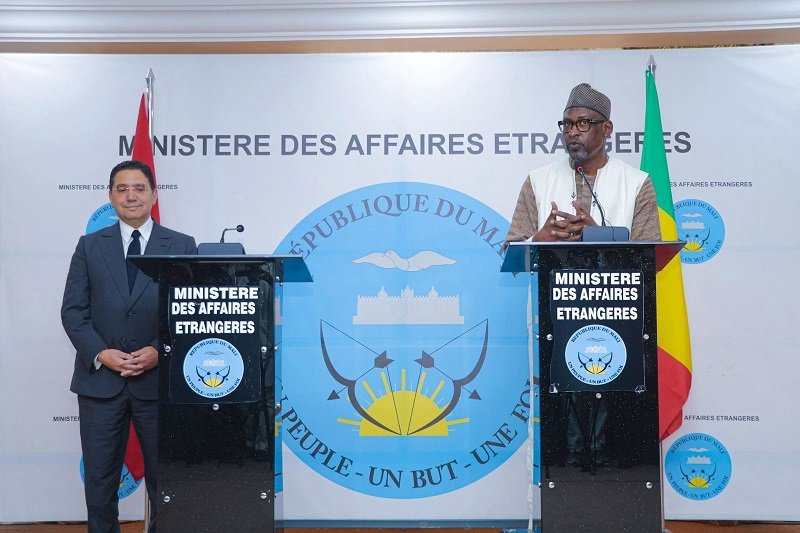
At a decisive regional turning point, marked by accelerating geopolitical transformations across the African continent, the potential shift in the position of Mali on the Sahara issue emerges as a signal that goes beyond its apparent diplomatic dimension, revealing a deep reconfiguration of power balances and alliances within the Sahel-Saharan space. A state that historically served as one of the platforms for the dissemination of the separatist thesis now appears on the verge of reassessing its positioning, granting Rabat not merely an additional point of support, but what resembles a “strategic lever” within Africa.
This shift cannot be interpreted in isolation from the gradual erosion of the legitimacy of the Polisario Front within the African system, where recognition of it no longer enjoys the same momentum that characterized the 1970s and 1980s. In contrast, the Moroccan approach, based on the autonomy initiative, continues to expand its circle of acceptance, benefiting from an active diplomatic dynamic and the repositioning of several African states according to economic and security interests rather than ideological alignments.
Within this context, Mali’s position gains strategic significance as it may open the door to a “domino effect” across the region, particularly in Mauritania, which remains in a sensitive position between historical balances and increasing geopolitical pressures. Moroccan-Mauritanian relations are no longer merely traditional ties; they have evolved into an intertwined network of economic and logistical interests, ranging from trade corridors to infrastructure projects, making any shift in Nouakchott’s stance a natural extension of the growing rapprochement with Rabat.
However, a deeper reading reveals that the stakes are no longer solely diplomatic, but have become primarily security- and development-driven. The stability of the axis linking Rabat to Nouakchott, passing through the Sahel region, constitutes a decisive factor in addressing cross-border threats, from terrorism to irregular migration. In this framework, political rapprochement becomes a tool for reengineering the regional space, rather than merely a form of temporary coordination.
Historically, Mali holds a particular symbolic significance in this conflict, having hosted key negotiation stages in the late 1970s, in parallel with the aftermath of the Mauritania’s withdrawal from Oued Eddahab 1979. This legacy gives any shift in its position additional weight, as it enables a reinterpretation of the past through the lens of the present and lays the groundwork for a redistribution of roles across the continent.
Conversely, this shift is part of a broader wave of international repositioning, as several states move toward reviewing their recognition of entities not recognized by the United Nations, amid the rise of pragmatic approaches that place stability and development at the forefront of priorities. Within the African Union, this dynamic is reflected in the declining number of states supporting the Polisario, alongside the growing prominence of the Moroccan proposal in both formal and informal discussions.
Yet the deeper impact of this trajectory remains tied to its implications for regional balance, particularly for Algeria, which finds itself facing a diplomatic environment increasingly less favorable to its traditional positions. Each withdrawal of recognition, or even its suspension, does not merely represent a symbolic loss, but redraws lines of influence across Africa and reduces room for maneuver in a long-standing conflict.
Thus, the anticipated shift in Mali’s position does not appear as an isolated event, but rather as part of a broader process of profound reconfiguration of a regional landscape gradually moving toward a new logic: one in which legitimacy is measured by the capacity to produce stability, and alliances are built on the basis of mutual interests rather than historical slogans.


