

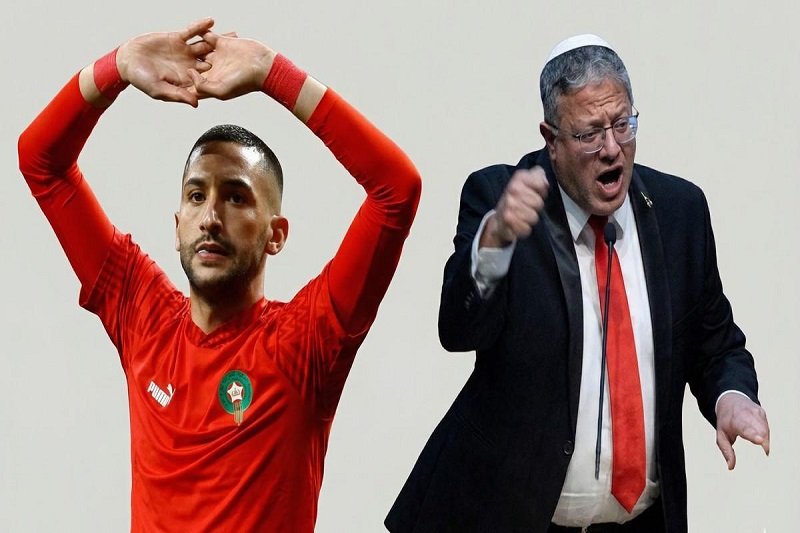
In early April 2026, a social media post by Moroccan football star Hakim Ziyech, who plays for Wydad AC, triggered a political and media storm that spread far beyond the world of sports. Ziyech shared a photo of Itamar Ben‑Gvir, Israel’s National Security Minister, at a moment related to recent legislation in the Israeli parliament and questioned the moral justification behind it. What began as a personal expression quickly escalated into a public clash between the athlete and a key Israeli official, drawing in political actors, media outlets, and ordinary citizens from multiple societies. This controversy has become a vivid example of how athletes’ voices can intersect with geopolitics in the digital age.
Ziyech’s post referenced a controversial new law passed by the Israeli Knesset on March 30, 2026, which introduces the death penalty as the default punishment for Palestinians convicted of deadly attacks in military courts, particularly in the West Bank. He captioned the image with a pointed question about whether Ben‑Gvir would again characterize the law as a form of “self‑defense,” implicitly criticizing both the legislation and the minister’s political position.
Ben‑Gvir responded forcefully on social media and in interviews, labeling Ziyech an “anti‑Semitic player” and warning that “Israel will no longer deal cautiously with its enemies,” and that the new law would be applied firmly. The exchange quickly became more than a disagreement over wording; it evolved into a political confrontation that reflected deeply rooted tensions in the region.
The Law That Sparked the Storm
The law at the center of this controversy was approved in the Israeli parliament by a vote of 62 in favor and 48 against. It mandates that Palestinians convicted of lethal so‑called “terrorism” offenses in military courts face the death penalty by hanging, with executions required to be carried out within 90 days of sentencing — without the possibility of pardon or clemency provisions that are standard in many jurisdictions. The bill was heavily promoted by Ben‑Gvir and is part of a broader political agenda supported by the governing coalition.
Under the law, military courts in the occupied West Bank would regularly impose capital punishment on Palestinians, while critics note that Israeli civilians accused of similar crimes would not face the same default sentence — a point that has been widely criticized by human rights organizations and governments abroad.
The legislation has reignited global debates over justice and equality under the law, prompting legal challenges within Israel. One recent petition filed with the Israeli High Court argues that the statute should be struck down as unconstitutional, challenging its application in military law and calling for urgent judicial intervention before implementation.
International and Legal Backlash
The law’s critics have been vocal both regionally and internationally. The United Nations High Commissioner for Human Rights described the measure as violating international humanitarian law and urged its repeal, stating that it raises serious concerns about due process and discriminates based on national identity.
A group of eight Muslim‑majority countries — including Pakistan, Turkey, Egypt, Indonesia, Jordan, Qatar, Saudi Arabia, and the UAE — issued a joint statement condemning the legislation as a “dangerous escalation” likely to further inflame tensions and undermine prospects for peace. These governments emphasized the urgent need for restraint and respect for international norms.
Human rights advocacy organizations have also decried the law as discriminatory. Independent groups such as the Palestinian Al‑Mezan Center for Human Rights have described the legislation as a racially biased tool that denies basic legal protections and could be considered a violation of international conventions against racial discrimination and arbitrary sentencing.
Political and Public Reactions Beyond Israel
The controversy has not remained confined to Israel and Palestine. In Morocco, political figures and parties have publicly come to Ziyech’s defense, framing his comments as an expression of moral and humanitarian concern rather than an attack on an entire people. This reflects a broader sentiment in parts of the Arab world, where public opinion often strongly supports Palestinian rights.
Public demonstrations in Morocco and elsewhere have also shown support for the footballer, with crowds waving his images during gatherings that express broader opposition to policies perceived as unjust or discriminatory. Through these reactions, the dispute has transcended the original social post to touch on larger narratives of justice, identity, and international solidarity.
Media and the Changing Role of Athletes
Responses from media outlets internationally underscore the evolving role of athletes in public discourse. Some commentators have criticized Ziyech for “politicizing sports,” while others defend his right to speak out on issues of human rights and public policy. This incident illustrates how figures with significant public followings can influence political narratives and public discussion in ways that were once the domain of traditional political actors.
In today’s media environment, a single post can reverberate across nations, challenging the boundaries between sports, politics, ethics, and diplomacy. The Ziyech–Ben‑Gvir episode highlights how interconnected these realms have become, and how modern public figures navigate — and sometimes provoke — debates on justice, policy, and international relations.


