

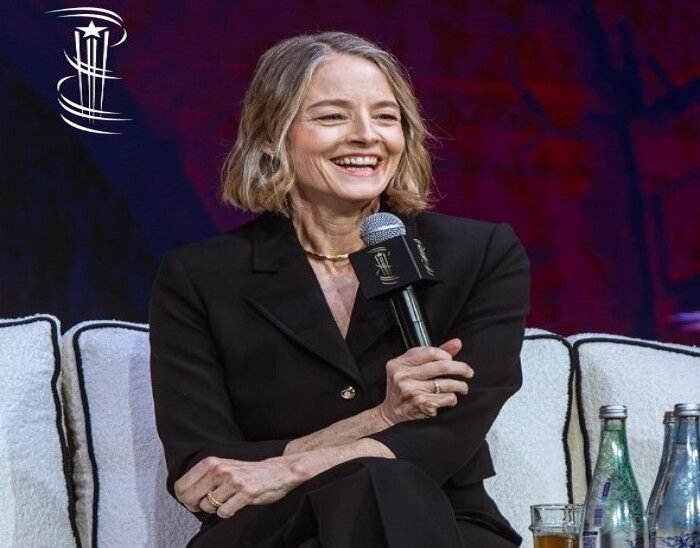
Jodie Foster’s appearance in the “Conversations” segment of the 22nd Marrakech International Film Festival was far from a fleeting moment. It resembled a cinematic scene where the audience — and perhaps she herself — witnesses the intricate details of a being who has lived under the spotlight since the age of three, yet truly understood the act of acting only at twelve.
What she shared in Marrakech was not a conventional autobiography, but an introspective analysis of an existential journey, revealing an actress navigating both her craft and her consciousness.
1. The child pulled from innocence into the camera’s gaze
Foster stated with a clarity bordering on starkness:
“I never chose to be an actress. The job was chosen for me before I could even remember anything about myself.”
Her career, then, did not begin from passion but from an imposed destiny. As a child, she was asked to cry “like her grandfather” without guidance. She describes her early adaptation as a “survival mechanism,” developing emotional depth while her natural disposition leaned toward intellect and reflection.
The critical question emerges:
Is an actor born or made?
Foster suggests that sometimes, an actor is forged by the necessity to survive a role, long before consciously embracing it.
2. Seeing oneself from the inside and the outside
One of the most striking statements she made was:
“When you start working before you have memories, you only learn to see yourself from the inside and the outside at the same time… and it’s a kind of blessing.”
She is not merely describing acting, but a fundamental human experience: living while simultaneously observing one’s own life, where self-awareness becomes both a tool and a burden.
Thus, when she admits:
“I don’t know if it made me crazier… or more sane,”
it is not humor, but the acknowledgment of an intrinsic duality in the artistic experience.
3. Loving cinema, not just acting
Asked how she maintains enthusiasm after decades of roles, she answered:
“I love cinema. That’s the secret. If I were on a deserted island, I wouldn’t act, but I would watch films.”
This distinction is crucial: Foster is not a “stage girl” in the traditional sense. For her, cinema is philosophy, a mirror, an archive of the human soul, whereas acting remains an intense, demanding challenge.
She therefore chooses her roles carefully, seeking projects that unexpectedly enrich her, not merely those she decides to pursue.
4. Female heroes and the legacy of second-wave feminism
She confessed:
“When I was young, I wanted the film to be about me. I didn’t want to be anyone’s sister, daughter, or girlfriend… I was influenced by second-wave feminism.”
Here, Foster emerges as a cinematic project in her own right: a child star grown into a woman constructing her own heroine, refusing to be a subordinate figure. She acknowledges her early self-centeredness as both a personal trait and an act of resistance against an industry that long reduced women to emotional functions.
5. Why so many victim roles?
One of her most candid admissions:
“I played many victims… without really knowing why.”
This reveals a later awareness of the invisible structures shaping role selection, especially for actresses: market demands, the male gaze, audience expectations, and unspoken personal wounds.
Looking back allowed her to reclaim agency over her choices.
6. “Taxi Driver”: the awakening to true acting
Foster recalls learning alongside Robert De Niro in cafés and hotels. She was initially surprised by his muteness and apparent ordinariness. The transformation occurred during their third improvised session, where she realized that bringing something of oneself to the character is the essence of acting.
At twelve, she understood: “It’s my fault the character doesn’t yet exist.”
The revelation was complete: acting is not merely delivering lines, but inhabiting and enriching the life of the role.
7. Between profession and existence: a conscious choice
When Foster says:
“If I were on a deserted island, the last thing I would do is act,”
she does not reject the profession but reveals the unvarnished truth about acting: it is not a natural instinct, but an enormous psychological and emotional effort.
This explains why she selects projects with care, interspersed with long periods of withdrawal and reflection.
Analytical Summary: What Jodie Foster Truly Conveyed in Marrakech
-
Acting did not stem from desire but from imposed survival.
-
The actor’s greatest challenge is not the role, but embodying the self.
-
For women in cinema, a role is a struggle for identity, not a subordinate function.
-
True passion is not for the camera, but for cinema as an art form.
-
Talent emerges when we stop waiting for a role and start constructing it ourselves.


