

The analysis published by the Spanish newspaper La Razón regarding Morocco’s regional role goes beyond descriptive reporting to frame the kingdom within a broader geopolitical architecture where security, religion and diplomacy intersect. In this perspective, Morocco is not portrayed as a marginal actor but as a stabilizing force whose influence extends from the Sahel to the evolving security arrangements in Gaza, while also encompassing the Sahara issue and its strategic partnership with Washington.
According to this reading, Morocco plays a proactive role in monitoring and containing the movements of Salafi-jihadist groups operating in the Sahel region. This function cannot be separated from geography: the kingdom’s internal stability has direct implications for the northern Mediterranean shore, particularly Spain and Europe. It is within this context that the United States considers Morocco an advanced buffer against the expansion of extremist networks — not only to safeguard its own interests, but also to indirectly reinforce security in southern Europe.
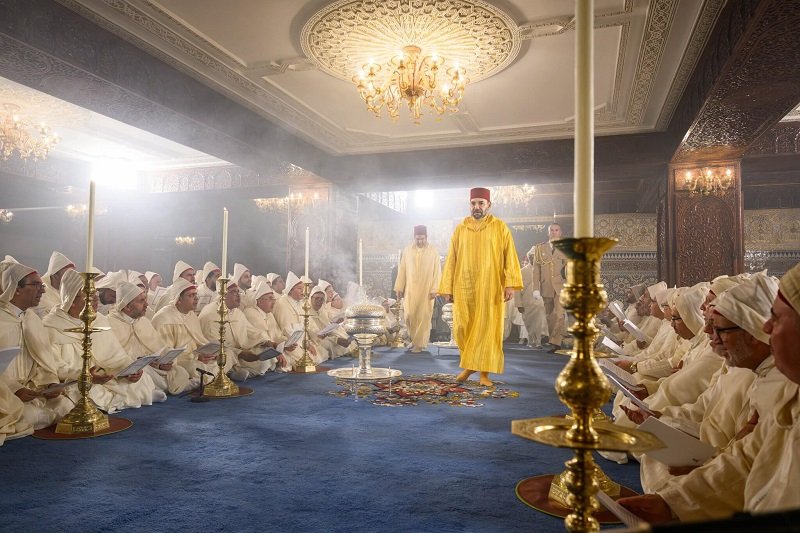
This security posture rests on a defining pillar: the Moroccan religious model. Based on the Maliki school of jurisprudence and Sunni Sufism, institutionalized through the framework of the Commandership of the Faithful, this model differentiates itself from radical Salafi currents active in parts of the Sahel. The religious dimension here is operational rather than symbolic. It is implemented through imam training programs, religious cooperation with African states, and the promotion of an institutional form of Islam intended to strengthen social resilience against extremism.
Morocco’s strategy therefore combines soft power through religious diplomacy with hard power modernization, including the strengthening of military capabilities and enhanced intelligence cooperation. The gradual retreat of French influence in Francophone Africa, coupled with Spain’s limited footprint on the continent, has opened a strategic space that Rabat has gradually consolidated with American backing. In this competitive environment, the modernization of Morocco’s armed forces forms part of a broader regional balance shaped by strategic rivalry and an arms dynamic — particularly vis-à-vis Algeria.
US support for the autonomy initiative in the Western Sahara dispute fits into this framework. From Washington’s perspective, endorsing a pragmatic and negotiated solution contributes to consolidating a reliable partner in a sensitive region. The connection between territorial stability and strategic alignment reinforces the idea that security cooperation functions as a key diplomatic lever in Moroccan-American relations.
Regarding Gaza, La Razón highlights another dimension of Morocco’s strategic positioning. The Washington meeting held on February 19 to discuss security and stabilization prospects in Gaza demonstrated, according to the newspaper, Morocco’s political relevance in international coordination mechanisms. Although the kingdom is not among the largest financial or military contributors to a potential stabilization force, it possesses a distinctive advantage: its ability to engage with actors that hold divergent positions.
Morocco maintains full diplomatic relations with Israel since the normalization agreement resumed in 2020, while simultaneously preserving its historical commitment within the Al-Quds Committee and sustaining a political discourse supporting Palestinian rights. This dual positioning grants Rabat diplomatic flexibility and allows it to operate within post-conflict arrangements as a facilitator capable of bridging gaps between conflicting stakeholders.
Through this lens, Morocco emerges as a state managing strategic balances through pragmatism: consolidating an institutional religious model, modernizing defense capacities, diversifying international partnerships and adapting to shifting regional configurations. Nevertheless, this trajectory raises questions about sustainability and autonomy within a global environment marked by intensifying competition and geopolitical volatility.
Ultimately, La Razón’s reading situates Morocco within a structural repositioning process — one where geography, alliances and institutional identity are transformed into instruments of regional influence spanning the Sahel and Gaza alike.


