

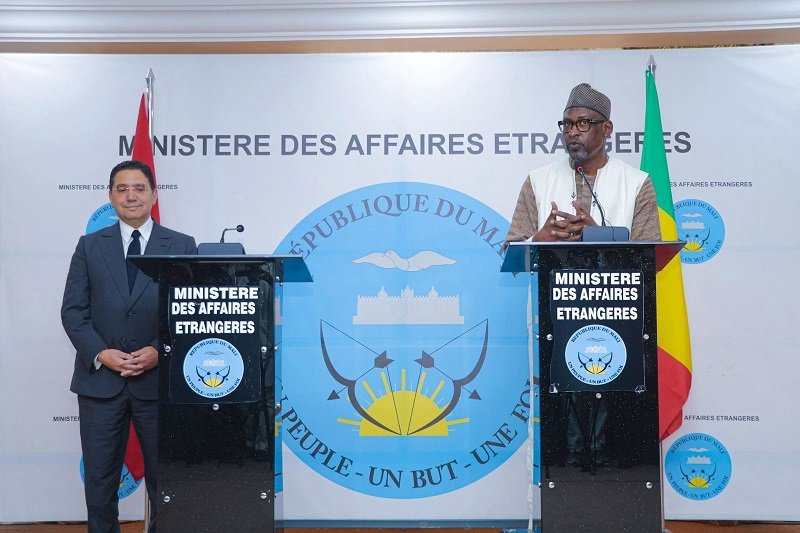
In a context that, at first glance, appeared technical and diplomatically cold, Bamako was in the process of repositioning itself within a complex regional conflict map—one that cannot be measured solely through foreign ministry statements, but through the intersections of security, economy, and sovereignty…
Mali’s decision to withdraw its recognition of the so-called “Sahrawi Republic” was not merely an adjustment of a 42-year-old diplomatic stance, but rather an announcement of a strategic shift reflecting a transition from a logic of historical alignment to one of direct interests and a redefinition of priorities in the Sahel region.
The statement issued by the Malian government left no room for interpretation. Beyond withdrawing recognition, Bamako went further by explicitly supporting the autonomy proposal put forward by Morocco, considering it “the only serious and credible basis.” This formulation, which aligns with United Nations Security Council resolutions—particularly Resolution 2797 adopted in October 2025—reveals that Mali’s shift is not isolated, but part of a growing international dynamic that is repositioning several states on this issue, based on political realism rather than ideological slogans.
However, a deeper reading of this shift requires going beyond the text to the broader context. Since the transitional authorities led by Assimi Goïta came to power in 2021, signs of gradual rapprochement with Rabat began to emerge, culminating in Mali’s participation in the Atlantic Initiative launched by Mohammed VI. This initiative aims to break the geographic isolation of Sahel countries by providing strategic maritime access through Dakhla. Here, the issue goes beyond diplomacy—it is about redrawing the maps of economic and logistical influence in West Africa, where access to the sea is shifting from a geographic advantage to a decisive instrument of sovereignty.
Conversely, relations with Algeria were moving in the opposite direction. The chronic tension between Bamako and Algiers, rooted in the issue of northern Mali and the Azawad region, reached its peak with the downing of a Bayraktar TB2 drone in April 2025. This incident was not merely a military event, but a revealing moment of deep mistrust: Mali saw it as a direct violation of its sovereignty, while Algeria framed it as a defense of its borders. Between these two narratives, what remained of communication channels collapsed, turning the crisis into an open diplomatic rupture.
Within this context, Mali’s decision becomes understandable as part of a broader equation: a strategic repositioning in response to rising security pressures, and a search for partners capable of providing tangible support—whether in combating armed groups or advancing development projects. It is precisely here that the contrast between two models becomes clear: an Algerian model accused—by Bamako—of playing on Mali’s internal contradictions, and a Moroccan model presenting itself as a partner in stability and development through integrated economic and security initiatives.
Thus, the issue is not merely the “loss” of a traditional ally, but the collapse of an entire narrative built on the stability of alignments within the African continent. Mali, long classified among the “traditional” supporters of the separatist stance, has chosen to redefine its national interest outside that framework—even at the cost of reshaping its regional relationships.
At the heart of this shift lies a striking paradox: the drone incident, whose value does not exceed five million dollars, has become a symbol of the breakdown of diplomatic balances that had endured for four decades. Yet in reality, it is not the cause, but merely a trigger that exposed the fragility of alliances rooted more in legacy than in interests.
Thus, between a carefully worded diplomatic statement and a border conflict spoken in the language of weapons, a deeper story emerges: that of a region rewriting its alliances under the pressure of security and development, and of a Sahara issue that is no longer just a UN file, but a mirror reflecting shifts in power dynamics across Africa.


