

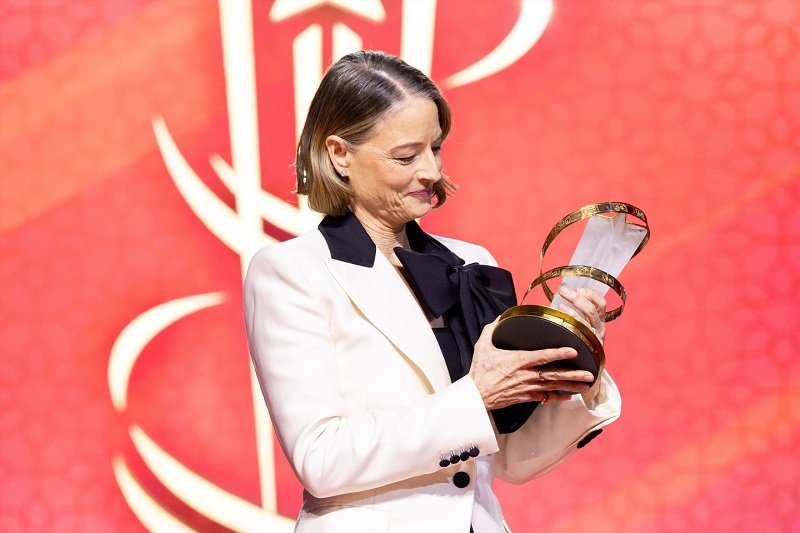
On that night, Marrakech did not simply welcome an international icon. The city seemed to enter into a quiet conversation with cinema’s own memory.
The tribute to Jodie Foster was not a social ritual; it was an invitation to revisit a journey that has shaped much of what we cherish in film today.
Foster, who began as a child actress before becoming one of the sharpest and most emotionally intelligent performers of her generation, was not honored for longevity alone. She was honored for the fearlessness of her choices: the bold roles, the breaks with convention, and the unwavering commitment to artistic integrity in an industry that often rewards conformity.
The room lit up when Korean filmmaker Bong Joon-ho presented her with the Golden Star. The encounter brought together two distinct filmic worlds: Bong’s social realism and Foster’s psychological depth. It was a moment where cinema, freed from geography, spoke in its purest form.
Then came the surprise message from Martin Scorsese, adding an almost historical layer to the evening. When one of the masters of American cinema salutes an artist he considers essential, the tribute can no longer be seen as protocol—it becomes an act of artistic acknowledgement.
But behind this celebration lay something deeper about Marrakech itself. Over two decades, the festival has become a crossroads where major filmmakers come not only to be honored, but to engage in a broader reflection on creation, memory, and the future of cinema.
The homage to Jodie Foster was not mere celebration.
It was a cinematic statement: true artistic greatness is not measured by glamour or numbers, but by the ability to question the world, touch the human spirit, and endure through time.
On that night, Foster was not just the guest of honor—she was a living reminder of what it means to remain faithful to one’s artistic core.


