

Several indicators, notably a report published by the British newspaper Rutland Herald, suggest that the United States now sees Morocco not only as a political partner in North Africa but also as a strategic platform providing direct access to over one billion consumers spanning Africa, Europe, and the Mediterranean basin. This shift in American perspective explains the growing interest in supporting investment across all regions of the Kingdom, including the southern provinces—a strategy closely linked to recent diplomatic developments.
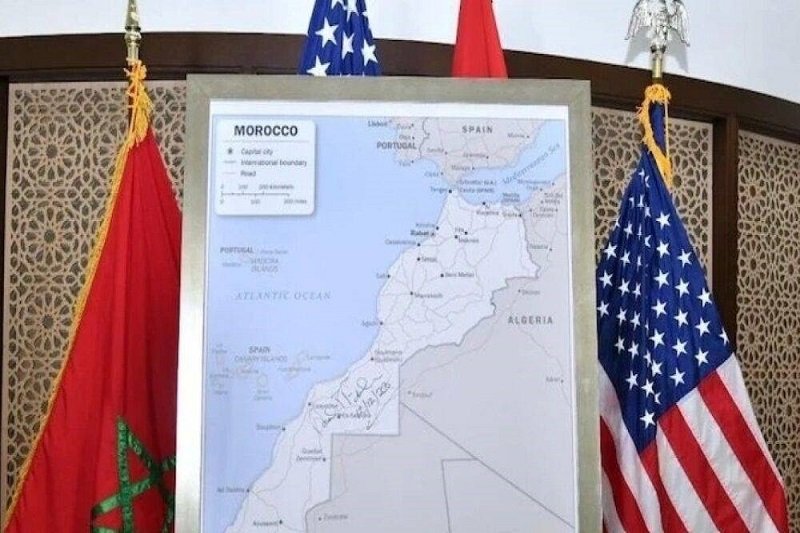
According to the report, U.S. Deputy Secretary of State Christopher Landau reaffirmed on September 25 Washington’s support for American companies wishing to invest in Morocco, emphasizing that this support covers the entire Moroccan territory, including the Sahara. These statements go beyond routine protocol; they signal a clear political and economic message: the United States views the southern provinces as viable investment zones within a legal and political framework it considers clear and stable, especially following the recognition of Moroccan sovereignty over the Sahara in 2020.
Morocco, from the American perspective, combines a strategic geographic location with a network of free trade agreements with the U.S., the European Union, and several African countries, giving American investors direct access to a market exceeding one billion consumers. This context clarifies the selection of priority sectors, which align with U.S. goals in energy transition and sustainable development.
At the forefront is renewable energy, with the southern provinces offering substantial solar and wind potential. Supporting projects in this field is seen as a logical extension of U.S. energy policy in Morocco, particularly since American development institutions have already financed clean energy projects within the Kingdom.
The infrastructure and logistics sector emerges as the second strategic axis. Major projects, such as the Atlantic Port of Dakhla, strengthen the Sahara’s role as a hub linking African supply chains to international markets—a key asset for American companies operating in transport and logistics.
The report also highlights agriculture and agro-industry, where Morocco is already a significant U.S. trading partner. Concrete opportunities exist to expand investments in agricultural processing, fisheries, and agri-tech, enhancing food security and creating new economic prospects.
Finally, the minerals and strategic materials sector draws attention. Morocco is a global player in phosphate and is developing exploration of other minerals used in renewable energy and advanced technologies, opening new investment avenues in the southern provinces and impacting the regional and international investment landscape.
This reading of the U.S. shift goes beyond mere economics; it reflects a long-term strategy integrating political, economic, and developmental dimensions, positioning Morocco as a launch platform toward Africa and Europe, within a context that redefines the priorities of American economic diplomacy.


