

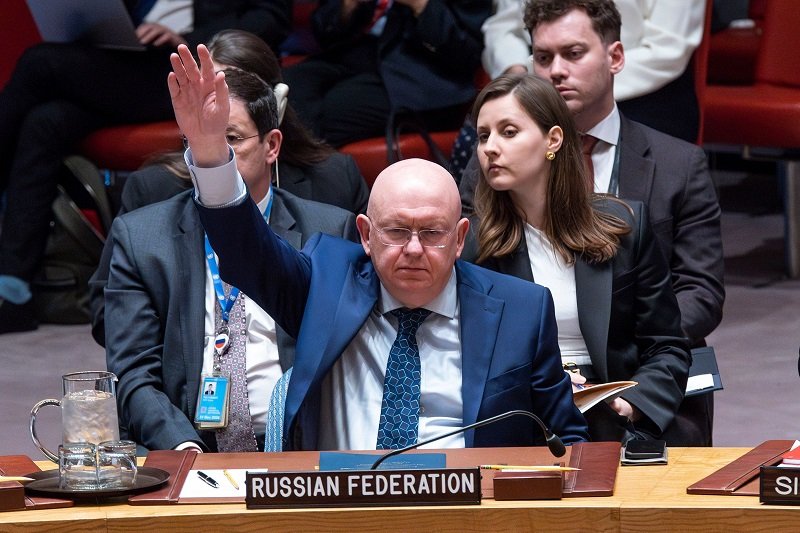
In a charged international turning point—where strategic geography collides with energy markets, and diplomacy intertwines with raw power—a UN draft resolution aimed at securing one of the world’s most critical maritime arteries, the Strait of Hormuz, has failed. This failure goes far beyond procedure; it reflects a deep political fracture after the Russia and China exercised their veto power inside the United Nations Security Council, bringing down a proposal backed by Bahrain and supported by Western powers amid an unprecedented escalation with Iran.
On the surface, it was a vote blocked by two permanent members. At a deeper level, it signals a reconfiguration of global power balances. The draft, which secured 11 votes in favor, ran into a geopolitical wall, underscoring how the United Nations Security Council has shifted from a chamber of consensus into an arena of open great-power confrontation.
In the background, tensions are being fueled by rhetoric from the United States, where Donald Trump issued an alarming warning about the possible destruction of an entire “civilization,” referring to Iran if it continues to keep the strait closed. This statement cannot be separated from an ongoing military escalation that began weeks earlier, following U.S.–Israeli strikes that prompted Tehran to tighten its grip on a corridor through which nearly a fifth of the world’s energy supply flows.
Yet beyond a maritime security crisis lies a broader struggle over legitimacy: who has the authority to secure global trade routes? Washington frames the issue as a matter of “freedom of navigation,” while Moscow and Beijing view the resolution as a pretext to legitimize expanded Western military presence under the banner of maritime security.
Statements from U.S. diplomat Mike Waltz were notably sharp, accusing Russia and China of siding with a “regime that threatens the global economy.” In contrast, China’s representative Fu Cong argued that adopting such a resolution amid threats of “civilizational annihilation” would have sent a dangerous signal. Meanwhile, Russia’s envoy Vassily Nebenzia announced that Moscow and Beijing would jointly propose an alternative resolution to reshape the framework of maritime security in the Middle East.
Here, the deeper layer of the crisis becomes visible: a clash of narratives. The West speaks of safeguarding trade and stability; Russia and China counter with warnings against the militarization of international waterways. As for Iran, it appears to be leveraging this division to ease diplomatic pressure, with its envoy Amir Saeid Iravani praising the veto as a move that prevented the “legitimization of aggression.”
Notably, even after the draft resolution was significantly softened—removing any explicit authorization for the use of force—it still failed to pass. This underscores that the opposition was not technical but fundamentally strategic. Even the notion of defensive naval escorts is seen by Moscow and Beijing as a gateway to a new military reality in the Strait of Hormuz shaped by external powers.
Ultimately, the Strait of Hormuz is no longer just an energy chokepoint—it has become a stress test for the international system itself. The Russian-Chinese veto did not merely bury a resolution; it exposed a deepening fracture in the global order, where bloc politics increasingly override consensus, and where the very definition of “security” is being rewritten according to power dynamics rather than international law.


