

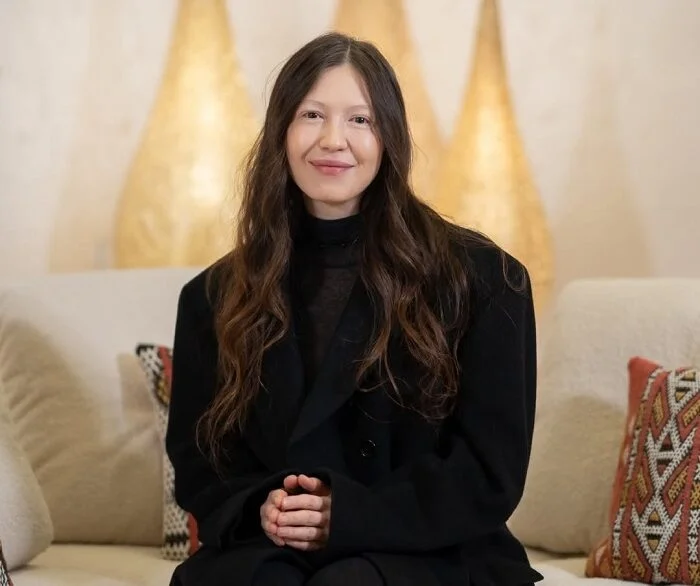
At the Marrakech Film Festival—where cinema acts as a dialogue between memory, aesthetics, and the unspoken—Russian-Chechen director Vladlena Sandu brings a work that doesn’t merely tell a story, but challenges the dominant narrative surrounding one of the darkest chapters in post-Soviet history. Her film Memory positions itself not as entertainment, but as an act of reclamation: a refusal to allow the Russian state’s version of the Chechen wars to become the final draft of history.
Sandu speaks not as a filmmaker observing from a safe distance, but as a witness—someone whose childhood unfolded within the machinery of war. For her, to explain this piece of history to the world is to restore a truth that official discourse has long tried to replace with euphemisms. What many called a “special military operation” was, in her words, a real war, one that targeted civilians and left a generation psychologically displaced.
Her aesthetic choices emerge from this lived reality. She turns to childhood memory, a territory untouched by political rhetoric, where perception remains raw, instinctive, and unbound by stereotypes. This explains her bold blending of Mozart with Dr. Alban, Enigma with Beethoven—a form freed from categorization, a refusal to adopt any predefined artistic box.
Beneath the artistic layer lies a deeper ethical question:
How do we protect children growing up in war zones? And how do we create conditions that allow them to dream of peace?
In this sense, Memory positions itself as more than a film. It becomes a conversation starter—a small but meaningful attempt to reopen a discussion that has been silenced for too long.
And in Marrakech, a city where stories intersect and memory breathes in the present, Sandu’s film finds a fitting home: a place where cinema refuses to surrender truth to the comfort of forgetting.


