

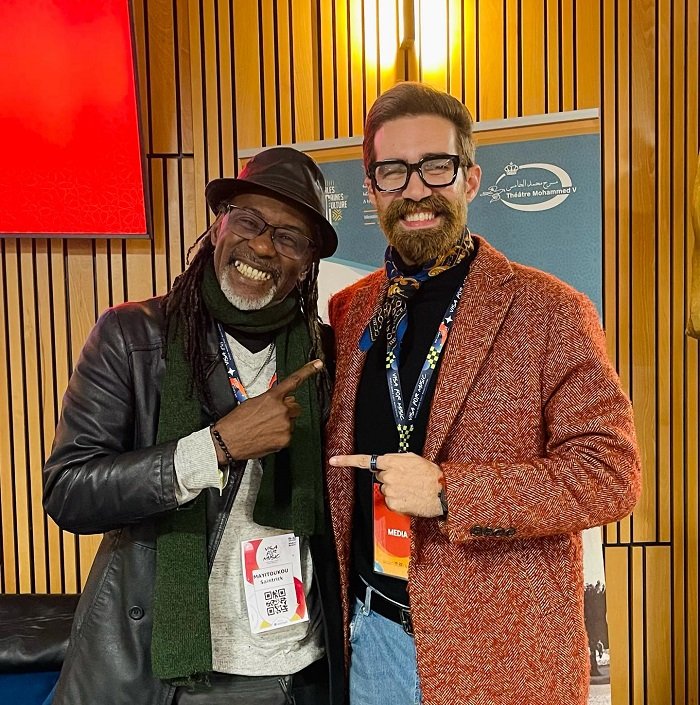
In the space of the Visa For Music festival, where the quiet paths of music from the four continents cross, the encounter with the Senegalese artist Saintrick felt like standing before an artistic entity that recognizes no borders. The man is not merely a singer or a composer; he is a complete artistic state. His voice carries history, his steps carry the memory of the continent, and he moves with the lightness of a poet and the discipline of a composer who knows exactly what he wants from art and where it is taking him.
An artist born from the soil of West Africa… yet speaking to the world
Saintrick possesses that rare ability to carry the musical heritage of West Africa — from Wolof rhythms to Songhai spirituality — and then fuse it into a contemporary form that blends global music with cultural commitment. He does not offer music solely for entertainment, but an artistic project intent on redefining African identity through art, so that Africa becomes an actor and not a receiver, a source and not merely a source of inspiration for others.
This spirit reflects his deep roots in Senegal, a country that has produced major voices in world music, from Youssou N’Dour to Baaba Maal. But unlike many artists of his generation, he insists that his art be a “shared language” between the people of the continent and the world, rejecting any reduction of Africa to stereotypical or folkloric images.
Behind the scenes of Visa For Music: a conversation about journey, identity, and artistic responsibility
During our meeting in Rabat, Saintrick revealed the details of his creative journey and how his artistic identity was shaped through stages stretching between Senegal, France, and various cultural spaces. He spoke of music as a living memory, of composition as a means of rewriting human experience, and of theatre as the natural extension of the voice when it becomes body and presence.
It was not a mere recounting of an artistic biography, but an intellectual reflection on what it means to be an artist from Africa today:
Should he settle for celebrating heritage? Or risk modernizing it?
Should he carry his voice to the world’s grand stages? Or bring it back to the alleys where it was born?
Saintrick chose both. His art belongs to the roots, yet does not surrender to them. He embraces modernity without severing his bond with the land. This makes him a truly contemporary African voice.
Art defined by the multiplicity of his talents
What distinguishes Saintrick is not simply the diversity of his talents, but the internal logic that binds them:
He is a writer who captures the small details of African life.
A composer who translates them into melodies capable of reaching others.
An actor who uses the body to express what music cannot.
Through this combination, the artist becomes an “aesthetic text” open to reading and interpretation. Meeting him becomes an experience that goes beyond traditional interviewing and turns into the discovery of identity layers that build art with poetic sensitivity and clear vision.
Why is Saintrick important today?
Because Africa — as he says — needs voices that “retell its story” away from narratives shaped by others.
Because art is no longer a luxury, but a necessity for building consciousness, confidence, and identity.
And because the world, despite its apparent openness, still knows very little about Africa’s cultural depth.
For this reason, Saintrick embodies the artist who is not just a witness to his era, but an active force within it.
Conclusion: a tribute to an artist who carries Africa in his voice
Meeting him at Visa For Music was the discovery of a creator who embodies the soul of the continent without pretension, offering an art that belongs simultaneously to two temporalities: the time of ancient storytelling and the era of rapid digital dissemination.
A captivating personality, a mature vision, and a voice that opens a window onto West Africa as we had never seen it before.
Saintrick is not just an artist; he is an artistic experience that must be followed, for it offers us — as well — the opportunity to rediscover art as a language of communication, a tool for contemplation, and a bridge linking peoples and generations.


