

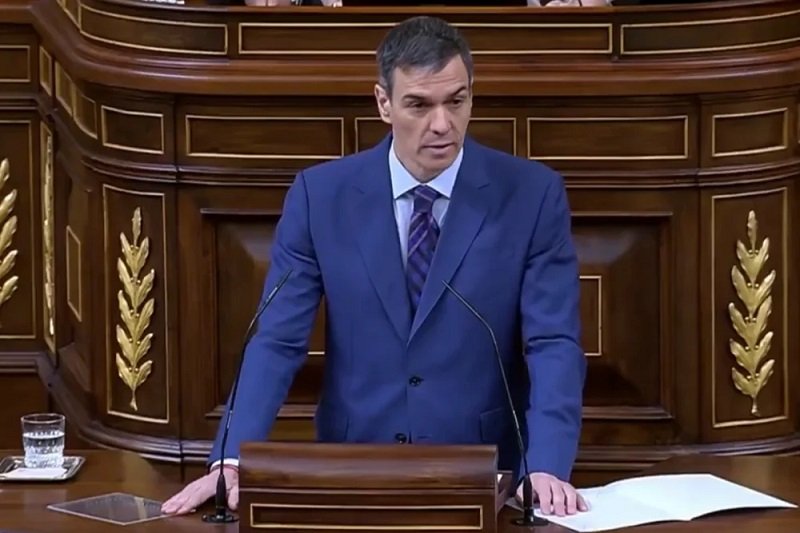
At a moment of heightened regional tension, where military dynamics intersect with political calculations, Spanish Prime Minister Pedro Sánchez addressed Parliament in Madrid with a tone that goes beyond conventional diplomatic discourse. His remarks were not confined to a situational reading of events, but instead sought to frame the unfolding developments in the Middle East as part of a broader, multi-layered escalation rather than a contained conflict.
🚨 عاجل |
صرّح بيدرو سانشيز بأن مجتبى خامنئي يتبنّى نهجًا متشدّدًا، واعتبر أنه أكثر تشددًا من والده، مشيرًا إلى دعمه لتطوير إيران لقدرات نووية، في تصريحات تعكس تصعيدًا في الخطاب السياسي. pic.twitter.com/02hLHH4Pod
— Diplomatique.ma الدبلوماسية (@diplomatique_ma) March 25, 2026
At the center of his intervention was a direct accusation against Israeli Prime Minister Benjamin Netanyahu. Sánchez argued that Netanyahu aims to inflict on Lebanon “the same level of destruction” seen in the Gaza Strip—an assertion that carries significant strategic implications, suggesting not merely a military response, but a reproducible model of warfare in which deterrence gives way to sustained destruction.
However, Sánchez did not limit his analysis to Israel. He expanded the scope to include Iran, a key actor in the regional balance. Referring to the rise of Mojtaba Khamenei, he described a shift toward a more hardline leadership—one he characterized as potentially even more “bloodthirsty” than that of his predecessor Ali Khamenei. This assessment reflects broader European concerns that internal changes in Tehran could reduce diplomatic flexibility and accelerate escalation dynamics.
The parliamentary context of these remarks further amplifies their significance. Sánchez was outlining his government’s position regarding what he described as a “U.S.-Israeli war on Iran,” a politically charged expression that signals Spain’s intent to distance itself from an escalation-driven trajectory while maintaining a critical stance toward its traditional Western allies.
Beyond rhetoric, the speech highlights a deeper transformation in the nature of conflicts in the Middle East: a shift from localized crises to open, interconnected confrontations shaped by overlapping security concerns, regional rivalries, and global strategic interests. It also underscores growing European anxiety over the broader consequences of such conflicts, including regional instability, energy security risks, and migration pressures.
Ultimately, Sánchez’s statements should not be read as a mere political position, but as part of a broader shift in the European perspective on the region—one that combines explicit criticism with a forward-looking concern about potential escalation. In an environment where balances are increasingly fragile, the question is no longer whether the conflict will expand, but how far it might go.


