

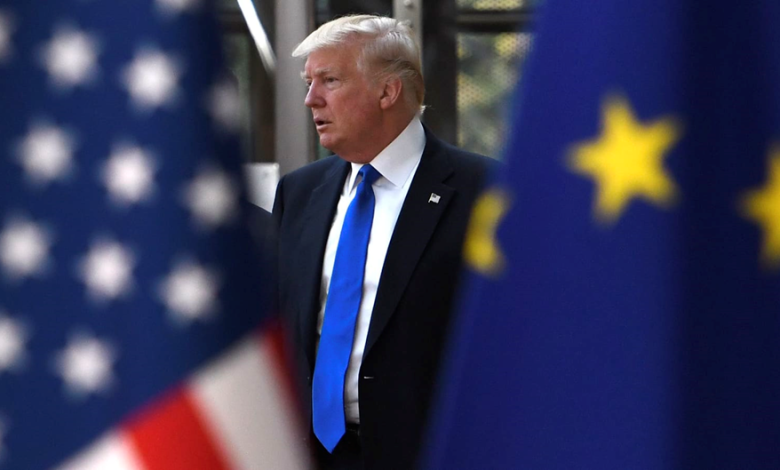
The British Financial Times published an opinion piece by John Thornhill entitled “Thanks Donald, Europe will take over from now on,” in which the writer begins by pointing out the need for the European continent to strive to break free from its ties with the United States.
Europe’s Independence
The author says, “There may come a time when Europeans will thank Trump for pushing them to do what they should have done a long time ago,” namely, “reasserting their military and technological independence”.
He adds that for years the European strategic position has been characterized by optimism and preparation for the best-case scenarios, but Trump’s message at the Davos forum recently was explicit: “Europe must prepare for the worst”, Despite Trump’s retreat from the military option against Greenland and from imposing punitive tariffs on its European supporters, “his hostility towards Europe remained sharp, and it is time for Europe to absorb this message, and to break eight decades of dependency, and take the path of self-reliance wherever possible”.
The author believes that Europe’s attempt to reduce its dependence on the United States is a very complex challenge. Many see this as impossible, given the depth of transatlantic economic, financial, technological and military ties. However, this endeavor remains an inevitable necessity, and Canada has provided a model to be emulated.
Replicating Canadian approach
The author says that the European Union has already begun to replicate the Canadian approach, by boosting investment in technology and working to expand trade partnerships with South America and India, in order to counterbalance American influence. This prompted the President of the European Commission, Ursula von der Leyen, in Davos to declare that “the time has come to seize the opportunity and build a new, independent Europe”.
Nevertheless, the author points out that it will be difficult for Europe to break free from the American technological system. According to one estimate, three American companies dominate about 65 percent of the cloud computing market in Europe, American companies also control key artificial intelligence technologies, semiconductors, search engines, social media platforms, and messaging applications within the continent.
The author believes that even if Europe cannot replace all these services with the American alternative, it can take broader steps to strengthen its technology sector, and says that deepening the single market is the greatest contribution that European leaders can make in this context, They can also work to mobilize more private growth capital to support startups and encourage governments and businesses to adopt a “buy Europe first” policy.
Europe needed an external shock
Luis Garicano, professor of economics at the London School of Economics, says that Europe “was in dire need of an external shock,” adding that if Trump’s policies succeed in bringing Europe together around practical and sensible reforms, “the region will be in a stronger position 20 years from now”.
The author, Thornhill, concludes his article by noting that despite the growing European desire for change, significant challenges remain, as Trump is deeply unpopular in Europe, However, confronting it may help undermine the influence of populist nationalists, who have a strong presence on the continent. Just as Eastern pressures forced Europe to unite during the Cold War, threats from the West today may force Europe to reinvent itself and achieve a new renaissance.


