

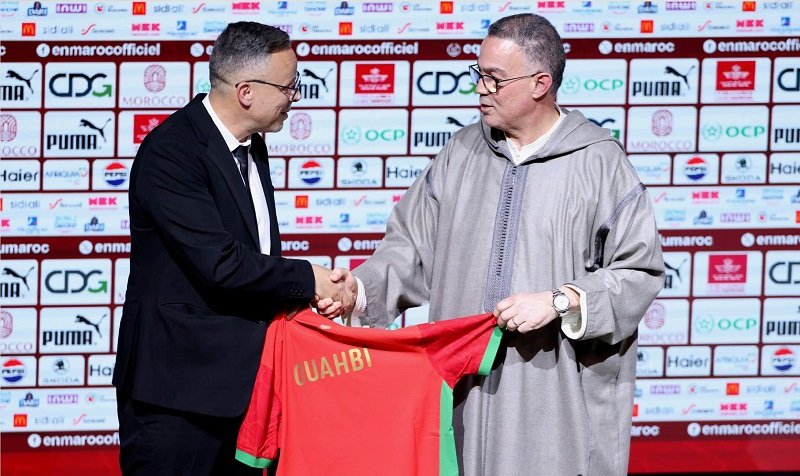
In a move whose timing appears as significant as its content, the president of the Royal Moroccan Football Federation, Fouzi Lekjaa, announced on Thursday evening in Salé the appointment of Moroccan coach Mohamed Ouahbi as the new head coach of the Moroccan national team, replacing former manager Walid Regragui.
The announcement was made during a press conference held at the Mohammed VI Football Complex.
Officially, the decision has been framed as part of a strategy aimed at “renewing the team’s momentum” ahead of major upcoming competitions, particularly the 2026 FIFA World Cup. Yet a deeper reading suggests that the decision goes beyond a purely technical change and touches on the broader management of Morocco’s rapidly rising football project.
When announcing his departure, Walid Regragui emphasized that the move was the result of a comprehensive evaluation and part of a broader effort to ensure the continued evolution of the national team. He also expressed pride in the achievements accomplished during his tenure, thanking Mohammed VI, the federation, the players, and Moroccan supporters, whom he described as the team’s “twelfth player”.
Behind the conciliatory tone, however, lies a more complex reality. Morocco’s recent football success has dramatically raised expectations surrounding the national team. As a result, every decision related to the Atlas Lions is now viewed not only through a sporting lens but also through strategic and symbolic perspectives.
For Fouzi Lekjaa, one of the most influential figures in African football governance, managing the national team has become part of a broader national sports strategy. In this sense, the coaching change can be interpreted as an attempt to recalibrate the project before entering the crucial stage of World Cup preparation.
The choice of Mohamed Ouahbi is far from accidental. The coach has emerged in recent years as one of the most promising figures in Moroccan football management, particularly after leading the under-20 national team to a historic world title. That achievement strengthened his reputation as a coach capable of developing talent, structuring tactical systems, and managing long-term projects.
However, moving from youth teams to the senior national team represents a completely different challenge. Media pressure, public expectations, and the management of a dressing room composed of players competing in Europe’s top leagues will all test the new coach’s leadership.
The challenge is even greater considering Morocco’s group in the 2026 FIFA World Cup, which includes the national teams of Brazil, Scotland, and Haiti — a group that could prove highly competitive.
Before that global stage, Morocco will face the national teams of Ecuador and Paraguay in friendly matches during March, which will serve as the first practical test for the new technical staff.
Ultimately, the decision opens a new chapter in Morocco’s football journey. Yet it also raises a deeper question: is this merely a coaching change, or the beginning of a new phase in Morocco’s ambition to transform a historic football breakthrough into a lasting global football power?


