

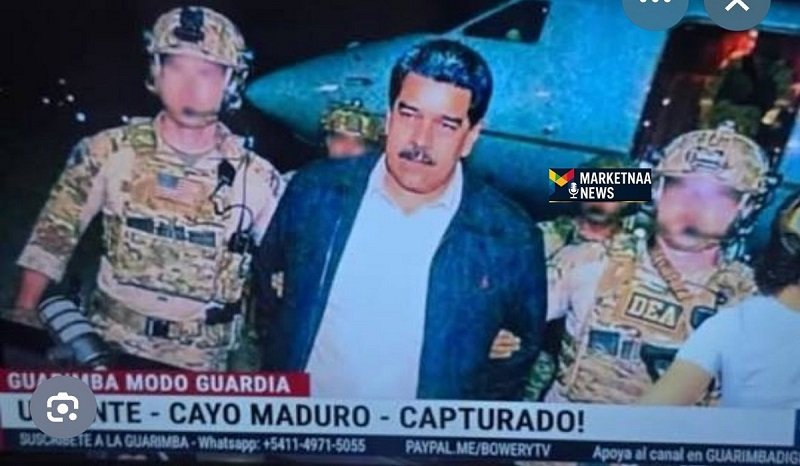
U.S. President Donald Trump announced, in a statement that sent shockwaves across diplomatic and political circles, that the United States had carried out what he described as a “large-scale operation” targeting Venezuela’s political leadership, resulting in the arrest of Venezuelan President Nicolás Maduro and his wife, and their transfer outside the country.
STATEMENT FROM PRESIDENT DONALD J. TRUMP pic.twitter.com/nHDqtsqRFh
— Karoline Leavitt (@PressSec) January 3, 2026
In a post published on his platform Truth Social, Trump claimed that the operation was conducted in direct coordination with U.S. law enforcement agencies, without disclosing the exact nature of the intervention or the legal framework under which it was carried out. He added that further details would be revealed during an upcoming press conference at Mar-a-Lago.
ترامب عن عملية اعتقال الرئيس الفنزويلي مادورو :
"لم أرَ شيئاً كهذا من قبل، لقد تمكنت من مشاهدته في الوقت الفعلي، وشاهدت كل جانب منه، كان من المذهل رؤية هذا المستوى من الاحترافية، جودة القيادة، كان أمر مذهل". pic.twitter.com/TujHXgYe6r
— Diplomatique.ma الدبلوماسية (@diplomatique_ma) January 3, 2026
At the time of the announcement, no official response had been issued by the Venezuelan government or by international organizations, deepening the uncertainty surrounding the claim and raising profound legal and political questions.
If confirmed, this development would not represent merely another episode in the long-standing tensions between Washington and Caracas. Rather, it would mark a potential rupture in contemporary international relations, reviving a fundamental question:
Can a state—no matter how powerful—lawfully arrest a sitting head of state? And under what authority?
Sovereignty as the Rule, Intervention as the Exception
The modern international order is built upon the principle of state sovereignty and non-intervention, enshrined in the Charter of the United Nations. Article 2 affirms the sovereign equality of states and prohibits the threat or use of force against the territorial integrity or political independence of any state.
Within this framework:
-
a head of state enjoys full sovereign immunity while in office;
-
arrest or coercive action by a foreign state is prohibited, except under narrowly defined and internationally recognized exceptions.
Those exceptions are limited to:
-
an explicit authorization by the UN Security Council under Chapter VII;
-
the right of self-defense in response to an actual armed attack.
In the Venezuelan case, no Security Council mandate exists. Moreover, allegations leveled against Nicolás Maduro—however serious—do not legally constitute an “armed attack” that would justify unilateral military or law-enforcement action across borders.
Presidential Immunity: Law Versus Political Practice
The Vienna Convention on Diplomatic Relations, together with customary international law, recognizes that heads of state benefit from absolute personal immunity (immunity ratione personae) while in office. This immunity includes inviolability and protection from arrest or criminal prosecution by foreign jurisdictions.
International legal doctrine is largely unanimous on one point: such immunity can be lifted only in two circumstances:
-
once the official mandate has ended;
-
or before a competent international criminal tribunal, not before the domestic courts of another state.
From this perspective, any unilateral action aimed at arresting a sitting head of state outside these frameworks constitutes a clear violation of fundamental principles of international law, regardless of the political or moral arguments advanced to justify it.
The U.S. Position: Domestic Law Beyond Its Borders
For years, Washington has justified its stance toward Nicolás Maduro by citing indictments issued by U.S. federal courts, particularly on charges related to drug trafficking and so-called “narco-terrorism.” Substantial financial rewards had previously been offered for information leading to his capture.
🚨🚨🚨🚨⚡️ عاجل:
البنتاغون يشن غزواً على فنزويلا…
الرئيس الفنزويلي مادورو قبل أيام:
«أمريكا لا تريد الديمقراطية… تريد نفط فنزويلا، ذهبها، وعناصرها النادرة» pic.twitter.com/7x6xCmcTzy
— الموجز الروسي | Russia news 🇷🇺 (@mog_Russ) January 3, 2026
Yet the core issue is not the substance of the accusations, but the extraterritorial projection of U.S. domestic criminal law. International law does not recognize the supremacy of national legislation over the sovereignty of other states, nor does it authorize the enforcement of domestic arrest warrants on foreign soil without consent.
This is where the shift occurs:
from law as an instrument of justice to law as an instrument of power.
Why Maduro? The Question of Selective Enforcement
The announcement inevitably raises a broader question:
Why target the Venezuelan president, while other leaders in Africa or the Arab world—facing serious allegations of corruption or human rights violations—remain beyond the reach of similar actions?
The answer lies less in legal doctrine than in geopolitical reality:
-
Venezuela is relatively isolated on the international stage;
-
it is subject to severe economic sanctions;
-
and it operates outside dominant Western alliance systems.
By contrast, other states benefit from implicit protection derived from strategic importance, regional stability considerations, or deep integration into global political and security networks—making direct intervention too costly or destabilizing.
In this sense, international law often functions not as a neutral and universally applied system, but as a framework interpreted through the prism of power relations.
Political Message or Legal Precedent?
If Trump’s announcement proves accurate, it would not establish a new legal precedent so much as reinforce a logic of permanent exception, where power reshapes the boundaries of legality. This dynamic echoes historical episodes in which security arguments eclipsed multilateral legal frameworks.
The essential question, therefore, is not only:
-
is the action lawful?
but also: -
who has the authority to interpret international law?
-
and at what point does the exception become the rule?
An Open-Ended Conclusion
The announcement of the arrest of Venezuela’s president transcends the realm of diplomatic news. It represents a revealing moment that exposes the structural fragilities of the international order—where sovereignty increasingly appears as a relative concept, contingent upon power balances rather than legal texts.
DERNIÈRE MINUTE 🇺🇸🇻🇪🔥 Les forces spéciales américaines (Delta Force) viennent d'atterrir à Caracus, #Venezuela . pic.twitter.com/5MuNw7rft5
— AES Alerte (@Aesalerte) January 3, 2026
This signal extends beyond Venezuela itself. It speaks to all states observing how, under certain political conditions, law can shift from a shield of protection into a tool of coercion.


