

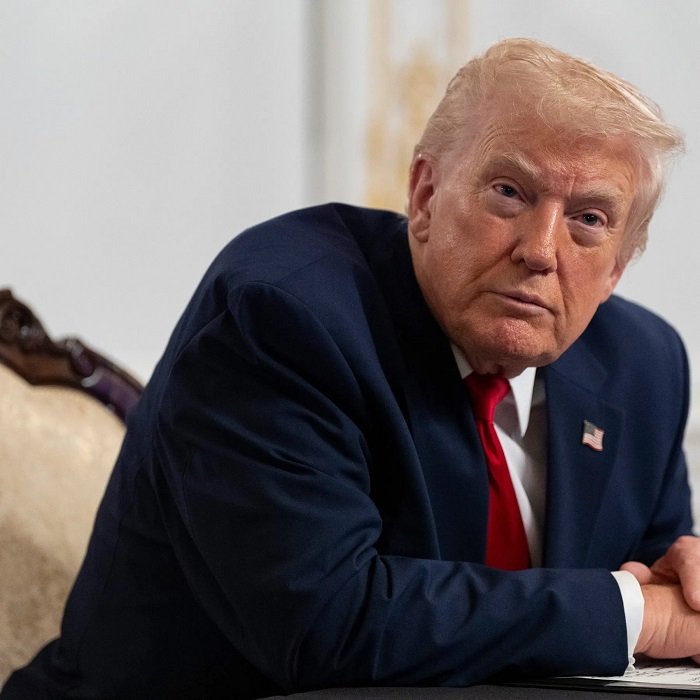
In an unprecedented political and military escalation, U.S. President Donald Trump has raised the confrontation with Iran to its highest level by declaring that no agreement with Tehran will be possible without “unconditional surrender.”
This phrase, deeply rooted in the historical memory of the end of major wars, goes far beyond a simple political statement. It signals a profound shift in Washington’s strategic approach toward Iran—and, by extension, toward the balance of power in the Middle East.
In diplomatic and military history, the concept of unconditional surrender usually appears when a conflict has moved beyond the stages of pressure or negotiation and entered a phase aimed at reshaping the defeated state itself. From this perspective, Trump’s rhetoric suggests that the objective may extend well beyond limiting Iran’s nuclear program or curbing its military capabilities.
Instead, the statement hints at a broader strategic vision: the possibility of re-engineering Iran’s political system.
This interpretation gains further weight when Trump links the idea of surrender with promises of a future economic recovery plan designed to “save Iran from the brink,” implemented by the United States and its allies. The proposal combines military pressure with economic incentives, evoking comparisons to a modern-day “Marshall Plan”—albeit one conditioned on profound political and strategic transformations.
Yet this approach raises a fundamental question: is Washington’s real objective to compel Iran to change its strategic behavior, or to transform the regime that produces that behavior?
The distinction between these two goals is crucial. The first would eventually lead back to negotiations under stricter conditions. The second implies that the current war could mark the beginning of a far deeper political transformation within Iran, a scenario fraught with uncertainty in an already fragile region.
On the Iranian side, the response has also been firm. Iranian President Masoud Pezeshkian has stated that while Iran remains committed to peace, it will never accept conditions that undermine its sovereignty or national dignity. This stance reflects a longstanding principle in Iran’s strategic culture: negotiation may be possible, but never from a position of surrender.
Here lies the central paradox of the confrontation. Washington speaks in the language of decisive strategic victory, while Tehran frames the conflict as a struggle of endurance and resistance. Between these two opposing logics, the risk of the conflict expanding across the region continues to grow.
From a broader strategic perspective, what is unfolding today may be more than a war between two states. It could represent a struggle over the future architecture of the Middle Eastern regional order.
If the United States succeeds in imposing its vision, a new geopolitical balance may emerge in the region. But if Iran manages to absorb the shock and maintain internal cohesion, the outcome could be the opposite: a Middle East characterized by prolonged instability and competing centers of power.
For this reason, Trump’s invocation of “unconditional surrender” should not be understood merely as political rhetoric. It is a strategic message directed simultaneously at multiple audiences: Iran itself, U.S. allies, and rival global powers.
At such pivotal moments in history, the real question is not simply who will win the military confrontation, but what kind of regional order will ultimately rise from the aftermath of this war.


