

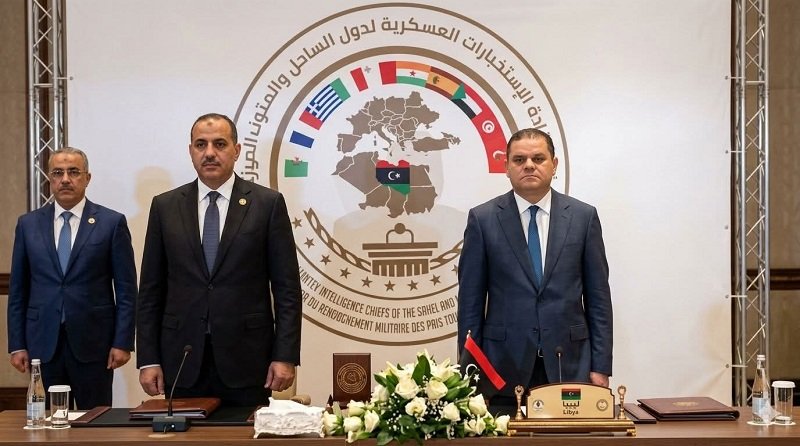
In a regional context saturated with overlapping interests and competing agendas, it is no longer possible to interpret what occurred in Tripoli as a mere “protocol mishap.” The incident involving the display of a truncated map of Morocco—excluding its southern provinces—during a high-level security meeting opens the door to deeper readings that go beyond the ظاهر of the event and into its geopolitical layers, where narrow calculations intersect with broader struggles for influence across the Sahel–Mediterranean space.
Formally, the “Conference of Chiefs of Military Intelligence of Sahel and Mediterranean Countries – 2026” was framed around coordination to confront irregular migration, organized crime, and terrorism. Yet, as is often the case, it was the overlooked details that triggered controversy: the projection of a map that touched a highly sensitive nerve in relation to the Moroccan Sahara issue.
A deeper reading, however, cannot be confined to technical error or protocol negligence. It raises a central question: was this an indirect message in a moment of internal Libyan reconfiguration, or merely an administrative slip within a fragmented environment shaped by multiple and often conflicting influences?
In this regard, it is essential to recall Morocco’s structural role in the Libyan file—a role that has been neither marginal nor circumstantial, but firmly rooted since the Skhirat Agreement, which became an internationally recognized framework for political settlement. Rabat deliberately positioned itself as a neutral mediator, privileging dialogue over alignment, as reflected in key milestones such as the Bouznika talks and the Tangier dialogue, both of which contributed to rebuilding trust among Libyan stakeholders.
This diplomatic capital has established Morocco as a discreet yet influential actor in shaping Libya’s fragile balance, particularly through the outcomes of the “6+6” joint committee meetings in Bouznika in 2023, which laid the legal groundwork for elections. In this light, any symbolic affront to Morocco’s territorial integrity within an official Libyan setting cannot be detached from this history of constructive engagement.
The paradox becomes more striking when viewed against the backdrop of recent rapprochement between Rabat and Tripoli, under the government of Abdul Hamid Dbeibeh, which benefited from explicit Moroccan support in key diplomatic moments—most notably Morocco’s backing of Libya’s candidacy to the African Union Peace and Security Council in 2025. The incident thus appears as a dissonant note within an otherwise gradual trajectory of convergence.
Beyond bilateral relations, the broader international shift regarding the Moroccan Sahara must also be considered, particularly following the adoption of UN Security Council Resolution 2797, which reaffirmed the autonomy initiative under Moroccan sovereignty as a realistic basis for negotiations. This evolving international stance has inevitably provoked reactions from regional actors for whom the issue remains a strategic lever.
From this perspective, the Tripoli incident may be interpreted as part of a subtle “symbolic war,” where protocol signals and cartographic representations function as أدوات of implicit political messaging—especially in a fragile and contested arena like Libya.
Morocco’s absence from this expanded intelligence meeting adds another layer of complexity, raising questions about the nature of the invitation or Rabat’s own strategic calculations. In certain contexts, absence itself can be a deliberate and meaningful form of presence.
At a deeper level, a broader question emerges: is what Morocco faces today a manifestation of geopolitical envy driven by its accumulated diplomatic and economic gains, or simply a natural consequence of the rise of a regional power redefining its position within the international order?
The answer likely lies in a gray zone between both interpretations. Morocco’s advances, under the leadership of Mohammed VI, across complex dossiers from Libya to the Sahel, have placed it at the heart of competitive dynamics where even the smallest detail can carry strategic weight.
Thus, a truncated map displayed in a conference hall becomes more than a visual error—it transforms into a mirror reflecting a quiet contest over influence, legitimacy, and positioning in a world where geography is no longer just about borders, but a political language in its own right.


