

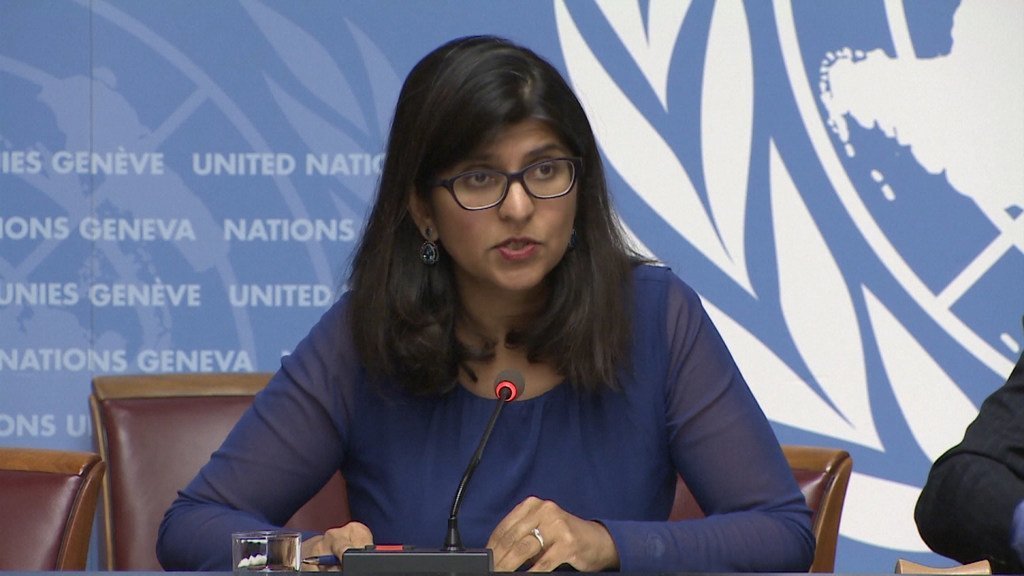
United Nations Human Rights Office spokesperson Ravina Shamdasani stated that the fear, panic, and anxiety felt by millions across the Middle East and beyond are plainly visible and, in her words, could have been entirely avoided. She added: “The situation is worsening and deteriorating hour by hour, as our worst fears are being realized”.
According to a statement distributed by the United Nations Information Centre in Cairo, a copy of which was obtained by Diplomacy Correspondent, the spokesperson explained that Volker Türk, the United Nations High Commissioner for Human Rights, is deeply shocked by the impact of the large-scale hostilities on civilians and civilian infrastructure since the outbreak of the conflict last Saturday, following attacks by Israel and the United States on Iran, Iran’s retaliation against countries in the region, and the subsequent involvement of Hezbollah in the conflict.
The Laws of War and the Protection of Civilians
According to Shamdasani, the laws of war are unequivocally clear. “Civilians and civilian objects are protected. All states and armed groups must comply with these laws”.
She added: “The High Commissioner calls on all parties to exercise maximum restraint, prevent further escalation, and take all possible measures to protect civilians, including foreign nationals, as well as critical infrastructure. A return to the negotiating table is the only way to put an end to the killing, destruction, and despair”.
She continued: “So far, in addition to Iran and Israel, hostilities have affected 12 other countries, destroying or damaging homes, offices, businesses, airports, energy infrastructure, and other civilian infrastructure”.
Casualties in Iran
Ravina Shamdasani stated that in Iran, reports from the Iranian Red Crescent Society indicate that the civilian death toll has reached 787. In the deadliest and most devastating incident, dozens of girls were killed and injured when their primary school in Minab, southern Iran, was struck during the school day. She added: “The High Commissioner calls for a prompt, impartial, and comprehensive investigation into the circumstances of the attack. Responsibility for investigating the attack lies with the forces that carried it out. We urge them to publish the findings and ensure accountability and compensation for the victims”.
She further stated: “The Iranian military responded to the U.S. and Israeli attacks by launching hundreds of missiles and drones, as well as other weapons systems, against countries in the region, resulting in civilian deaths and damage to civilian infrastructure. In the city of Beit Shemesh in central Israel, nine people were killed when a missile struck a residential area”.
Lebanon
The spokesperson for the United Nations Human Rights Office also said: “We are deeply concerned about the escalation of hostilities in Lebanon after Hezbollah launched a barrage of projectiles at Israel and Israel carried out intense retaliatory strikes, including in Beirut. We urge both sides to immediately end this major escalation of violence and return to the agreed ceasefire”.
She revealed: “Reports indicate civilian casualties and damage to civilian infrastructure, in addition to significant renewed displacement as a result of Israeli strikes in the south of the country and in Beirut’s southern suburbs. Information received suggests that around 30,000 residents fled the affected areas overnight, in addition to the 64,000 already displaced”.
She added: “International humanitarian law stipulates that any attack must comply with the fundamental principles of distinction and proportionality and that precautions must be taken to protect civilians. Attacks directed against civilians or civilian objects, as well as indiscriminate attacks, constitute serious violations of international humanitarian law and may amount to war crimes”.
Concerns About the Internal Situation in Iran
Ravina Shamdasani also stated: “Across Iran, we are extremely concerned for the population, given the government’s record of using lethal force on a large scale to suppress dissent and new threats from senior officials against any expression of opposition at this time. We remind the authorities of their obligations under international human rights law to protect the fundamental freedoms of Iranians”.
She further said: “We are also concerned that many Iranians remain unable to access the internet, limiting their access to essential information, including information necessary to seek safe shelter from the ongoing hostilities. We call for the immediate restoration of communications services”.
She continued: “We are also concerned for the safety of hundreds of political prisoners who remain arbitrarily detained in Iran. Every possible effort must be made to ensure their protection, and we urge their prompt release”.
She emphasized: “Human rights must not be exploited by any state or used as a bargaining chip. We know from painful history what brutal external force can mean for human rights. Human rights must be at the center of Iran’s future”.
The spokesperson concluded: “The High Commissioner appeals to all parties to come to their senses and put an end to this violence. He calls on all states to respect and uphold the United Nations Charter, international human rights law, and international humanitarian law”.


