

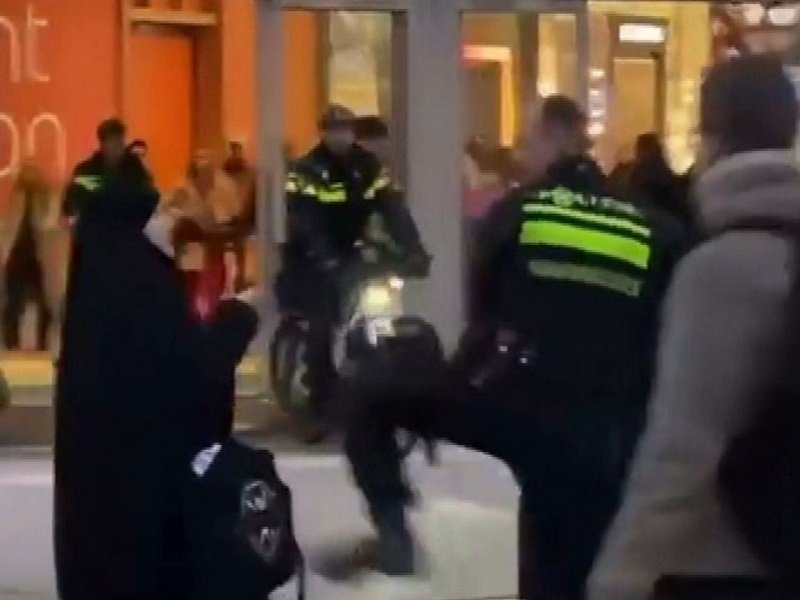
In the heart of a busy street in central Utrecht, what initially appeared to be a routine police intervention quickly turned into a major public controversy. Within hours, the incident placed the Dutch police once again under intense scrutiny and reopened a broader debate that goes far beyond the event itself: the limits of authority, latent racism, and the fragile meaning of trust between citizens and security institutions.
Footage recorded by bystanders and widely shared on social media shows a police officer dragging a veiled woman after a verbal argument. A second woman, who was filming the scene, is then kicked aside, before the officer strikes the first woman repeatedly with his baton. These short but powerful images were enough to shock Dutch public opinion, not only because of the physical violence, but also because of the symbolic identity of the victims: two Muslim women in a public space that is supposed to guarantee safety and neutrality.
The victims’ testimony adds an even more troubling layer to the case. Alongside the physical assault, they report being subjected to racist insults, including the phrase “you do not belong to this country”. Such statements shift the incident from a possible professional misconduct to a serious suspicion of racial discrimination within a law enforcement body meant to uphold equality before the law. Both women have announced their intention to file formal complaints for assault and attempted serious bodily harm.
In an interview with the public broadcaster’s programme “Nieuwsuur”, the lawyer representing the women confirmed that his clients are receiving medical treatment for their injuries and that the racist remarks were not isolated or accidental. His reluctance to disclose precise medical details reflects an awareness that the case is likely to escalate legally and politically.
The police, however, presented a different version of events. According to their statement, the incident took place amid chaos involving around twenty people, and one of the women allegedly insulted an officer verbally. This narrative is firmly rejected by the defence, which considers it an attempt to reframe the incident and dilute responsibility by placing the violence within a story of “restoring public order”.
The official response of the Dutch police has remained cautious. While acknowledging public concerns, especially those related to racism, the institution insists that the investigation is ongoing and that it is too early to determine whether the officer will face criminal prosecution or internal disciplinary measures. Such careful language reflects the institution’s awareness of the case’s sensitivity and its fear that the issue may evolve from an individual mistake into a structural indictment of policing practices.
Beyond the immediate facts, the Utrecht incident raises deeper questions. To what extent do segments of European law enforcement still operate under cultural assumptions that equate “difference” with “threat”? And how far can citizen cameras, as tools of social accountability, challenge official narratives and reshape symbolic power relations between police officers and ordinary citizens?
Ultimately, what happened in Utrecht is not merely an internal disciplinary matter. It is a revealing episode that exposes latent tensions within Dutch society itself: between official discourses of equality and the lived experiences of minorities, between the proclaimed neutrality of the law and everyday practices, and between the image of a liberal state and the persistence of unresolved racial questions.


