

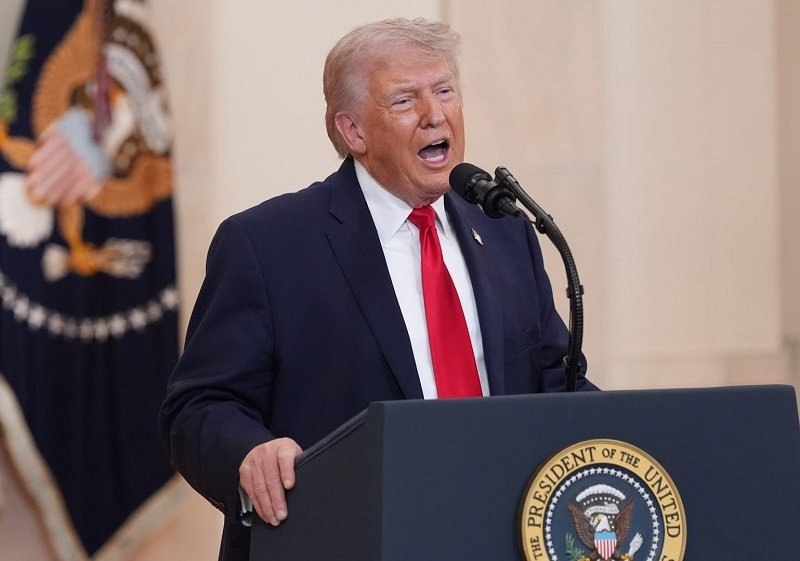
At a moment when the world seemed to be holding its breath for a decisive speech by Donald Trump, it was not the content of the address that left the strongest impression, but rather the strategic void it exposed. Instead of offering clarity or direction, the speech acted as a mirror reflecting deep disorder within the core of American decision-making, revealing a crisis managed by impulse rather than coherent vision.
In the hours leading up to the speech, financial markets appeared to anticipate uncertainty: stocks rose, oil prices dipped, only to reverse sharply afterward. This volatility was not incidental—it was an immediate interpretation of a message that failed to reassure and instead deepened confusion. Here, the language of power no longer produces stability; it generates instability.
At a deeper level, this moment signals a troubling shift in the nature of governance in Washington. A president expected to project strategic clarity appears trapped in contradictions: hinting at regime change in Iran, then retreating; suggesting backchannel communications, then implicitly denying them. This inconsistency is not merely rhetorical—it reflects the absence of a defined course.
Beyond the figure of Donald Trump, the entire American decision-making system comes into question. Institutions once seen as stabilizing forces—from the Pentagon to policy think tanks—appear either sidelined or unable to restrain a political logic driven by the illusion of a “quick strike,” a pattern seen before in conflicts such as the Iraq War.
However, today’s global context no longer allows for such miscalculations. The rise of China and the enduring tensions with Russia have reshaped the strategic landscape. Any military engagement in the Middle East now carries global implications. The central question is no longer how to win the war, but whether there is a vision for ending it at all.
The much-anticipated speech, expected to serve as a strategic compass, instead confirmed a state of drift. Threats targeting energy infrastructure, for instance, are not merely acts of escalation—they signal a narrowing of options, as such moves would expose not only the Gulf region but the entire global economy to severe disruption.
Perhaps most revealing is what remains unsaid. Western media, while acknowledging the “embarrassment of allies,” still hesitates to fully dissect Israel’s role in shaping this trajectory. This silence is telling: it reflects the limits of mainstream discourse and suggests that decision-making is no longer purely American, but the result of complex strategic entanglements.
As for the consequences, the outlook grows darker. What was framed as a swift and controlled operation is gradually resembling a familiar pattern: overwhelming destructive capability paired with an inability to reconstruct stability. A repetition of past failures, from the Vietnam War to Iraq.
Ultimately, this speech should not be seen as an isolated event, but as a symptom of a deeper imbalance within American power: an excess of military capability contrasted with a deficit in political vision. Between the two, the world now navigates an extended zone of uncertainty, where the real danger lies not only in war itself, but in the absence of meaning that defines—and confines—it.


