

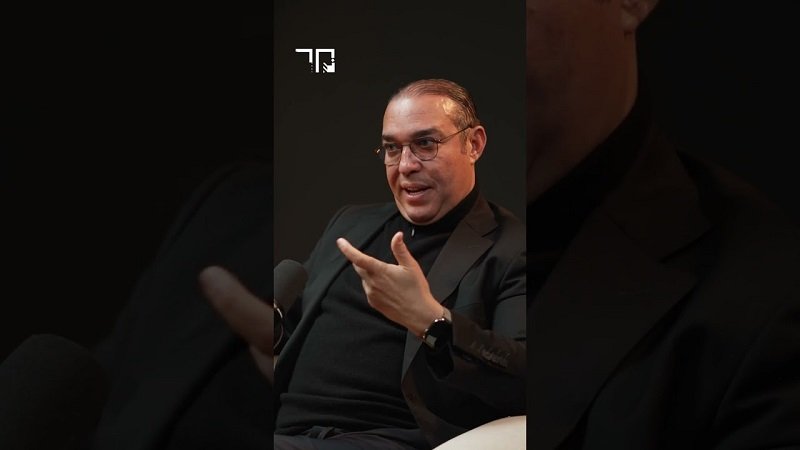
Who Has the Courage to Lead Morocco’s “World Cup 2026 Government”?
7 January 2026
As Morocco approaches a decisive international milestone, where domestic electoral dynamics intersect with unprecedented global responsibilities, Mohamed Ouzzine, Secretary-General of the opposition Popular Movement, raises a question that goes beyond partisan ambition:
is leading the government in the run-up to the 2026 World Cup an act of political aspiration, or a heavy historical responsibility?
Drawing on a brief excerpt—less than two minutes—from a podcast lasting over an hour, Ouzzine deliberately distances himself from the language of personal ambition. He frames the leadership of what could be called the “World Cup government” not as a prize to be claimed, but as a state-level challenge, tied to a broader national project rather than conventional electoral competition.
Ambition or political burden?
Ouzzine’s discourse reverses the usual political narrative. Governing during this period is portrayed not as an achievement, but as a demanding responsibility. He implicitly warns that seeking power without fully grasping its consequences would amount to political recklessness.
This framing introduces a key idea: the government of 2026 will not be assessed solely on economic indicators or institutional reforms, but on its capacity for accountability—toward citizens, and, in a more symbolic sense, toward history itself.
Proximity to the people: belief or strategy?
A central theme in Ouzzine’s remarks is the Popular Movement’s claimed closeness to ordinary citizens. He presents the party as rooted in everyday social realities, in contrast to political elites perceived as distant or disconnected.
While this narrative resonates in a climate of growing public distrust toward political institutions, it also invites a critical question:
does this reflect a long-standing political conviction shaped by years in opposition, or a strategic repositioning aimed at exploiting the current government’s social and economic shortcomings?
What is said—and what remains unsaid
Ouzzine emphasizes courage, responsibility and the refusal to remain silent in times of crisis.
Yet several fundamental issues remain unaddressed:
what concrete economic vision underpins this discourse?
how would a future government balance international expectations with domestic social demands?
and what practical mechanisms would translate this rhetoric of proximity into effective public policy?
A provisional assessment
At this stage, Ouzzine’s intervention appears less like an explicit bid for power than an attempt to redefine the meaning of governance itself at a critical juncture. The tone is reflective rather than confrontational, focusing on legitimacy and responsibility rather than direct political attack.
Ultimately, the credibility of this discourse will depend on its consistency with future actions, the clarity of the proposed alternative project, and the party’s ability to move from moral critique to concrete solutions, commensurate with Morocco’s ambitions on the road to 2026.


