

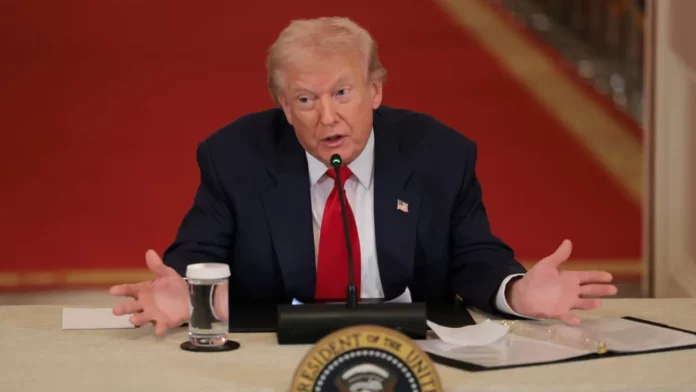
At the heart of rising tensions in the Gulf, the Strait of Hormuz has emerged as a focal point for strategic and political debate. During a thirty-minute intensive broadcast on France 24, the program highlighted a complex web of consequences facing former U.S. President Donald Trump, demonstrating the intertwining of American, Iranian, and international interests in this vital maritime passage. This analysis revisits the broadcast from an investigative perspective, decoding explicit and implicit statements and situating them within regional and global contexts.
The Beginning: Signs of American Confusion
The program highlighted the stark contrast in Trump’s statements, oscillating between affirming U.S. military strength and calling for help from European countries and Gulf allies. This contradiction raises the first question: does it implicitly acknowledge a strategic failure against Iran, or is it an attempt to engage allies to secure political and diplomatic support?
Experts noted that Trump faced simultaneous internal and external pressure, needing to demonstrate strength while avoiding a war outside the UN Security Council framework. Thus emerges what the program called the “Hormuz Trap”: a complex political network placing allies and adversaries in a delicate position and complicating the EU’s and NATO’s strategic calculations.
Managing the Strait: Military Power vs. Diplomacy
The program analyzed the practical dimensions of controlling the Strait, explaining that the U.S. does not necessarily need a direct military intervention to secure freedom of navigation but rather a post-control administrative and diplomatic framework. Trump’s repeated mention of “only 1% of participants needed” reflects this approach: limiting other actors’ involvement while maintaining American dominance, leaving allies in a largely symbolic role.
This demonstrates the contrast between direct U.S. military strategy and regional political strategy aiming to manage Iran and secure maritime and energy trade without engaging in full-scale conflict.
Reading the Iranian Map: Institutional Strength or Controlled Chaos?
The program devoted significant time to Iranian strategy, noting that Tehran is not a monolithic entity but a complex institutional network from the Supreme Leader to the Revolutionary Guards. This fragmentation generates what experts call “apparent unpredictability.”
According to analysts, this is not a sign of weakness but a survival tactic and long-term strategy, keeping adversaries constantly alert. Iran leverages this system to protect its interests, threaten American companies, and exploit diplomatic and strategic gaps in the region.
Economic and Political Global Considerations
The broadcast also examined global economic impacts, noting that any disruption in the Strait directly affects oil markets, with countries like Japan, South Korea, and Europe depending on the stability of this passage. Here, politics and economics intersect: the U.S. seeks to secure the Strait without compromising its economic interests, while Iran uses its position to strengthen its negotiation leverage.
The analysis also highlighted U.S. pressure on Gulf countries and the reorganization of economic alliances, showing that movements in the Strait are part of a broader strategy to rebalance regional power.
The “American Trap” and Its Effects on Allies
A central point of the program is the concept of the “American trap”: Trump, according to experts, became ensnared by his unilateral policies, creating confusion among European and Gulf allies. The EU, accustomed to coherent diplomacy, had to adapt to unforeseen demands, while Trump sought to involve allies without giving them real influence, explaining the visible disarray in official responses.
Information Warfare and Media Scene
The program also examined the role of media and information warfare, showing how political and military statements are used to send internal and external messages, influence public opinion, and even impact the Iranian system. The contrast between military and political discourse creates a “strategic confusion,” imposing multiple scenarios on regional and global decision-makers.
Conclusion: Complex Strategic Dimensions
In conclusion, the situation in the Strait of Hormuz goes beyond a simple U.S.-Iran confrontation. It is a complex network of interests, strategies, and international alliances. Trump faces unexpected challenges between unilateral decision-making, ally engagement, managing an institutional Iranian system, and protecting economic interests.
The key question remains: did Trump successfully navigate this complex game, or did he fall into the trap of his own ambitions, balancing military control with the need for diplomatic equilibrium? The program leaves the question open, offering viewers a deeper understanding of geopolitical and strategic stakes in the Gulf.


