

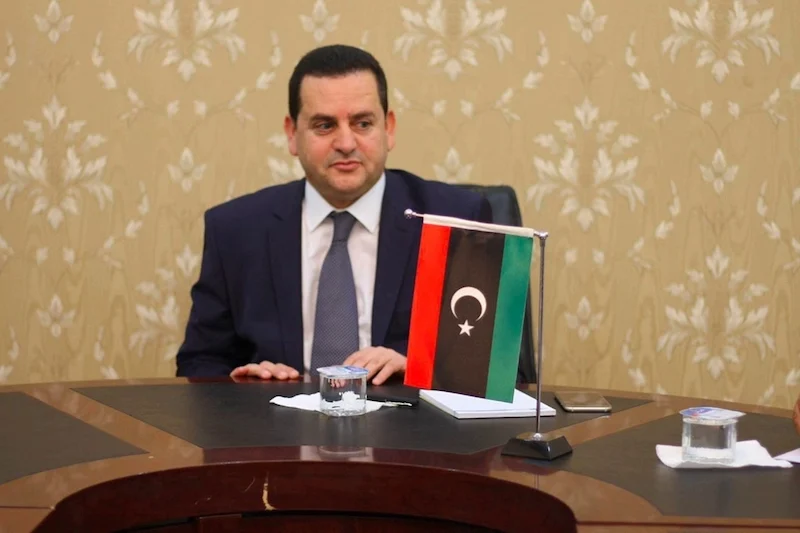
The presentation of a “truncated” map of Morocco during the Conference of Military Intelligence Chiefs of the Sahel and Mediterranean Countries – 2026 in Tripoli immediately caught the attention of diplomatic and security observers. Official images from the conference, overseen by the National Unity Government led by Abdel Hamid Dbeibah, revealed a visual backdrop showing a map that did not include Morocco’s entire territory, a detail documented by participants inside the official venue.
The incident, occurring during discussions on counterterrorism, irregular migration, and organized crime, did not go unnoticed. In a high-level intelligence setting, accuracy in symbols and representations is paramount, especially when dealing with sensitive maps that carry clear political significance.
In response, Libyan Foreign Minister from the Parliament-appointed government, Abdel Hadi Al-Huwij, distanced his administration from the incident, stressing that it concerned exclusively Dbeibah’s government and denying any connection of his administration to the event. He emphasized Libya’s ongoing political and institutional divisions: “This happened in Tripoli; we operate from Benghazi,” while noting that his government upholds Morocco’s position on the Sahara and would not adopt any stance undermining Morocco’s territorial integrity.
However, the silence from Dbeibah’s government and the absence of any official written clarification complicate the matter. The incident comes at a delicate moment, after recent rapprochement between Rabat and Tripoli, highlighted by Morocco’s support for Libya’s candidacy to the African Union Peace and Security Council in 2025—a move positively received by Tripoli at the time.
The event raises questions about the political symbolism of maps at multilateral conferences, particularly with the participation of major European powers such as Italy, France, Spain, Greece, along with Turkey, Algeria, and Tunisia. Are visual symbols becoming tools of indirect political messaging? Does Morocco’s absence indicate a diplomatic reserve regarding the balance of arrangements governing the summit?
This is more than a mere procedural error; it highlights the fragility of regional and international consensus and underscores the use of security platforms for conveying political signals. Such platforms should ideally serve as grounds for unifying efforts against common challenges, free from tensions over sovereign issues, particularly Morocco’s territorial integrity.
Between Benghazi’s disavowal and Tripoli’s silence, the diplomatic community and regional observers await official clarification from the organizers to avoid potential repercussions on Morocco-Libya relations. Since 2011, Rabat has been a key actor supporting Libya’s institutional stability and mediating among conflicting parties.
To date, no official explanation has been provided for the truncated map, leaving the incident open to multiple political and diplomatic interpretations, and emphasizing that symbolic details in security conferences are never trivial.


