

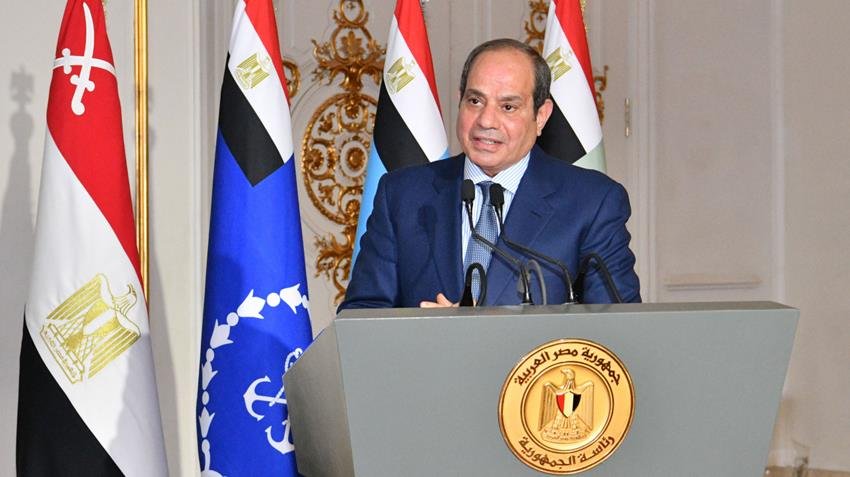
Today, President Abdel Fattah El-Sisi, President of the Republic and Supreme Commander of the Armed Forces, attended the annual Iftar hosted by the Armed Forces, coinciding with the celebrations of the anniversary of the 10th of Ramadan victories. Also present were Speaker of the House of Representatives Counselor Hisham Badawi, Speaker of the Senate Essam Farid, Prime Minister Dr. Moustafa Madbouly,
Commander-in-Chief of the Armed Forces and Minister of Defense and Military Production Lieutenant General Ashraf Salem Zaher, Chief of Staff of the Armed Forces Lieutenant General Ahmed Khalifa, Pope of Alexandria and Patriarch of the See of St. Mark Pope Tawadros II. This is in addition to a number of ministers, governors, commanders of the main branches of the Armed Forces and the civilian police, senior state officials and members of parliament, veteran Armed Forces commanders, and a number of students from the Egyptian Military Academy.
The Spokesman for the Presidency, Ambassador Mohamed El-Shennawy, said President El-Sisi delivered the following speech:
In the name of Allah, the Most Gracious, the Most Merciful
Praise be to Allah, Lord of the Worlds.
I would like to welcome you all and welcome all the commanders and guests present.
The topic of the hour is the current crisis and war in the region. In Egypt, we have tried, through sincere efforts over the past months, to avoid the crisis by bringing viewpoints closer and mediating between the United States and Iran to reach an agreement because wars always have a negative impact on the countries in which they break or their neighboring countries, particularly with the development of means of warfare. Our efforts were sincere and enlightened, as wrong assessments have negative repercussions for countries. The repercussions of wars have a profound impact on balance because of the humanitarian dimension, among other dimensions. I reckon that there must be a great caution regarding the repercussions of the war on countries, and the ensuing results on the stability of the region. In just two days, very significant and rapid developments have occurred. In Egypt, we were keen to emphasize the importance of de-escalation, achieving calm, and even halting the war, although I doubt this will be possible.
Egypt is an integral part of the region and is directly affected by developments within it. I have engaged in discussions with our brothers in the Gulf and other concerned Arab states to reaffirm our categorical rejection of aggression against states. I emphasized Egypt’s unwavering support for our brothers and our solidarity with them in confronting crises.
We remain vigilant regarding the potential consequences of the war, including the closure of the Strait of Hormuz and its impact on the Suez Canal. We have been affected since October 7, and maritime traffic through the Canal has not returned to its normal course, resulting in financial losses. The closure of the Strait of Hormuz would significantly affect oil flows and global prices. Accordingly, the Egyptian state and government must carefully examine all the different possibilities and scenarios.
To our people, I say: there is no cause for concern. Praise be to Allah, we have taken the necessary precautions and I assure you. At the same time, the duration of this crisis remains uncertain. Over the past two years, we have worked diligently to overcome the economic challenges and mitigate their effects. Yet, the global and regional economic crisis will inevitably have repercussions. We hope, and it would be gratified, if this crisis comes to an end as swiftly as possible.
For us Egyptians, it is essential that the state and the people stand as one. I firmly believe that the most important foundation of Egypt’s success lies in its stability and steadfastness. The credit for this, first and foremost, belongs to Allah Almighty, above all else and I pray that He continues to grant us security and stability. Secondly, it is due to you, the Egyptian people, through your endurance and resilience. We feel your sacrifices and are committed to exerting our utmost efforts to improve conditions and circumstances.
Since 2020, Egypt has faced difficult circumstances. The COVID-19 pandemic, lasting a year and a half, left significant economic repercussions. This was followed by the war in Ukraine, then the conflict in Gaza, and now the Iranian war. The most important thing is that we remain united, that we endure and understand the challenges, and that we recognize certain matters lie beyond our control.
We strive to play a constructive role in every crisis and in the resolution of conflicts. Even in dealing with internal crises, we have exercised patience and restraint, avoiding impulsive reactions. This approach is well recognized, and it is essential to prevent negative consequences.


