

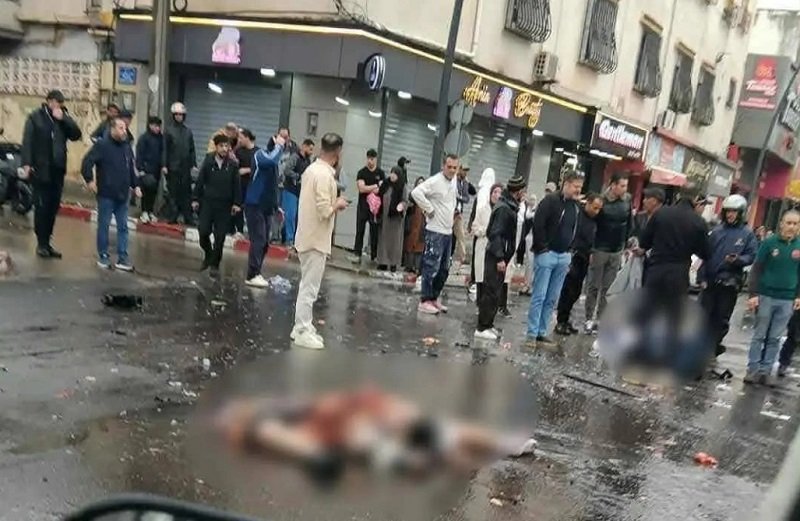
At a moment that was supposed to be staged as a sequence of religious and diplomatic opening, with the arrival of Pope Léon XIV in Algeria and his meeting with President Abdelmadjid Tebboune at the El Mouradia palace, the city of Blida was shaken by two suicide attacks that abruptly bring back to the center of debate the issues of security, the state, and collective memory. But beyond the nature and timing of the attacks, it is the official and media silence that raises questions, as if the state had chosen to look away in the face of a critical moment.
The available data, although fragmentary, indicate (indicate) two coordinated attacks: the first targeting a security headquarters in the middle of an urban area, causing losses among police forces, and the second targeting an industrial facility in the same city. This modus operandi suggests a high degree of planning and raises questions about a possible security breach, especially since the events occurred less than fifty kilometers from the capital, in a highly sensitive context.
🔴 نشر أول صور للشخص الذي نفّذ تفجيرًا انتحاريًا في مدينة البليدة قرب العاصمة الجزائرية، تزامنًا مع زيارة البابا إلى البلاد pic.twitter.com/mBhTBJd6OL
— المغرب الآن Maghreb Alan (@maghrebalaan) April 13, 2026
However, the event cannot be reduced to a purely security reading. It also constitutes a revealer of the complex relationship between power and information. The silence of the authorities and public media—from national television to the official agency—fits within a political tradition of controlling the narrative, where information is perceived as a lever of sovereignty rather than a citizen’s right. This silence does not erase the event: it reconfigures it within the collective imagination and opens the way to parallel narratives, often less rigorous and more speculative.
Faced with this vacuum, international media and social networks have occupied the field, broadcasting images, testimonies, and videos relayed by citizens. The digital space thus becomes an “alternative newsroom,” but also a space of informational disorder, where facts mix with interpretations and where the boundary between information and rumor becomes blurred.
The timing of the attacks, coinciding with a religious visit of global significance, places security apparatuses in a delicate position. Such visits imply a maximum level of vigilance and serve to project an image of stability. Therefore, such an event raises the question of symbolic cost: what will be its impact on Algeria’s international image? And to what extent can it affect the course of the visit?
More deeply, these events revive the memory of the “black decade,” a period still vivid in the collective consciousness. Certainly, the current context differs, but the return of suicide attacks in urban settings reactivates a fundamental question: is this an isolated incident or the symptom of deeper security mutations?
In this framework, official silence appears as a political choice in its own right. It reflects a will to control the tempo and avoid panic, but at the same time it weakens trust between the state and society. In the absence of a clear official narrative, the citizen is forced to seek elements of understanding elsewhere, further widening the credibility gap.
Ultimately, what happened in Blida goes far beyond the human toll or the absence of official communication. It is a multidimensional test: a test of the state’s ability to manage crises in the digital age, a test of the solidity of the security apparatus, and above all a test of its capacity to move from a logic of concealment to a logic of transparent management of truth.


