

“A Feast Overshadowed by Rising Costs” — Moroccans Cling to the Spirit of Eid Despite Soaring Sacrifice Prices and Families Forced to Celebrate Without Sheep
At dawn on Eid al-Adha, Moroccan cities do not need clocks to know that the sacred day has arrived. One only has to open a window before sunrise to hear the takbirs echoing through quiet streets, to see children running behind their fathers in brand-new djellabas, and to smell coffee, incense, mint tea, and grilled meat blending into a collective memory carried by generations. For a few hours, Morocco seems to pause the weight of everyday life and return to something deeply rooted: the feeling of belonging to a community united by shared rituals, emotions, and traditions.
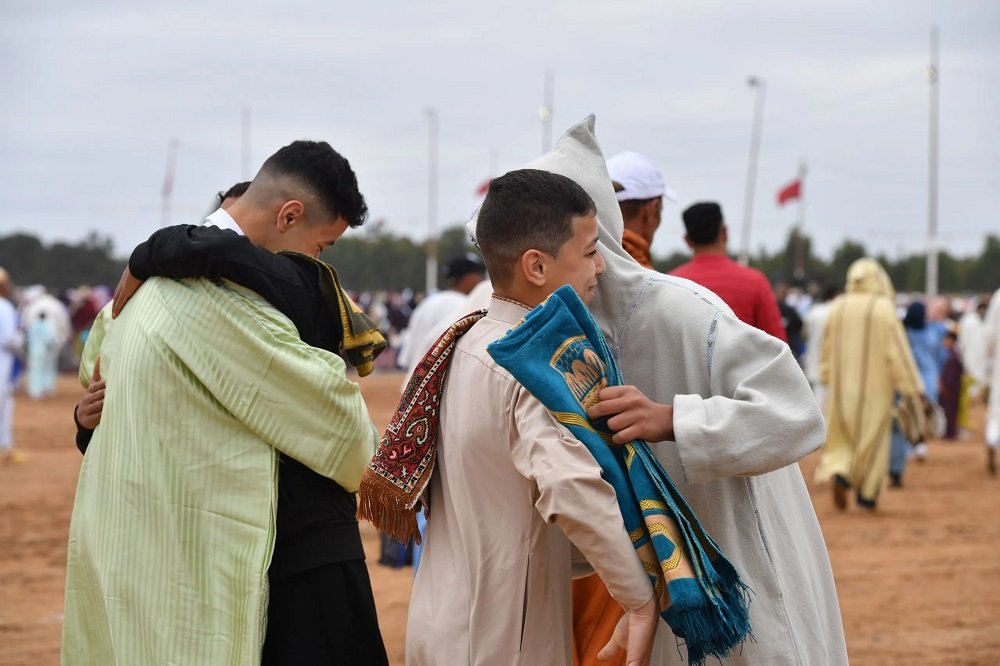
That was the image seen this year in Rabat – Salé and across many Moroccan cities: crowded prayer grounds, entire families leaving home before dawn, men dressed in white robes, women in traditional clothing, children taking photos with their parents’ phones. Yet behind this warm and spiritual scene, another reality moved quietly beneath the surface — an Eid marked by inflation, economic anxiety, and crushing social pressure weighing heavily on thousands of households.
Around the prayer grounds, conversations were no longer only about celebration, but about prices. Sheep selling for 5,000 or even 6,000 dirhams. Families spending days desperately searching for an “affordable” animal. Fathers returning from livestock markets exhausted, fully aware that their purchasing power can no longer keep pace with the soaring cost of living. Inflation is no longer an abstract economic statistic discussed in official reports; it has entered the most intimate details of daily life, even a religious celebration that is supposed to bring serenity and comfort.
For years, Eid al-Adha represented for Morocco’s middle and working classes a religious and family occasion capable of preserving emotional balance inside households. Today, for many families, it has become a financial and social ordeal. Many people no longer buy a sheep because they can truly afford it, but because they fear the judgment of society, the comments of neighbors, or the disappointment of their children. And this is where the silent tragedy begins: when a religious rite rooted in mercy and personal ability turns into suffocating collective pressure.
What hurts most is not simply that some families cannot afford a sacrifice, but that many now feel excluded from the “social landscape of Eid.” As if human worth is measured by the size of the sheep brought home rather than by dignity, faith, or the ability to protect one’s family from hardship. This year, many households chose to preserve at least the symbolic atmosphere of Eid without slaughtering an animal: buying children new clothes, preparing modest meals, and attending Eid prayers so their children would not feel different from others.
But even this “symbolic Eid” carried hidden pain. Behind mothers’ smiles were suppressed tears, and behind children’s photographs were new debts quietly accumulating. Already struggling under the rising cost of living, many families borrowed money simply to prevent the holiday from feeling different from previous years. In this way, the sacrifice itself has become for many low-income households a delayed debt rather than a source of joy — the beginning of a new cycle of financial exhaustion that will continue long after Eid has passed.
Among the most painful scenes repeated every year are families forced to sell part of the meat only hours after slaughtering the animal, simply to recover some of the money they borrowed. Eid meat becomes a means of repaying loans and debts, as though the holiday itself has turned into an economic burden imposed on the poor. Some families even sell portions of meat donated by charitable people in order to buy medicine, pay utility bills, or cover urgent necessities.
This reality reveals far more than an economic crisis. It exposes a profound social and cultural transformation. For many, Eid has gradually become a stage for social competition and public display rather than a moment of spirituality and solidarity. Livestock markets have turned into arenas of comparison centered around breeds, size, and price. Social media platforms overflow with images of sheep, lavish meals, and displays of purchasing power, to the point where the value of the holiday sometimes seems measured by online visibility rather than acts of generosity.
Even children are absorbing this logic. They compare sheep, boast about horns, breeds, and prices, instead of learning the values of compassion, humility, and sharing. In this way, social inequality reproduces itself early in childhood through the very rituals that were originally meant to unite communities.
And yet, the original spirit of Eid was entirely different: to remind the wealthy of the poor, to transform sacrifice into an act of sharing and dignity, and to ensure that everyone feels included within the community. The true meaning of sacrifice was never supposed to be a competition over the most expensive sheep, but rather a doorway to human solidarity. Because what truly nourishes the poor is not only meat, but the feeling of being treated with dignity, respect, and compassion.
Despite everything, Moroccans continue to cling to the spirit of Eid with a form of quiet resistance. In spite of inflation, debt, and social exhaustion, they still wake before dawn to attend Eid prayers, wear their finest clothes, and exchange greetings. It is as though Eid remains one of the last spaces where society still attempts to preserve a fragile sense of equality and collective belonging. In the rows of prayer, rich and poor stand side by side, repeating the same invocations, sharing — if only briefly — the same feeling of community.
Perhaps this is why Eid prayer remains so important in Morocco. Because it represents far more than a religious ritual. It becomes a collective attempt to resist fear, humiliation, and social despair. When preserving joy itself becomes a form of daily resistance, it means the crisis is no longer merely economic — it has become moral, emotional, and symbolic as well.
The real question raised by this year’s Eid, therefore, is not simply why sheep prices have become unbearable. The deeper question is this: how did society reach a point where the poor fear Eid instead of awaiting it with peace and anticipation? How did a celebration rooted in mercy become a source of psychological and social pressure? And how did the fear of public judgment become stronger than the spiritual meaning of the ritual itself?
Moroccans today may not only need better-regulated markets or lower prices. They may need to rediscover the true meaning of Eid itself: solidarity instead of ostentation, dignity instead of comparison, humanity instead of appearances. Because the greatest danger facing any society is not merely rising prices, but the gradual loss of the values that once gave meaning to joy, belonging, and human dignity.
And perhaps that is the deepest and most painful question left behind by this Eid: is Eid al-Adha still a celebration of compassion, sacrifice, and solidarity, or is it slowly becoming a harsh mirror reflecting widening social inequality and collective exhaustion?
For many Moroccans are no longer searching only for an affordable sheep. They are searching for an older meaning of Eid — one in which human dignity is not measured by what people can buy, but by what remains in their hearts of mercy, solidarity, and humanity.


