

Spain’s victory in the FIFA World Cup on July 19 was far more than a historic sporting achievement. It became a revealing political moment that exposed a reality often concealed beneath the surface of national celebrations: a World Cup trophy may unite millions behind one flag, but it cannot erase competing visions of nationhood.
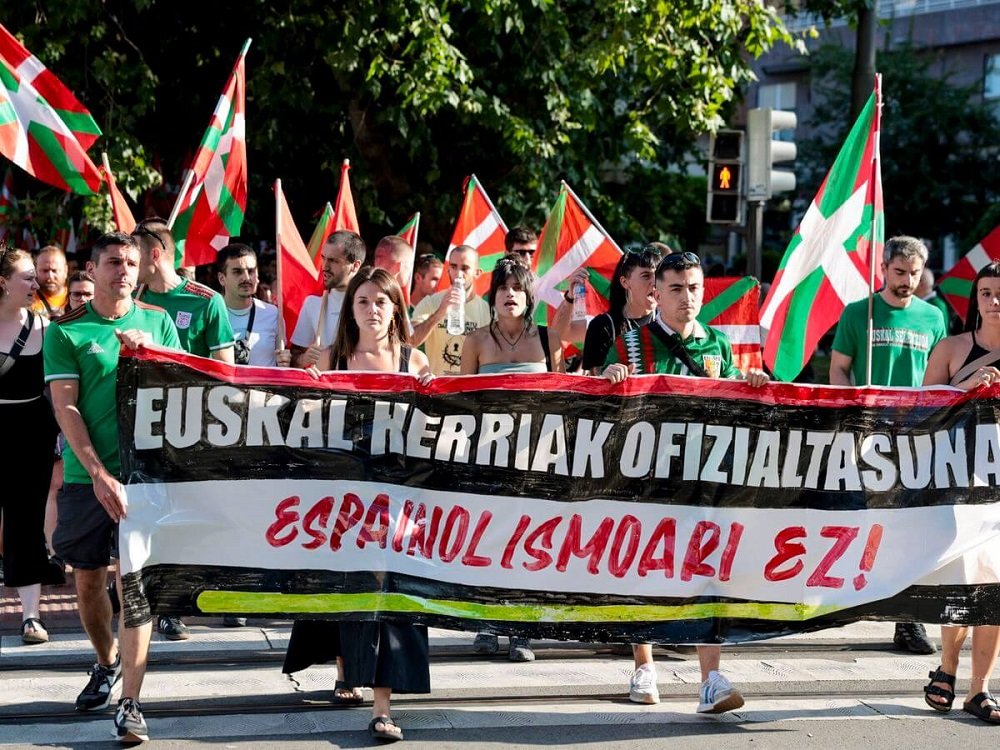
While Madrid, Seville, Valencia and dozens of Spanish cities erupted in scenes of jubilation, large parts of the Basque Country and neighboring Navarre experienced an entirely different night. Instead of celebrating Spain’s global success, nationalist groups took to the streets demanding official recognition of a Basque national football team and reaffirming their long-standing claim to the right of self-determination. In several locations, isolated violent incidents targeted people celebrating Spain’s victory, transforming what should have been a nationwide sporting celebration into yet another reminder that the debate over identity remains one of Spain’s deepest unresolved political questions.
On the surface, these demonstrations appeared to be little more than political activism exploiting a major sporting event. Yet a deeper reading tells a different story. The timing was deliberate. Nationalist movements understand that moments of overwhelming national unity offer the greatest opportunity to challenge the state’s dominant narrative. If millions of viewers across the world were watching Spain celebrate itself as one nation, Basque nationalists wanted the world to witness another message: that not everyone living within Spain accepts that national identity.
Simultaneous demonstrations unfolded in Bilbao, San Sebastián, Vitoria-Gasteiz, Eibar, Pamplona and even Bayonne on the French side of the Basque homeland. Demonstrators waved the Ikurriña—the Basque flag—and demanded international recognition for “Euskal Herria” as an independent sporting entity. To outside observers, the demand may have seemed limited to football. In reality, football merely provided the stage.
For Basque nationalism, sport has long represented something far greater than competition. National teams are symbols of sovereignty. They carry flags, play anthems and embody political recognition. Securing international recognition for a Basque national team would therefore represent far more than participation in football tournaments; it would symbolize acknowledgement that the Basque nation exists independently from the Spanish state.
The demonstrations, however, were not entirely peaceful. Basque authorities arrested several individuals and launched investigations following assaults reported in Vitoria-Gasteiz, San Sebastián and other municipalities. In Berriozar, Navarre, masked attackers stormed a bar where civilians and military personnel were watching the World Cup final, injuring several people. Both the Basque Government and the Basque Nationalist Party (EAJ-PNV) swiftly condemned the attacks, emphasizing that defending Basque identity can never justify violence or intimidation.
This condemnation itself reveals how profoundly Basque nationalism has evolved.
The era in which armed confrontation dominated the movement effectively ended with ETA’s definitive dissolution in 2018. Since then, the struggle has shifted almost entirely toward democratic institutions, elections, courts, cultural influence and symbolic politics. Today’s battlefield is no longer clandestine militancy; it is public opinion—and increasingly, global sporting events.
Yet perhaps the greatest irony of the evening lay elsewhere.
Five members of Spain’s World Cup-winning squad originated from the very geographical and cultural territory nationalists describe as Euskal Herria. Goalkeeper Unai Simón, Martín Zubimendi, Mikel Oyarzabal, Mikel Merino and Nico Williams all played decisive roles in delivering Spain’s greatest football triumph, even as part of the nationalist movement refused to celebrate that victory because it represented a state they do not fully recognize as their own.
This paradox illustrates one of Spain’s most complex political realities. The debate is no longer simply between “Spaniards” and “Basques.” Rather, it concerns competing understandings of identity itself.
Many Basques see no contradiction between preserving their regional culture while proudly representing Spain on the international stage. For nationalist movements, however, cultural identity remains incomplete unless it is accompanied by political sovereignty. Their argument is that a nation truly exists only when it possesses its own institutions, its own symbols—and ultimately, its own national team.
The images broadcast after the final told an entirely different story.
Nico Williams and Lamine Yamal celebrated beneath the Spanish flag, while Mikel Merino proudly spoke of representing Navarre as part of Spain’s national team. Their message stood in direct contrast to nationalist discourse. It suggested that identities need not be mutually exclusive—that local, regional and national loyalties can coexist rather than compete.
This is precisely where football transcends sport.
For decades, the Basque Football Federation has sought admission to both FIFA and UEFA in order to allow a Basque national team to compete independently in official international competitions. Its formal application, submitted in 2020, was rejected in 2021 because membership in both organizations is generally reserved for sovereign states, with only a handful of historical exceptions such as England, Scotland, Wales and Northern Ireland.
Yet rejection did not weaken the movement’s ambitions. Quite the opposite.
Every friendly match played by the Basque representative team, every campaign calling for international recognition and every public demonstration has become part of a broader symbolic strategy. The objective extends well beyond football itself. Recognition on the pitch would reinforce a political narrative asserting that the Basque people constitute a nation deserving independent representation before the international community.
To understand why these demands continue to resonate, one must return to history.
Basque nationalism is rooted in a distinctive cultural and historical identity. Its language—Euskara—is one of Europe’s oldest living languages and bears no known relationship to the Indo-European linguistic family. The region also preserved unique historical legal privileges known as the fueros, reinforcing a long tradition of institutional autonomy. Modern Basque political nationalism emerged in 1895 when Sabino Arana founded the Basque Nationalist Party, arguing that the Basques constituted a nation separate from Spain both culturally and historically.
Following the death of Francisco Franco, Spain attempted to reconcile these historical tensions through the 1978 Constitution and the 1979 Statute of Autonomy, granting the Basque Country one of Europe’s broadest systems of self-government while recognizing Euskara as an official language alongside Spanish.
For many Basques, however, autonomy never fully answered the national question.
Where ETA once pursued independence through armed struggle, today’s nationalist movement increasingly advances its objectives through democratic institutions. The battlefield has shifted from violence to ballots, legislation, constitutional debate and international legitimacy.
Electoral results confirm the continued strength of nationalist parties across the Basque Country. Nevertheless, political dominance should not be mistaken for overwhelming support for immediate independence. Recent opinion polls consistently show that support for secession remains below an outright majority, with many citizens preferring either enhanced autonomy or the current constitutional framework rather than complete separation.
This distinction is crucial.
The World Cup ultimately revealed that the contemporary Basque question is no longer simply about independence. It is about recognition—about who defines nationhood, who speaks in its name and which symbols command legitimacy.
Football merely provided the world’s largest stage upon which these competing visions could once again confront one another.
Spain lifted the World Cup as a united national team, yet the celebrations simultaneously exposed the persistence of unresolved historical debates over sovereignty, identity and belonging. What appeared to be a sporting triumph also became a reminder that, in twenty-first-century Europe, football has evolved into one of politics’ most powerful languages—a field where flags, anthems and national teams continue to express struggles that constitutions and decades of autonomy have yet to settle.


