

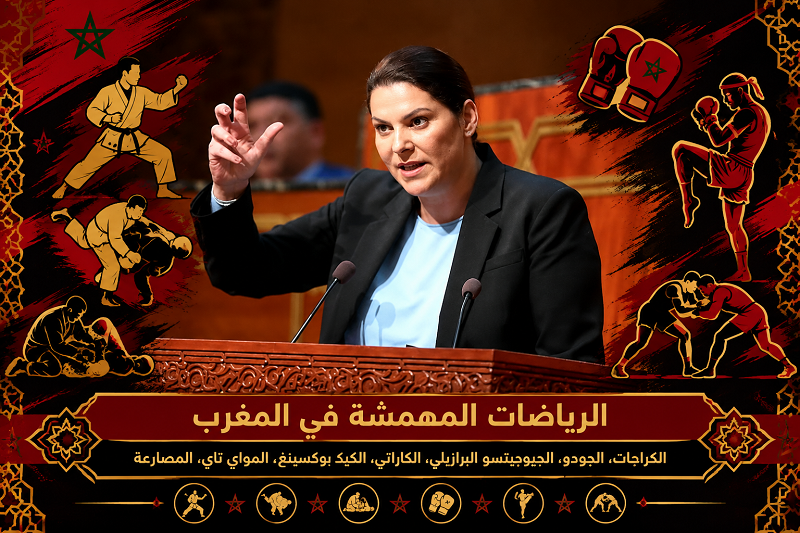
Between the economic ambitions surrounding the 2030 World Cup and the realities of sports professions, recognising the sector’s investment potential is not enough. A legal and professional framework is needed to guarantee clear rights and effective social protection for those who work in it.
When Head of Government Fatima Zahra El Mansouri presented the government programme for 2026–2031 to Parliament on Monday, 19 October 2026, sport featured in the government’s stated economic vision through an intention to develop the “sports economy”. The sector was presented as having the potential to generate added value, expand economic activity and create jobs. This direction appeared under the seventh pillar, which focuses on building a strong economy capable of financing Morocco’s social and sovereign ambitions.
That recognition deserves attention. Yet it opens a debate that goes beyond placing sport among the sectors considered economically promising. The sports economy cannot be built solely through investment in facilities, the organisation of major events or the international visibility Morocco may gain from hosting the 2030 World Cup. It depends on a diverse workforce: athletes, coaches, referees, technical and medical staff, physical-conditioning and rehabilitation specialists, managers, competition organisers, marketing professionals, media producers and workers providing services connected with sporting activity.
If the government sees this sector as a source of job creation, a practical question follows: what kind of jobs does it have in mind? Stable employment, supported by clear contracts, social coverage and defined professional rights? Or will the sports economy remain primarily associated with investment volumes, revenues and major events, while the working conditions of many professionals continue to depend on uneven contractual arrangements, insufficient guarantees or rules whose application remains uncertain?
The question matters all the more because an analysis published after the government programme was presented noted that the announcement of plans to develop the sports economy was not accompanied, in this area, by specific numerical targets or detailed mechanisms for financing, governance and evaluation. This does not, by itself, prove that the government has no other measures relating to sport. It does, however, show that the announced economic vision needs to be translated into practical action if it is to become a set of measurable and accountable commitments.
A law exists — but have sports professions become a source of enforceable rights?
The debate over the professional status of people working in sport does not begin in a legal vacuum. Since Morocco adopted Law No. 30.09 on physical education and sport in 2010, the legal framework has included specific provisions governing employment relationships in sport. Some concern contracts for professional athletes and certain categories of sports personnel, with references to provisions of Labour Code No. 65.99 within the limits established by the applicable legislation.
It would therefore be inaccurate to reduce the problem to the claim that sport is entirely outside the Labour Code. The more precise issue is the extent to which legal protection covers the different sports professions, which categories are actually covered by the legislation, whether existing provisions are suited to the nature of sports work and, above all, how effectively those provisions are enforced.
A professional athlete does not have the same job as a coach; a coach does not occupy the same position as a referee; and a referee is not in the same situation as a physiotherapist, strength and conditioning specialist or rehabilitation professional. Likewise, someone working in competition organisation, facility management, marketing or media production may operate under a contractual relationship different from the one linking an athlete to a club or sports company. Seasonal and independent work must also be considered, along with jobs connected to events and competitions that do not necessarily fit the conventional model of employment.
These differences must not become an excuse for leaving workers in the sector facing a lack of rights or legal uncertainty. They instead make it necessary to define sports professions more precisely, establish the conditions under which they may be practised, clarify the contracts governing them, determine employers’ responsibilities, strengthen dispute-resolution mechanisms and ensure guarantees relating to pay, social protection and workplace safety.
From sports investment to a genuine labour market
Developing the sports economy necessarily means treating sports professions as an integral part of the sector’s economic infrastructure, rather than as ancillary services supporting competition or entertainment. Every tournament requires skilled people. Every club needs administrative, technical and medical management. Every sports facility requires staff to operate, maintain and supervise it. Every professional activity needs contracts and clear rules on responsibility and accountability.
A coherent public policy cannot therefore stop at encouraging private investment or increasing the number of events. It must also organise the sports labour market, identify professions and categories of workers, assess their training and qualification needs, and clarify their legal and social status. It must distinguish between professional athletes, employees of sports organisations, independent workers, volunteers and seasonal workers, rather than treating fundamentally different employment situations as though they belonged to a single category.
If announced job opportunities are not matched by guarantees of stability and protection, economic activity may expand without workers benefiting to the same extent. The market for sports events and services may grow while some professional relationships remain precarious, leaving workers struggling to establish their rights or identify the authority responsible for protecting them.
The 2030 World Cup cannot replace reform of national sport
Hosting the 2030 World Cup offers Morocco an important opportunity to develop infrastructure, services and sports investment. It should not, however, become the sole measure by which sports policy is judged. The national challenge goes beyond building stadiums and hosting international matches. It involves creating a sustainable sports system capable of training skilled professionals, generating decent jobs, widening access to participation, supporting clubs and different disciplines, and developing industries and services linked to sport.
The risk is that sport receives exceptional attention when it is tied to a major international deadline, while the everyday difficulties faced by professionals, associations, clubs and participants are pushed aside. Successfully staging a global event does not compensate for the absence of a coherent professional policy. Nor does infrastructure development alone guarantee the sustainability of the activities taking place in those facilities or the quality of the jobs created around them.
Turning sport into an economic driver requires a broader approach: moving from investment in infrastructure to investment in the people who operate, manage and support sporting activity. Any strategy for developing the sports economy should therefore be linked to indicators covering employment, training, professional stability, social protection, compliance with contracts and the contribution of different sports to the national economy.
What responsibility rests with the government and political parties?
The government is not solely responsible for developing the legal framework governing sports professions. Parliament, political parties, relevant ministries, sports organisations and social stakeholders all have roles in debate, legislation and oversight. Nevertheless, the inclusion of the sports economy in the government programme provides a basis for asking the executive what measures will turn this direction into practical action, and what deadlines and indicators will make it possible to assess the results.
General declarations must give way to specific commitments. Will the rules governing work in sport be reviewed to clarify the relationship between sports legislation and the Labour Code? Will professional categories that lack adequate protection be identified? Will mechanisms for monitoring contracts and resolving disputes be strengthened? Will public investment programmes and subsidies be tied to clear standards for protecting workers and meeting social obligations?
Political parties’ responsibilities do not end with general references to sport, youth or employment in their programmes. They should put forward legislative proposals that can be debated and implemented, monitor the delivery of government commitments and treat sport as an economic, social and professional sector — not as a seasonal issue that comes to the fore only during major competitions or international milestones.
Assessing this issue requires neither denying progress nor assuming that every sports profession faces the same conditions. It requires an accurate picture based on legislation, available data, workers’ testimony, the nature of signed contracts and the actual fulfilment of obligations. Serious accountability begins by identifying and verifying shortcomings and establishing who is responsible, rather than relying on general accusations or sweeping judgments.
The real test of the sports economy
The inclusion of the sports economy in the government programme gives the debate a clear political and economic starting point. But the value of this direction will not be measured by the appeal of the phrase itself. It will depend on the policies, budgets and measures that give it substance, and on its ability to improve working conditions and expand access to organised employment.
The sports economy needs qualified professionals. Announced jobs need a clear legal definition. Professional relationships need enforceable contracts. Social protection needs mechanisms that ensure workers can actually access it. Without these elements, the sports economy may remain an ambitious investment concept without comparable progress in building a structured labour market.
If the government is relying on the sports economy to create jobs, the real test begins with a direct professional and legal question: how will these opportunities become organised professions, clear contracts, effective social protection and rights that can be enforced and monitored?


