

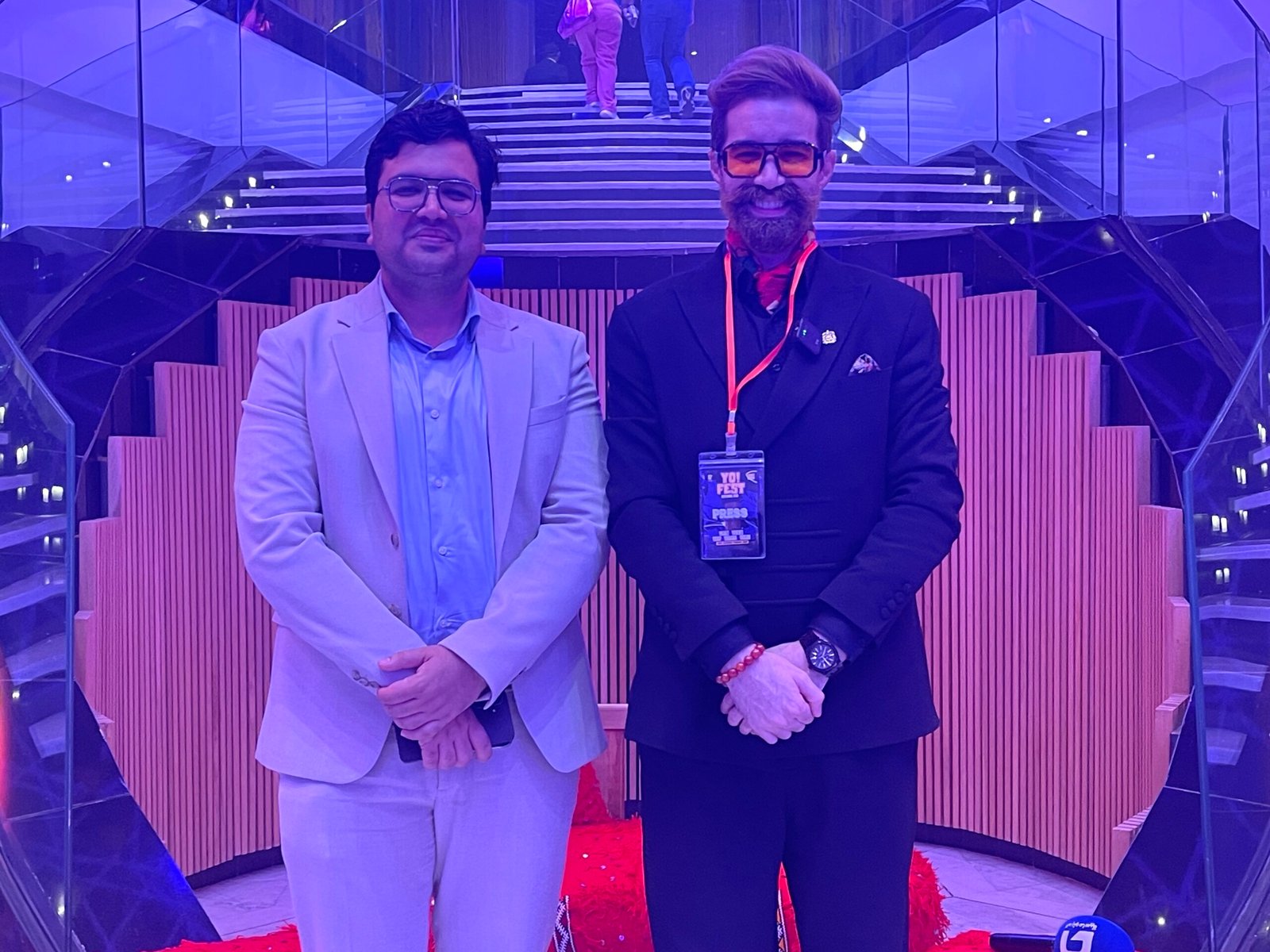
The 13th edition of YOFEST once again demonstrated that a cultural festival can be much more than a stage for music and performance. It can also become a meeting point for ideas, identities and diplomacy.
Among the distinguished guests present at this year’s edition was Mr. Amit Get, Chargé d’Affaires of the Embassy of India in the Kingdom of Morocco, whose participation added a diplomatic dimension to a festival already marked by cultural diversity and artistic exchange.
In conversation with Diplomatique Magazine, Mr. Get spoke about the cultural richness of India and Morocco and the similarities that connect the two societies. Beyond their geographical distance, both countries possess strong traditions, deeply rooted cultural identities and a remarkable ability to preserve heritage while remaining open to modernity.
At the heart of the conversation was a simple but powerful idea: art brings people together.
That statement captures much of what cultural diplomacy is about.
Relations between countries are often discussed through the language of economics, politics, trade and strategic cooperation. Yet some of the strongest connections between nations are created away from conference rooms. They emerge through music, literature, cinema, dance, food and the everyday cultural expressions that allow people to understand one another on a more personal level.
India and Morocco offer a particularly interesting example of this.
Both societies are shaped by diversity. Their histories have produced rich artistic traditions, distinctive musical identities and cultures in which heritage continues to occupy an important place in public life. These similarities create fertile ground for cultural dialogue and mutual discovery.
The relationship between India and Morocco has developed over decades across a wide range of sectors, but cultural exchange gives that relationship a different kind of depth. It creates emotional and human connections that formal agreements alone cannot produce.
This is where festivals such as YOFEST play an important role.
By bringing diplomats, musicians, writers, artists and audiences into the same space, cultural events help transform international relations from an abstract concept into a lived experience. An audience discovering a new musical tradition, an artist meeting a counterpart from another country, or a diplomat engaging directly with local cultural actors can all contribute, in their own way, to stronger ties between societies.
Mr. Get’s presence at YOFEST therefore reflected more than diplomatic protocol. It represented the growing importance of cultural dialogue as a way of building bridges between Morocco and India.
Art has a unique capacity to cross linguistic, political and geographical boundaries. A song can be understood emotionally before its words are translated. A painting can communicate without explanation. A performance can create a shared moment between people who may come from completely different backgrounds.
That is the strength of culture: it does not require people to become the same in order to feel connected.
For Morocco and India, this kind of exchange can continue to open new possibilities for cooperation between artists, cultural institutions, young creators and wider communities. It can also introduce younger generations to one another’s traditions while encouraging new and contemporary forms of collaboration.
YOFEST’s 13th edition offered a glimpse of what such exchanges can look like in practice: a space in which diplomacy was not limited to official speeches, but expressed through conversation, creativity and human encounter.
In an increasingly interconnected world, international relationships are strengthened not only by what governments negotiate, but also by what people share.
And sometimes, the strongest bridge between two countries is not built through politics at all.
It is built through art.


